
Message Board

Dear readers, authors and reviewers,you can add a message on this page. We will reply to you as soon as possible!

2018 Volume 40 Issue 7
Article Contents

Juan-juan ZHAO, Chen-chen SONG, Shi-yan LIU. Analysis of the Characteristics of Species Composition for Urban Plants——a Case Study of Xiamen, China[J]. Journal of Southwest University Natural Science Edition, 2018, 40(7): 1-8. doi: 10.13718/j.cnki.xdzk.2018.07.001
Citation: Juan-juan ZHAO, Chen-chen SONG, Shi-yan LIU. Analysis of the Characteristics of Species Composition for Urban Plants——a Case Study of Xiamen, China[J]. Journal of Southwest University Natural Science Edition, 2018, 40(7): 1-8. doi: 10.13718/j.cnki.xdzk.2018.07.001

Analysis of the Characteristics of Species Composition for Urban Plants——a Case Study of Xiamen, China

More Information
  • Received Date: 11/12/2017
    Available Online: 20/07/2018
  • MSC: Q948.13

  • As one of the foci of urban ecology, plant species composition provides a reference for revealing the mechanisms of urban plant diversity. Based on the abundant data of field observations, a case study was made ofXiamen so as to explore the characteristics of plant species composition and the potential problems in urban plant diversity. The results demonstrated that Xiamen supported a rich diversity of plants and the characteristics of species composition was obvious. A total of 467 plant species were recorded, of which only 6 were nationally rare or endangered species. The species frequency distribution of plants was fit by a logistic equation (R2>0.99), and one family, one genus and 25 species were above the 10/20/30 benchmark (Kendal et al., 2014). Low frequency species accounted for 81.5% of all urban plant species, and tropical components accounted for 72.4% of the herb genera and 72.3% of the woody genera. Spontaneous herbs were much richer in species than woody plants, and accounted for 37.5% of all plant species, although they were frequently deliberately destroyed. Based on the above results, this paper concludes that reducing the human destruction of wild herbs through effective policies is an effective way to improve the biodiversity in cities and proposes that more attention should be paid to the protection of low frequency and rare species and the coordination of species composition in the construction of urban green spaces.
  • 加载中
  • [1] UNITED NATIONS, DEPARTMENT OF ECONOMIC AND SOCIAL AFFAIRS, POPULATION DIVISION. World Urbanization Prospects: The 2014 Revision[EB/OL]. (2017-08-06). http://www.un.org/en/development/desa/publications/2014-revision-world-urbanization-prospects.html.

    Google Scholar

    [2] CRANE P, KINZIG A. Nature in the Metropolis[J]. Science, 2005, 308(5726):1225.

    Google Scholar

    [3] 张伟, 朱玉碧, 陈锋.城市湿地局地小气候调节效应研究——以杭州西湖为例[J].西南大学学报(自然科学版), 2016, 38(4):116-123.

    Google Scholar

    [4] KENDAL D, DOBBS C, LOHR V. Global Patterns of Diversity in the Urban Forest:is there Evidence to Support the 10/20/30 Rule?[J]. Urban Forestry & Urban Greening, 2014, 13(3):411-417.

    Google Scholar

    [5] SUDHA P, RAVINDRANATH N. A Study of Bangalore Urban Forest[J]. Landscape and Urban Planning, 2000, 47(1):47-63.

    Google Scholar

    [6] KNAPP S, KüHN I, WITTIG R, et al. Urbanization Causes Shifts in Species' Trait State Frequencies[J]. Preslia, 2008, 80(4):375-388.

    Google Scholar

    [7] THOMPSON K, MCCARTHY M. Traits of British Alien and Native Urban Plants[J]. Journal of Ecology, 2008, 96(5):853-859.

    Google Scholar

    [8] WILLIAMS N, SCHWARTZ M, VESK P, et al. A Conceptual Framework for Predicting the Effects of Urban Environments on Floras[J]. Journal of Ecology, 2009, 97:4-9.

    Google Scholar

    [9] 杨璇, 秦华.基于引鸟途径的重庆城市公园植物景观设计方法研究[J].西南师范大学学报(自然科学版), 2016, 41(5):52-56.

    Google Scholar

    [10] PICKETT S T A, CADENASSO M L, GROVE J M, et al. Urban Ecological Systems:Linking Terrestrial Ecological, Physical, and Socioeconomic Components of Metropolitan Areas[J]. Annual Review of Ecology and Systematics, 2001, 32:127-157. doi: 10.1146/annurev.ecolsys.32.081501.114012

    CrossRef Google Scholar

    [11] 厦门市统计局, 国家统计局厦门调查队.厦门经济特区年鉴[M].北京:中国统计出版社, 2016.

    Google Scholar

    [12] NOWAK D J, CRANE D E, STEVENS J C, et al. The Urban Forest Effects (UFORE) Model: Field Data Collection Manual[M]. New York: Northeastern Research Station 5 Moon Library, 2005.

    Google Scholar

    [13] 赵娟娟. 北京市建成区城市植物的种类构成与分布格局[D]. 北京: 中国科学院研究生院, 2010.

    Google Scholar

    [14] 赵娟娟, 欧阳志云, 郑华, 等.城市植物分层随机抽样调查方案设计的方法探讨[J].生态学杂志, 2009, 28(7):1430-1436.

    Google Scholar

    [15] KNAPP S, DINSMORE L, FISSORE C, et al. Phylogenetic and Functional Characteristics of Household Yard Floras and Their Changes Along an Urbanization Gradient[J]. Ecology, 2012, 93(8):S83-S98.

    Google Scholar

    [16] 中国植物志编辑委员会.中国植物志[M].北京:科学出版社, 1959-2004.

    Google Scholar

    [17] 陈文静. 厦门城市森林的结构特征与效益评价研究[D]. 福州: 福建农林大学, 2007.http://cdmd.cnki.com.cn/Article/CDMD-10389-2007135797.htm

    Google Scholar

    [18] 许彬, 张金屯, 杨洪晓等.百花山植物群落物种多样性研究[J].植物研究, 2007, 27(1):112-118. doi: 10.7525/j.issn.1673-5102.2007.01.021

    CrossRef Google Scholar

    [19] 吴征镒.中国种子植物属的分布区类型[J].植物分类与资源学报, 1991, 4(增刊):1-139.

    Google Scholar

    [20] R DEVELOPMENT CORE TEAM. A Language and Environment for Statistical Computing[M]. Vienna: The R Foundation for Statistical Computing, 2016.

    Google Scholar

    [21] MCGILL B J, ETIENNE R S, GRAY J S, et al. Species Abundance Distributions:Moving Beyond Single Prediction Theories to Integration Within an Ecological Framework[J]. Ecology Letters, 2007, 10(10):995-1015.

    Google Scholar

    [22] WILLIAMS N S G, HAHS A K, VESK P A. Urbanization, Plant Traits and the Composition of Urban Floras[J]. Perspectives in Plant Ecology Evolution & Systematics, 2015, 17(1):78-86.

    Google Scholar

    [23] VIOLLE C, NAVAS M, VILE D, et al. Let the Concept of Trait be Functional[J]. Oikos, 2007, 116(5):882-892. doi: 10.1111/oik.2007.116.issue-5

    CrossRef Google Scholar

    [24] SANTAMOUR F S. Trees for Urban Planting: Diversity, Uniformity, and Common Sense[C]//METRIA 7: Proceedings of the Seventh Conference of the Metropolitan Tree Improvement Alliance. The Morton Arboretum, Lisie, Illinois, 1990: 57-65.

    Google Scholar

    [25] CUMMING A B, TWARDUS D B, HOEHN R, et al. Wisconsin Street Tree Assessment 2002-2003[M]. Newtown Square PA: USDA Forest Service, North Eastern Area State and Private Forestry, 2008.

    Google Scholar

    [26] LOHR V I. Diversity in Landscape Plantings:Broader Understanding and More Teaching Needed[J]. Horttechnology, 2013, 23(1):126-129.

    Google Scholar

    [27] WILSON C L. The Long Battle Against Dutch Elm Disease[J]. Journal of Arboriculture, 1975, 1:107-112.

    Google Scholar

    [28] JONES P. The Geography of Dutch Elm Disease in Britain[J]. Transactions of the Institute of British Geographers, 1981, 6(3):324-336. doi: 10.2307/622291

    CrossRef Google Scholar

    [29] 王向歌, 张建林.基于城市景观视觉的山地公园植物景观规划设计研究[J].西南师范大学学报(自然科学版), 2017, 42(1):115-120.

    Google Scholar

    [30] DOBBS C, ESCOBEDO F, ZIPPERER W. A Framework for Developing Urban Forest Ecosystem Services and Goods Indicators[J]. Landscape and Urban Planning, 2011, 99(3/4):196-206.

    Google Scholar

  • 加载中
通讯作者: 陈斌, bchen63@163.com
  • 1. 

    沈阳化工大学材料科学与工程学院 沈阳 110142

  1. 本站搜索
  2. 百度学术搜索
  3. 万方数据库搜索
  4. CNKI搜索

Figures(4)  /  Tables(4)

Article Metrics

Article views(3995) PDF downloads(900) Cited by(0)

Access History

Other Articles By Authors

Analysis of the Characteristics of Species Composition for Urban Plants——a Case Study of Xiamen, China

Abstract: As one of the foci of urban ecology, plant species composition provides a reference for revealing the mechanisms of urban plant diversity. Based on the abundant data of field observations, a case study was made ofXiamen so as to explore the characteristics of plant species composition and the potential problems in urban plant diversity. The results demonstrated that Xiamen supported a rich diversity of plants and the characteristics of species composition was obvious. A total of 467 plant species were recorded, of which only 6 were nationally rare or endangered species. The species frequency distribution of plants was fit by a logistic equation (R2>0.99), and one family, one genus and 25 species were above the 10/20/30 benchmark (Kendal et al., 2014). Low frequency species accounted for 81.5% of all urban plant species, and tropical components accounted for 72.4% of the herb genera and 72.3% of the woody genera. Spontaneous herbs were much richer in species than woody plants, and accounted for 37.5% of all plant species, although they were frequently deliberately destroyed. Based on the above results, this paper concludes that reducing the human destruction of wild herbs through effective policies is an effective way to improve the biodiversity in cities and proposes that more attention should be paid to the protection of low frequency and rare species and the coordination of species composition in the construction of urban green spaces.

  • 到2050年,全球城市人口比例将达到66%[1].随着全球城市化进程进一步加快,城市栖息地和生物多样性变得尤为重要,甚至达到了国家和全球意义的高度[2-3].此外,城市生物多样性是城市生态系统健康的基础,例如,城市森林多样性可以降低病虫害与气候变化的风险,提高生态系统健康的供给弹性[4].

    城市植物的种类构成及其影响机制已经成为城市生态学一个重大的挑战[5].城市植物种类结构的研究,对理解城市化过程中城市植物种类的发展演变过程至关重要[6],为确定一些需要优先保护或者可能会在城市环境中野化的植物种类提供依据[7-8],但目前针对城市生态学研究热点之一的种类结构研究依然有待进一步加强[9-10].

    厦门市作为我国城市绿化和环境保护的模范城市之一,在生态环境保护方面做出了很多政策和行动上的努力,并被评为1997年“国家环境保护模范城市”和“国家园林城市”、2002年“国际花园城市”、2007年及2008年“全国绿化模范城市”,2003年获得“中国人居环境奖”.本研究以厦门市为例,通过调查城市植物,系统分析城市植物种类构成的特征,探讨城市植物多样性可能存在的问题,以期为城市植物多样性保护和绿地管理提供参考.

1.   研究方法
  • 厦门市位于台湾海峡西海岸中部(北纬24°23′~24°54′,东经117°53′~118°26′),属亚热带海洋性季风气候. 2015年厦门市年平均气温21.5 ℃,年降雨量1 480.9 mm,平均相对湿度79%,日照时数1 826.9 h[11]. 2015年地区生产总值3 466亿元,常住人口386万人,城镇居民人均可支配收入42 606.62元[11].

  • 2016年8月对厦门市城市植物进行调查,通过电脑分层随机抽样法在6个行政区共取样85个.对每个样点的乔木和灌木植物调查种名、株数,并在样点内调查3个1 m×1 m的草本样方.每个样方记录各草本植物种类的种名、株数.乔灌植物的测量方法参考美国URORE模型的调查手册[12],具体细节参考文献[13-14].

  • 根据《中华人民共和国野生植物保护条例》,野生植物是指在原生地天然生长的植物.由于城市野生植物难免受到人类的干扰,本文中所指城市野生植物指的是城市中非人工种植的、自发生长在城市绿地中,但一定程度上受到人类干扰的植物,国际上的一些报道也采用“半自然植物”或“自发性植物(Spontaneous plant/vegetation)”来表达[15].本文植物种名根据《中国植物志》[16]确定,每个变种和亚种都作为一个独立种,种以下的品种不予区分.

  • 式中,D为Simpson多样性指数;Pi为第i种植物的株数与植物群落总株数的比值[17].

  • 式中,R为Patrick丰富度指数;S为样方植物总种数[18].

  • 式中,Jsw为Pilou均匀度指数;Pi为第i种植物的株数与植物群落总株数的比值;S为样方植物总种数[18].

  • 采用各植物种类的重要值,通过SPSS 15.0进行K-means聚类分析,将各绿地类型的乔木、灌木及草本植物分别聚为两组.分析显示两组之间的差异达到显著水平(p<0.05)时,认定重要值高的一组为优势种.

  • 区系构成根据各分布区类型在所有植物属中所占的比例来确定[13].结合各区系类型比例,分析厦门植物属的区系结构.各植物属的分布区类型查询吴征镒的方法来确定[19].

  • 采用非线性回归分析拟合物种出现频度与物种数量之间的关系,并对比城市、山区与村庄之间的差异.

    本文的统计分析和数据处理都通过R语言软件进行[20].

2.   结果与分析
  • 本次调查共记录植物种类96科323属467种,包括乔木植物130种、灌木植物99种、草本植物199种、藤本植物39种,其中173种为野生草本植物.公园绿地丰富度最高,其次是其他具有丰富观赏植物的公共绿地,如居住区绿地和道路绿地(图 1).有些山区样点的物种丰富度甚至比许多城市绿地还低.
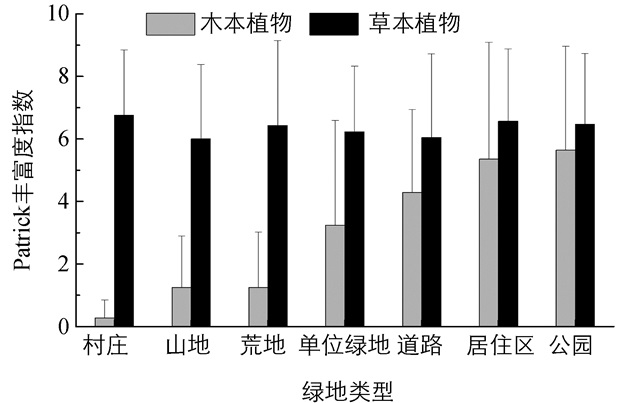
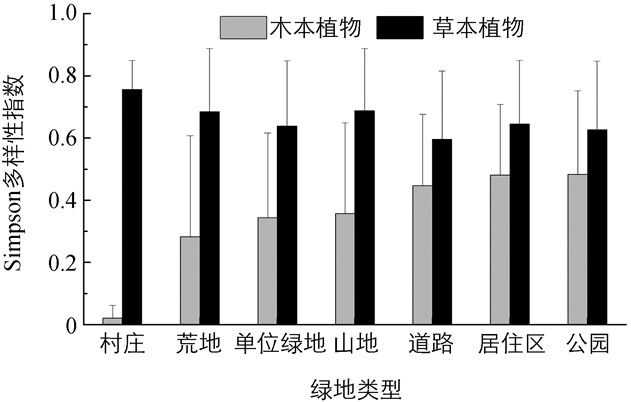
    各绿地类型中草本植物的Patrick丰富度指数和Simpson多样性指数高于木本植物(图 12),且各绿地类型草本植物间的差异小于木本植物.以Patrick丰富度指数为例,各绿地类型草本植物均值为6.00~6.76,差异很小,而木本植物间的差异显著.木本植物的Patrick丰富度指数以村庄绿地最低,仅为0.28,以公园绿地最高,达到5.64,相差19.32倍.
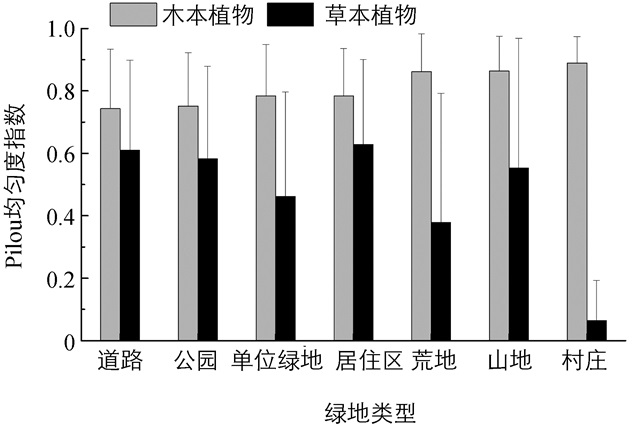
    而Pilou均匀度指数正好相反,木本植物均高于草本植物,各绿地类型木本植物间的差异也更小(图 3).
  • 厦门市城市植物优势科有大戟科(Euphorbiaceae)、菊科(Compositae)、豆科(Leguminosae)和禾本科(Gramineae),分别有27~38种植物,共占植物总种数的27.85%.这4个优势科的植物占乔木植物总个体数的16.04%、总频次的16.99%,占灌木植物总盖度的33.46%、总频次的18.69%,占草本植物总盖度的64.00%、总频次的53.34%.

    调查到323个属中,榕属(Ficus)、大戟属(Euphorbia)和木槿属(Hibiscus)的植物种数最多,分别为10种、7种和6种.而从植物个体数量和盖度来计算,则假连翘属(Duranta)是个体数最多的木本植物属,占总株数的22.4%;结缕草属(Zoysia)是盖度最高的草本植物属,占总盖度的18.5%.

    采用K-Means聚类分析确定各绿地类型的优势种类(表 1).记录的467种植物中在相应绿地中超过“10/20/30准则”的植物有25种,其中10种乔木、13种灌木的株数超过总株数的10%,2种草本植物的盖度超过总高度的10%.小叶榕(Ficus microcarpa)在荒地、道路绿地、公园绿地和单位绿地中都是优势种,并且在以上绿地类型中的重要值均排名第一、第二.酢浆草(Oxalis corniculata)、沟叶结缕草(Zoysia matrella)和细叶结缕草(Zoysia tenuifolia)也是常见的优势种,是四五种绿地类型的优势种.

    厦门市城区最高频的物种为杨桃(Averrhoa carambola)、短叶水蜈蚣、黄鹌菜、伞房花耳草,出现在45.2%~56.7%的样地中.实际上,频度排名前18的物种都是草本植物.而山区的高频物种,如鸡矢藤、竹叶草(Oplismenus compositus)、酢浆草、假臭草(Eupatorium catarium)的频率则相对较低,为33.3%~58.3%.

  • 城市区乡土植物的区系构成中以热带分布属所占比例最高,占草本植物属的72.4%、木本植物属的72.3%(表 2).山区样地中,其比例甚至更高,占草本植物属的83.9%、木本植物属的78.6%.此外,北温带分布和东亚分布也占很大比例.而其它区系类型只占很小的比例,绝大部分低于5%.

    相比于木本植物,草本植物区系类型在城市绿地与山区之间的差异更明显.其中,热带分布属在山地的比例比城市绿地高13.7%,而温带分布属在城市绿地的比例比山区高165.3%. “东亚和北美洲(间断)分布” “旧世界温带分布”和“温带亚洲分布”仅见于城市绿地的草本植物中.

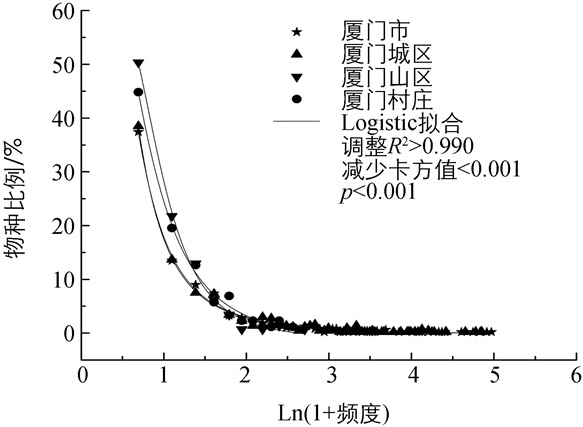
  • 植物种的频度与物种数量的非线性回归结果显示,城区、村庄、山区和整个厦门市的植物种频度分布曲线均符合Logistic函数(公式4,图 4).非线性拟合结果调整R2值均高于0.99,而减少卡方值均低于0.001.由分布曲线可知,调查样地中大多数物种的频率都较低,只有少数物种出现频率较高(图 4).曲线拟合分析的参数如表 3所示.
    厦门市城区最高频的物种为杨桃(Averrhoa carambola)、短叶水蜈蚣(Kyllinga brevifolia)、黄鹌菜(Youngia japonica)、伞房花耳草(Hedyotis corymbosa),出现在45.2%~56.7%的样地中.实际上,频度排名前18的物种都是草本植物.但城区不同绿地中的高频植物种类差异较大(表 4).而山区的高频物种如鸡矢藤(Paederia scandens)、竹叶草(Oplismenus compositus)、酢浆草(O.corniculata)、假臭草(Praxelis clematidea)的频率则相对较低,为33.3%~58.3%.

    出现频率低于5.0%的低频物种占城区植物总种数的81.5%、山区植物总种数的50.0%.频率低于10.0%的物种也占相当大的比例,达到城区植物总种数的81.5%、山区植物总种数的72.1%.

    式中:A1A2x0p均为常数,具体数值见表 3.

3.   讨论
  • 本研究调查分析了厦门市城市植物,共记录植物种类96科、323属、467种.物种丰富度总体较高,但有些位于山地的样点比城市区绿地样点的植物丰富度低.特别是有些山地主要种植单一物种的人工林,另一些山地因为林冠过密或者林下植被稀少,都可能导致山地植物种类丰富度不高.城市区植物种类丰富,已经成为厦门市生物多样性的重要组成部分.通过城市植物生态学的研究为保护城市生物多样性提供参考,具有重要意义.

    厦门市植物种的频度分布曲线(Species Frequency Distributions,SFDs)符合Logistic函数,调整R2值大于0.99,这种分布规律呈现低频植物占多数而高频植物只占少数的特征.在物种多度分布曲线(Species Abundance Distributions,SADs)的相关研究中也发现了类似规律,在柱状图上呈凹曲线或双曲线形状[21].虽然目前针对SADs分布已经有大量研究,但针对SFDs的报道还相对少见.研究SFDs分布的影响因素和过程,要考虑频度分布的尺度和特征,如生态位指标等[22].这些与物种直接相关的功能特性通过调控物种生长、繁殖和生存影响频度分布规律[23].

    优势植物种类的相对多度是预测多样性水平的实用指标[4]. Santamour针对优势物种的相对多度提出10/20/30准则,即在城市森林中,任何物种所占比例不应超过10%、任何属所占比例不应超过20%、任何科所占比例不应超过30%[24].目前该准则已经在全球许多城市被广泛参考、使用和改编[25],并且在基于全球108个城市的研究中被证实对城市森林生物多样性具有极好的预见性[4].为探索厦门城市植物多样性,将最常见的科、属、种的相对多度与10/20/30准则进行比较发现,有1个科、1个属和25个物种高于此准则.

    由于个别植物种类占据过高比例,当这些个别种类遭受病虫害时容易带来植物数量和生态服务功能的骤然下降,进而对城市生态环境造成剧烈影响[26].荷兰榆树病就曾经给欧洲和北美洲很多城市森林带来了大范围的严重灾害[27-28].生物多样性是生态系统抵抗外力干扰及保持生态平衡的重要保障.特别是在强烈的城市人为干扰活动和温室效应的作用下,多样性高的物种构成为城市植被在未来的新环境下适应和发展下去提供了更大的可能性,也为城市植被提供丰富多样的生态系统服务功能提供了必要的保障[29-30].

4.   结论
  • 本文以厦门市为例,探讨我国城市植物多样性的现状,解析植物种类构成的特征,探讨城市植物多样性的潜在问题.结果表明,植物种的频度分布(SFDs)符合Logistic函数,热带分布属占草本植物属的72.4%、木本植物属的72.3%,其中1个科、1个属和25个种的植物超出10/20/30准则[3].因此,厦门市城市植物中低频物种占多数、高频物种占少数,并且少数优势种类占据突出优势.城市野生植物在城市生态系统中占据重要地位,对于城市野生植物的研究和利用需要进一步引起足够的重视.制定有效的保护和管理政策、减少对城市野生植物的人为破坏是提高城市植物多样性的有效途径.对于超过10/20/30准则以及已经占据突出优势性的植物种及种类,在进一步开展大范围应用时或许有必要进行适当的风险评估和影响预测,并采取正确的措施保护当地生物多样性.在基础研究和应用实践比较充分的前提下,尽快建立城市野生草本植物利用和保护的系统方案和管理体系必将对城市野生草本植物的有效保护起到重要作用.

Figure (4)  Table (4) Reference (30)

Catalog

    /

    DownLoad:  Full-Size Img  PowerPoint
    Return
    Return