

Message Board

Dear readers, authors and reviewers,you can add a message on this page. We will reply to you as soon as possible!

2018 Volume 40 Issue 12
Article Contents

Yun-ye WANG, Hong-yu TONG, Xiao-xue ZHOU, et al. Two-Stage Rooting of Adventitious Buds of Ficus beipeiensis in Tissue Culture[J]. Journal of Southwest University Natural Science Edition, 2018, 40(12): 46-50. doi: 10.13718/j.cnki.xdzk.2018.12.007
Citation: Yun-ye WANG, Hong-yu TONG, Xiao-xue ZHOU, et al. Two-Stage Rooting of Adventitious Buds of Ficus beipeiensis in Tissue Culture[J]. Journal of Southwest University Natural Science Edition, 2018, 40(12): 46-50. doi: 10.13718/j.cnki.xdzk.2018.12.007

Two-Stage Rooting of Adventitious Buds of Ficus beipeiensis in Tissue Culture

More Information
  • Corresponding author: Shao-hu TANG
  • Received Date: 23/01/2018
    Available Online: 20/12/2018
  • MSC: Q948

  • The adventitious buds of Ficus beipeiensis were used as explants and a two-stage rooting method was used to generate roots (inducing adventitious roots in an agar medium and completing root development in a near-dark multi-porous matrix), and the results were compared with those of the general rooting method. The rooting rate was calculated and the growth and physiological indexes of the rooted plantlets were measured after they were cultured for 30 days. Their survival rate was counted and their growth indexes were measured 30 days after transplanting. The test results showed that the rooting rate of both methods was 100%. Compared with the general rooting method, the two-stage rooting method increased the number of root tips, total root length, total root volume and average root diameter of the rooted plantlets by 301.42%, 27.85%, 123.53% and 9.68%, respectively; enhanced plant height and leaf increment by 307.89% and 83.33%; and raised chlorophyll content and nitrate reductase activity 13.09% and 297.29%, respectively. All the rooted plantlets survived after transplanting, and the survival rate, plant height and leaf number were increased by 15.00%, 41.12% and 23.81%, respectively, and the differences between the two methods were statistically significant. In conclusion, the two-stage rooting method was significantly better than the general rooting method. The root system of the test-tube plantlets was well-developed, the survival rate after transplanting was higher, and the growth state was better. The two-stage rooting method has application value for the rooting of other plants in tissue culture.
  • 加载中
  • [1] 邓洪平, 李运婷, 陈龙, 等.北碚榕(Ficus beipeiensis S. S Chang)形态特征与花部显微特征研究[J].西南大学学报(自然科学版), 2014, 36(11):57-63.

    Google Scholar

    [2] 汪松, 解焱.中国物种红色名录:第1卷(红色名录)[M].北京:高等教育出版社, 2004:316.

    Google Scholar

    [3] 重庆市人民政府.重庆市人民政府关于公布重庆市重点保护野生植物名录(第一批)的通知[EB/OL]. (2015-02-13)[2018-01-10]. http://www.cq.gov.cn/publicity/nylysl/ly/2318.

    Google Scholar

    [4] 齐亮.北碚榕繁殖技术研究[D].重庆: 西南大学, 2010.http://cdmd.cnki.com.cn/Article/CDMD-10635-2010094204.htm

    Google Scholar

    [5] 齐亮, 李先源, 李名杨.北碚榕扦插繁殖技术研究[J].安徽农业科学, 2010, 38(6):2906-2907. doi: 10.3969/j.issn.0517-6611.2010.06.048

    CrossRef Google Scholar

    [6] 张艳玲, 唐澄莹, 何夫, 等.珍稀濒危植物北碚榕的组培快繁[J].植物生理学报, 2015, 51(4):471-475.

    Google Scholar

    [7] ZHAO J, LI ZT, CHEN J, et al. Purple-Leaved Ficus Lyrata Plants Produced by Overexpressing a Grapevine VvMybA1 Gene[J]. Plant Cell Reports, 2013, 32(11):1783-1793. doi: 10.1007/s00299-013-1491-5

    CrossRef Google Scholar

    [8] OBOH G, AKINYENI A J, OSANYINLUSI F R, et al. Phenolic Compounds from Sandpaper (Ficus Exasperata) Leaf Inhibits Angiotensin 1 Converting Enzyme in High Cholesterol Diet Fed Rats[J]. Journal of Ethnopharmacology, 2014, 157(18):119-125.

    Google Scholar

    [9] IRUDAYAYAJ S, CHRISTUDAS S, ANTONY S, et al. Protective Effects of Ficus carica Leaves on Glucose and Lipids Levels, Carbohydrate Metabolism Enzymes and β-Cells in Type 2 Diabetic Rats[J]. Pharmaceutical Biology, 2017, 55(1):1074-1081. doi: 10.1080/13880209.2017.1279671

    CrossRef Google Scholar

    [10] ALAMGEER, IMAN S, ASIF H, et al. Evaluation of Antihypertensive Potential of Ficus carica Fruit[J]. Pharmaceutical Biology, 2017, 55(1):1047-1053.

    Google Scholar

    [11] 戴叶辉, 王琳, 邢福武, 等. 13种榕属植物的叶片结构及其对环境的适应性[J].仲恺农业工程学院学报, 2012, 25(4):5-13.

    Google Scholar

    [12] 范明松, 叶冠, 黄成钢.榕属植物化学成分和药理作用研究进展[J].天然产物研究与开发, 2005(4):497-504. doi: 10.3969/j.issn.1001-6880.2005.04.031

    CrossRef Google Scholar

    [13] 钟小清, 徐鸿华.榕属药用植物研究概况[J].中草药, 2000, 31(9):84-85.

    Google Scholar

    [14] 吴尚勇.小叶榕气生根的培育[J].中国林业, 2010(7):48.

    Google Scholar

    [15] 汤绍虎, 罗充.植物生理学实验指导[M].重庆:西南师范大学出版社, 2012:53-56.

    Google Scholar

    [16] 孙俊宝, 王建新.樱桃叶绿素含量测定方法研究[J].山西农业科学, 2010, 38(3):18-19. doi: 10.3969/j.issn.1002-2481.2010.03.06

    CrossRef Google Scholar

    [17] 徐邦发, 徐雅丽.棉花叶片的叶绿素含量测定[J].塔里木农垦业大学学报, 1995, 7(2):29-32.

    Google Scholar

    [18] 陈薇, 张德颐.植物组织中硝酸还原酶的提取、测定和纯化[J].植物生理学通讯, 1980, (4):45-49.

    Google Scholar

    [19] 张希太.无机基质加简化的MS营养液快繁甘薯脱毒苗[J].河南职业技术师范学院学报, 2002, 30(3):24-25. doi: 10.3969/j.issn.1673-6060-B.2002.03.009

    CrossRef Google Scholar

    [20] 赵许朋, 罗克明, 周月, 等. "红阳"猕猴桃叶盘高频直接再生体系的建立[J].生物工程学报, 2013, 29(11):1599-1606.

    Google Scholar

    [21] 赵许朋, 周月, 杨立, 等. "红阳"猕猴桃茎段高效再生体系的建立[J].西南大学学报(自然科学版), 2013, 35(2):6-10.

    Google Scholar

    [22] 唐澄莹.昌州无刺花椒的离体快速繁殖研究[D].重庆: 西南大学, 2017.

    Google Scholar

  • 加载中
通讯作者: 陈斌, bchen63@163.com
  • 1. 

    沈阳化工大学材料科学与工程学院 沈阳 110142

  1. 本站搜索
  2. 百度学术搜索
  3. 万方数据库搜索
  4. CNKI搜索

Figures(2)  /  Tables(3)

Article Metrics

Article views(1764) PDF downloads(357) Cited by(0)

Access History

Two-Stage Rooting of Adventitious Buds of Ficus beipeiensis in Tissue Culture

    Corresponding author: Shao-hu TANG

Abstract: The adventitious buds of Ficus beipeiensis were used as explants and a two-stage rooting method was used to generate roots (inducing adventitious roots in an agar medium and completing root development in a near-dark multi-porous matrix), and the results were compared with those of the general rooting method. The rooting rate was calculated and the growth and physiological indexes of the rooted plantlets were measured after they were cultured for 30 days. Their survival rate was counted and their growth indexes were measured 30 days after transplanting. The test results showed that the rooting rate of both methods was 100%. Compared with the general rooting method, the two-stage rooting method increased the number of root tips, total root length, total root volume and average root diameter of the rooted plantlets by 301.42%, 27.85%, 123.53% and 9.68%, respectively; enhanced plant height and leaf increment by 307.89% and 83.33%; and raised chlorophyll content and nitrate reductase activity 13.09% and 297.29%, respectively. All the rooted plantlets survived after transplanting, and the survival rate, plant height and leaf number were increased by 15.00%, 41.12% and 23.81%, respectively, and the differences between the two methods were statistically significant. In conclusion, the two-stage rooting method was significantly better than the general rooting method. The root system of the test-tube plantlets was well-developed, the survival rate after transplanting was higher, and the growth state was better. The two-stage rooting method has application value for the rooting of other plants in tissue culture.

  • 北碚榕(Ficus beipeiensis S.S Chang)属桑科榕属植物,重庆特有,现有野生植株5株;因其种群数量稀少、传粉小蜂少、结实率低、种子萌发困难,故生存现状极危[1],2004年被列入《中国物种红色名录》[2],2015年列入重庆市首批重点保护野生植物名录[3].

    北碚榕四季常绿,冠大浓郁[4],是优良的园林绿化和低山造林树种[5].张艳玲等[6]开展了北碚榕的组培快繁研究,率先建立了北碚榕的离体繁殖体系,但其试管苗的再生根为棒状根,根系不发达.而榕属植物再生能力较强,小叶榕、无花果和爬藤榕等[7-14]均较易生根,有的还有气生根.所以,北碚榕组培不定芽所产生的棒状根可能主要是由环境因素导致的.在植物组织培养中,试管苗的棒状根现象极为普遍.我们认为,其原因是普遍采用琼脂固体培养基生根,通气性较差.因此,本实验中,我们对北碚榕的组培不定芽采用了两段生根法生根,即在琼脂固体培养基中诱导不定根的发生,在近黑暗、孔隙性基质中完成根系的发育,结果收到了良好的效果.

1.   实验材料与方法
  • 实验材料为北碚榕‘碚榕1号’无菌苗,接种外植体为第6代丛芽的不定芽(长约3 cm).

  • 不定根诱导:在无菌条件下,将不定芽接种到固体生根培养基中诱导不定根的发生,至不定芽基部刚露出白色根点为止(约10 d).

    根系的发育:将已发生不定根的不定芽转移到蛭石-珍珠岩(体积比1:1)的混合基质中完成根系的发育(约20 d).混合基质在使用前充分吸附液体生根培养基,并经高压灭菌.

  • 生根方法同上述“不定根诱导”,但不定芽一直在固体生根培养基中培养(30 d).

  • 生根培养基为1/2 MS+0.02 IBA,其固体培养基的琼脂质量浓度为6.5 g/L.培养温度(25±1) ℃,光照强度2 500 lx(14 h/d).

  • 生根培养30 d后,统计不定芽生根率.炼苗后洗净根部琼脂或孔隙性基质,然后用WinRHIZO型根系分析系统(加拿大生产)测定生根苗的根系长度、直径、体积、根尖数等指标;测定和计算株高增加量、叶片增加量;采用分光光度法测定叶片叶绿素质量分数[15-17]和硝酸还原酶活性[18].

    生根苗经炼苗、洗苗后移栽到营养钵中.营养土为品氏(PINDSTRUP)营养土(丹麦生产),移栽后常规管理. 30 d后统计移栽成活率,测定和计算株高和叶片增加量.

  • 实验数据利用SPSS 12.0软件进行平均数统计和水平间差异性分析,利用Microsoft Excel 2003软件对平均数和差异性作图.

2.   结果与分析
  • 30 d生根结果表明,两段生根法和一般生根法的生根率均达100%(表 1),但两段生根法根系发达,效果显著.其根系的根尖数达1 133.33条,总根长为424.06 cm,根总体积为0.38 cm3,根平均直径为0.34 mm,比一般生根法分别提高301.42%,27.85%,123.53%和9.68%,且两者之间的差异具有统计学意义(p<0.05).

    在固体生根培养基中,北碚榕不定芽7 d左右产生不定根,出现白色根点(图 1-A);不论是转移到孔隙性基质中(图 1-B1),还是继续在固体培养基中(图 1-B2),都能全部生根(图 1-C1图 1-C2).但最终(30 d后)两段生根法的生根效果明显优于一般生根法,前者产生的不定根数量尤多,根系庞大(图 1-D1),而后者的不定根数量很少,且部分为棒状根(图 1-D2).

  • 不定芽生根30 d后,生根苗的生长状况两段生根显著优于一般生根(表 2).在两段生根中,生根苗生长良好(图 1-C1),不定芽成苗率达100%,株高增加3.1 cm,叶片增加4.4枚,该3项指标比一般生根法分别提高38.89%,307.89%和83.33%,且二者之间的差异具有统计学意义(p<0.05).

  • 图 2a可知,在两段生根中,生根苗的叶片叶绿素质量分数(2.12 mg/g FW)比一般生根提高了13.09%,且二者间差异有统计学意义(p<0.05).
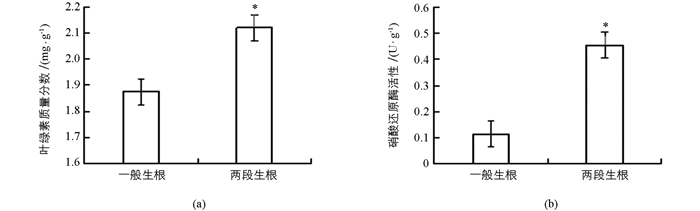
    图 2b可知,在两段生根中,生根苗的叶片硝酸还原酶活性(0.45 U/g FW)比一般生根显著提高297.29 %.由此可知,与一般生根法相比,两段生根法所得试管苗的生理活性较强.这与试管苗的根系体积与活力密切相关.

  • 生根苗移栽30 d后,两段生根所得试管苗的移栽成活率达95.83%(表 3),株高增加1.51 cm,叶片增加2.60枚,比一般生根分别提高15.00%,41.12%和23.81%,且二者之间的差异具有统计学意义(p<0.05).同时,两段生根苗移栽后长势较好(图 1-E1).

3.   结论
  • 试验结果表明,两段生根法显著优于一般生根法.北碚榕组培不定芽经两段生根产生的试管苗根系发达,营养生长更旺,生理状态更佳,移栽成活率更高.两段生根法对于其它植物的组培生根有应用价值.

4.   讨论
  • 植物根系的主要功能是固着和吸收.根系将植物体固定在土壤中,以抵抗风雨等自然外力和保持直立的姿态接收阳光,进行光合作用;植物通过根系吸收土壤中的水分和矿质.因此,良好的根系是植物生长发育的重要结构基础.

    在植物组织培养中,通过愈伤组织的再分化或顶芽、腋芽等外植体的丛芽诱导所形成的不定芽,都需要通过生根培养而形成完整植株,进而移栽到田间得到生产应用.也就是说不定芽的生根是试管苗繁殖不可缺少的重要环节.

    然而,在众多植物的组培报道中,由不定芽再生的不定根许多为棒状根,侧根及根毛少,根系发育差,木本植物尤其突出.究其原因,发现众多研究普遍采用固体生根培养基生根,整个生根阶段待生根的不定芽基部始终陷入琼脂培养基中.而根系的发育与基质的透气性密切相关[19],固体培养基通气性较差,势必影响根系发育.因此,近年来,我们开展了不定芽的两段生根法研究,在‘红阳’猕猴桃、昌州无刺花椒[20-22]不定芽生根中取得了初步效果,但未与一般生根法进行比较,且研究内容较单一,缺乏统计学结论.

    本实验采用对比实验法,以北碚榕无菌苗为材料,较为系统地研究了不定芽的两段生根,结果证明两段生根法显著优于一般生根法.在两段生根过程中,不定根发生后在多孔隙半黑暗的基质中发育,由于其发育基质的通气状况得以明显改善,且近于土壤自然环境,所以根系得到良好发育.一些实验结果与‘红阳’猕猴桃和昌州无刺花椒[20-22]不定芽的生根结果一致.本实验结果对于其它植物的组培生根有应用价值.

Figure (2)  Table (3) Reference (22)

Catalog

    /

    DownLoad:  Full-Size Img  PowerPoint
    Return
    Return