
Message Board

Dear readers, authors and reviewers,you can add a message on this page. We will reply to you as soon as possible!

2025 Volume 47 Issue 11
Article Contents

HAN Ruting, YU Ying, JIA Xiaochen, et al. Effects of Alkaline Soil Improvement Fertilization on Yield and Quality of Orah[J]. Journal of Southwest University Natural Science Edition, 2025, 47(11): 88-98. doi: 10.13718/j.cnki.xdzk.2025.11.007
Citation: HAN Ruting, YU Ying, JIA Xiaochen, et al. Effects of Alkaline Soil Improvement Fertilization on Yield and Quality of Orah[J]. Journal of Southwest University Natural Science Edition, 2025, 47(11): 88-98. doi: 10.13718/j.cnki.xdzk.2025.11.007

Effects of Alkaline Soil Improvement Fertilization on Yield and Quality of Orah

More Information
  • Corresponding author: YI Shilai
  • Received Date: 21/05/2025
    Available Online: 20/11/2025
  • MSC: S666.1

  • Under the condition of equal input of nitrogen, phosphorus and potassium nutrients, a 8-year-old Orah orchard on calcareous purple soil in Southwest China was selected as the research object, an experiment with six treatments, namely compound fertilizer (CK), formula fertilizer (T1), formula fertilizer plus sulfur powder (T2), formula fertilizer plus desulfurized gypsum (T3), compound fertilizer plus sulfur powder (T4), and compound fertilizer plus desulfurized gypsum (T5), was set up. The effects of these treatments on the yield and quality of Orah were studied for two continuous years from 2022 to 2024. The results showed that the fruits yields of various alkaline soil improvement fertilization treatments in the 2023 and 2024 increased by 7.8% to 60.2% and 3.5% to 60.2%, respectively, compared to the compound fertilizer, with the compound fertilizer combined with gypsum and the formulated fertilizer combined with gypsum treatments having the highest yields. At the time of fruit maturity and harvest in the 2024, the fruit peel thickness of the formulated fertilizer combined with gypsum treatment was the smallest, significantly less by 25.3% compared to the formulated fertilizer treatment, and the fruit peel hardness of the formulated fertilizer combined with sulfur powder treatment was the smallest, significantly less by 15.4% compared to the compound fertilizer treatment. The proportion of large-size fruits (L and XL grade) in the formulated fertilizer combined with gypsum, compound fertilizer combined with gypsum, and compound fertilizer combined with sulfur powder treatments was relatively high, respectively, and all were significantly different from that of the compound fertilizer treatment. At the time of fruit maturity and harvest in the 2023 and 2024, the soluble solid content (TSS) of the fruits in the formulated fertilizer combined with gypsum treatment was significantly increased by 11.0% and 9.2%, respectively, compared to the formulated fertilizer treatment, the titratable acid (TA) of the fruits in the formulated fertilizer combined with gypsum treatment was significantly reduced by 5.0% and 11.8%, respectively, compared to the formulated fertilizer and compound fertilizer treatments, and the solid-acid ratio (TSS/TA) of the fruits in the formulated fertilizer combined with gypsum treatment was significantly increased by 16.2% and 15.5%, respectively, compared to the formulated fertilizer and compound fertilizer treatments. The vitamin C (Vc) content of the fruits in the formulated fertilizer combined with gypsum and compound fertilizer combined with sulfur powder treatments was increased by 10.9% and 6.7%, compared to the compound fertilizer and formulated fertilizer treatments, respectively. The fruit peel hardness was positively associated with titratable acid (TA) content, but negatively associated with vitamin C (Vc) content. The order of the comprehensive scores of the main component analysis of the yield and quality indicators of each treatment from high to low was formulated fertilizer combined with gypsum, formulated fertilizer combined with sulfur powder, compound fertilizer combined with gypsum, compound fertilizer combined with sulfur powder, compound fertilizer, formulated fertilizer. It can be seen that the fertilization treatment for alkaline soil improvement increased the yield of Orah, and improved the fruit quality. Among them, the combined application of formulated fertilizer and desulfurized gypsum had the best overall effect.

  • 加载中
  • [1] 巫美桥红, 熊莉. "全国每五个沃柑就有一个来自武鸣"[N]. 广西日报, 2023-07-11(5).

    Google Scholar

    [2] 南文卓, 姬建新. 陕西苹果园土壤pH现状及改良措施[J]. 农业科技通讯, 2021(12): 319-321.

    Google Scholar

    [3] 廖世雪. 沃柑优质栽培技术[J]. 现代农业科技, 2020(2): 68-69.

    Google Scholar

    [4] GOULDING K W T. Soil Acidification and the Importance of Liming Agricultural Soils with Particular Reference to the United Kingdom[J]. Soil Use and Management, 2016, 32(3): 390-399. doi: 10.1111/sum.12270

    CrossRef Google Scholar

    [5] 王彤, 朱攀攀, 习建龙, 等. 重庆柑橘园土壤微量营养元素养分状况分析[J]. 果树学报, 2018, 35(12): 1478-1486.

    Google Scholar

    [6] 周岩, 武继承. 土壤改良剂的研究现状、问题与展望[J]. 河南农业科学, 2010, 39(8): 152-155.

    Google Scholar

    [7] 张智, 何豪豪, 郁妙, 等. 化肥减量配施土壤改良剂对土壤酸度、土壤养分和水稻产量的影响[J]. 浙江农业学报, 2025, 37(6): 1301-1308.

    Google Scholar

    [8] ZHAO Y C, YAN Z B, QIN J H, et al. The Potential of Residues of Furfural and Biogas as Calcareous Soil Amendments for Corn Seed Production[J]. Environmental Science and Pollution Research, 2016, 23(7): 6217-6226. doi: 10.1007/s11356-015-5828-1

    CrossRef Google Scholar

    [9] 姜雪, 郭丽琢, 牛济军, 等. 不同改良剂对河西灌区盐碱地土壤肥力状况的改良效应[J]. 江西农业大学学报, 2024, 46(4): 1086-1098.

    Google Scholar

    [10] 安长聪, 韩凤兰, 江成云, 等. MH盐碱地改良材料对盐碱土壤性能的影响[J/OL]. 矿产综合利用, (2023-11-28)[2025-06-22]. https://kns.cnki.net/kcms/detail/51.1251.TD.20231124.1805.009.html.

    Google Scholar

    [11] 张敬沙, 周建强, 方海兰. 脱硫石膏在我国土壤改良方面应用的研究现状分析及展望[J]. 现代化工, 2025, 45(S1): 6-11.

    Google Scholar

    [12] 王龙, 贾莉莉, 陈剑秋. 碱性土壤施酸性肥料对棉花生长的影响[J]. 湖北农业科学, 2019, 58(S2): 145-147, 166.

    Google Scholar

    [13] 朱家骝. 盐碱地水稻甬优1540施肥技术试验[J]. 浙江农业科学, 2020, 61(11): 2228-2229.

    Google Scholar

    [14] 合佳敏, 张永清, 梁萍, 等. 脱硫石膏对盐碱胁迫下藜麦农艺性状、生理特性及产量的调控作用[J/OL]. 草业科学, (2024-07-18)[2025-06-21]. https://kns.cnki.net/kcms/detail/62.1069.S.20240717.1340.004.html.

    Google Scholar

    [15] 杨恩宇, 王珍, 张峰举, 等. 生物炭与脱硫石膏配施对龟裂碱土理化性质的影响[J/OL]. 农业科学研究, (2025-04-14)[2025-06-22]. https://link.cnki.net/doi/10.13907/j.cnki.nykxyj.20250412.001.

    Google Scholar

    [16] 李性苑, 罗开源, 杨芩, 等. 施硫磺粉对土壤养分及蓝莓产量品质的影响[J]. 中国南方果树, 2015, 44(5): 101-105.

    Google Scholar

    [17] 申海林, 闫可, 邹利人, 等. 土壤改良对'着色香'葡萄生长发育的影响[J]. 中外葡萄与葡萄酒, 2020(5): 22-24.

    Google Scholar

    [18] 王雨, 陈湖, 武军凯, 等. 不同钾肥施用量对设施桃果实品质及产量的影响[J]. 江西农业学报, 2023, 35(3): 84-90.

    Google Scholar

    [19] 王江林, 王志强, 曾文芳, 等. 钾肥喷施量对桃树光合作用、果实糖酸组分及综合品质的影响[J]. 江苏农业科学, 2024, 52(10): 165-172.

    Google Scholar

    [20] 余苏凤. 钾肥施用量对金艳猕猴桃光合特性及果实品质的影响[J]. 南方农业, 2023, 17(10): 44-46.

    Google Scholar

    [21] 徐湘婷, 胡文杰, 王春艳, 等. 不同钾肥对阳光玫瑰葡萄养分吸收及果实品质的影响[J]. 贵州农业科学, 2024, 52(8): 94-103.

    Google Scholar

    [22] 杨梦宇, 杨怡帆, 唐玉薇, 等. 不同施肥处理对苹果果实品质和土壤理化性状的影响[J]. 北方园艺, 2025(8): 123-130.

    Google Scholar

    [23] 袁嘉玮, 张健, 王璐, 等. 长期施钾对富士苹果光合特性和果实品质的影响[J/OL]. 江苏农业科学, (2025-03-25)[2025-06-21]. https://kns.cnki.net/kcms/detail/32.1214.S.20250324.1645.010.html.

    Google Scholar

    [24] 闫晶蓉, 庞春花, 张永清, 等. 脱硫石膏与腐殖酸配施对盐碱地土壤及藜麦生长的影响[J/OL]. 作物杂志, (2025-02-05)[2025-06-22]. https://kns.cnki.net/kcms/detail/11.1808.S.20250205.1623.017.html.

    Google Scholar

    [25] 王笛, 李达, 韩东辰, 等. 脱硫石膏对改良盐碱地种植甜高梁的影响[J]. 农业与技术, 2021, 41(18): 44-48.

    Google Scholar

    [26] 冯浩杰. 水稻种植条件下脱硫石膏改良碱土的研究[D]. 泰安: 山东农业大学, 2015.

    Google Scholar

    [27] 杨浩, 吴文龙, 闾连飞, 等. 土壤pH值对蓝莓生长和生理特性的影响及其调节方法综述[J]. 江苏农业科学, 2022, 50(6): 1-8.

    Google Scholar

    [28] 李玉波, 许清涛, 李广帅. 脱硫石膏改良轻度碱化土壤对燕麦生长的影响研究[J]. 白城师范学院学报, 2018, 32(10): 1-5.

    Google Scholar

    [29] 喻莹. 碱性土改良施肥对沃柑生长发育及土壤性质的影响[D]. 重庆: 西南大学, 2024.

    Google Scholar

    [30] 隋世江, 张海楼, 陈丛斌. 脱硫石膏与硫酸亚铁配施对苏打盐碱水田的改良效果[J]. 辽宁农业科学, 2022(2): 79-81.

    Google Scholar

    [31] 闫洪, 仲生柱, 温晓亮, 等. 不同改良剂对盐碱地向日葵农艺性状及产量的影响[J]. 北方农业学报, 2021, 49(3): 36-40.

    Google Scholar

    [32] 林小芳, 王贵元. 钙在果树生理代谢中的作用[J]. 江西农业学报, 2007, 19(5): 61-63.

    Google Scholar

    [33] BELAL E E, SOWFY D M E, RADY M M. Integrative Soil Application of Humic Acid and Sulfur Improves Saline Calcareous Soil Properties and Barley Plant Performance[J]. Communications in Soil Science and Plant Analysis, 2019, 50(15): 1919-1930. doi: 10.1080/00103624.2019.1648497

    CrossRef Google Scholar

    [34] 李映龙, 单守明, 刘成敏, 等. 土施脱硫石膏对盐碱地"赤霞珠"葡萄生长发育和果实品质的影响[J]. 北方园艺, 2018(15): 65-69.

    Google Scholar

  • 加载中
通讯作者: 陈斌, bchen63@163.com
  • 1. 

    沈阳化工大学材料科学与工程学院 沈阳 110142

  1. 本站搜索
  2. 百度学术搜索
  3. 万方数据库搜索
  4. CNKI搜索

Figures(9)  /  Tables(3)

Article Metrics

Article views(1209) PDF downloads(142) Cited by(0)

Access History

Effects of Alkaline Soil Improvement Fertilization on Yield and Quality of Orah

    Corresponding author: YI Shilai

Abstract: 

Under the condition of equal input of nitrogen, phosphorus and potassium nutrients, a 8-year-old Orah orchard on calcareous purple soil in Southwest China was selected as the research object, an experiment with six treatments, namely compound fertilizer (CK), formula fertilizer (T1), formula fertilizer plus sulfur powder (T2), formula fertilizer plus desulfurized gypsum (T3), compound fertilizer plus sulfur powder (T4), and compound fertilizer plus desulfurized gypsum (T5), was set up. The effects of these treatments on the yield and quality of Orah were studied for two continuous years from 2022 to 2024. The results showed that the fruits yields of various alkaline soil improvement fertilization treatments in the 2023 and 2024 increased by 7.8% to 60.2% and 3.5% to 60.2%, respectively, compared to the compound fertilizer, with the compound fertilizer combined with gypsum and the formulated fertilizer combined with gypsum treatments having the highest yields. At the time of fruit maturity and harvest in the 2024, the fruit peel thickness of the formulated fertilizer combined with gypsum treatment was the smallest, significantly less by 25.3% compared to the formulated fertilizer treatment, and the fruit peel hardness of the formulated fertilizer combined with sulfur powder treatment was the smallest, significantly less by 15.4% compared to the compound fertilizer treatment. The proportion of large-size fruits (L and XL grade) in the formulated fertilizer combined with gypsum, compound fertilizer combined with gypsum, and compound fertilizer combined with sulfur powder treatments was relatively high, respectively, and all were significantly different from that of the compound fertilizer treatment. At the time of fruit maturity and harvest in the 2023 and 2024, the soluble solid content (TSS) of the fruits in the formulated fertilizer combined with gypsum treatment was significantly increased by 11.0% and 9.2%, respectively, compared to the formulated fertilizer treatment, the titratable acid (TA) of the fruits in the formulated fertilizer combined with gypsum treatment was significantly reduced by 5.0% and 11.8%, respectively, compared to the formulated fertilizer and compound fertilizer treatments, and the solid-acid ratio (TSS/TA) of the fruits in the formulated fertilizer combined with gypsum treatment was significantly increased by 16.2% and 15.5%, respectively, compared to the formulated fertilizer and compound fertilizer treatments. The vitamin C (Vc) content of the fruits in the formulated fertilizer combined with gypsum and compound fertilizer combined with sulfur powder treatments was increased by 10.9% and 6.7%, compared to the compound fertilizer and formulated fertilizer treatments, respectively. The fruit peel hardness was positively associated with titratable acid (TA) content, but negatively associated with vitamin C (Vc) content. The order of the comprehensive scores of the main component analysis of the yield and quality indicators of each treatment from high to low was formulated fertilizer combined with gypsum, formulated fertilizer combined with sulfur powder, compound fertilizer combined with gypsum, compound fertilizer combined with sulfur powder, compound fertilizer, formulated fertilizer. It can be seen that the fertilization treatment for alkaline soil improvement increased the yield of Orah, and improved the fruit quality. Among them, the combined application of formulated fertilizer and desulfurized gypsum had the best overall effect.

  • 开放科学(资源服务)标识码(OSID):

  • 沃柑(Citrus reticulata ‘Orah’)属于晚熟杂交柑橘,我国沃柑年产量高达750万t,主要分布在广西、云南、四川、重庆等省(区、市)[1]。沃柑以鲜食为主,其果实富含膳食纤维、抗氧化物质、维生素C等,营养物质丰富,保健价值高。土壤酸碱度是衡量土壤质量的重要指标之一,对作物生长和产量、品质影响至关重要,沃柑种植适宜的土壤pH值范围为5.5~6.5,即微酸性土壤[2-4],而重庆有接近36%的柑橘园土壤pH值高于7.5,土壤中碳酸钙积累,降低土壤养分的有效性,阻碍根系发育,不利于柑橘地上部的生长,严重影响了柑橘产量与品质,故亟需进行碱性土改良[5]

    除了施用有机肥、种植绿肥和轮作等措施外,土壤改良剂提供了另一种有效的土壤改良途径[6]。土壤改良剂是指能改善土壤物理、化学和生物性质的一类化合物,主要分为有机改良剂、无机(化学)改良剂、微生物改良剂和合成改良剂[7]。通过改良剂调节土壤酸碱度,为作物生长创造更适宜的土壤环境条件,实现作物高产优质的目的[8-9]。目前,化学改良法以其显著的效果和较低的成本,成为盐碱地改良的首选方法[10]。脱硫石膏中溶解的Ca2+可置换土壤胶体吸附的Na+,借助淋洗过程将钠排出土体,以达到碱性土改良的目的[11]。硫磺粉通过化学和生物过程被氧化,从而释放出氢离子,可使土壤酸化。碱性土除了采用土壤酸性改良剂,还可通过施用过磷酸钙、硫酸钾等酸性肥料,降低土壤pH值,提高土壤养分的生物有效性,有利于作物生长及其产量、品质的提升[12-13]。因此,如何科学有效地改良柑橘园碱性土壤,筛选出适宜的碱性土改良材料及配方,对果树产量、品质的提升具有十分重要的作用。合佳敏等[14]研究发现,在低盐碱环境下,距土壤表层0~20和0~30 cm施加脱硫石膏,均可显著提高藜麦产量。杨恩宇等[15]研究表明,通过单施脱硫石膏,可显著提高高粱的籽粒产量。李性苑等[16]提出,适量施用硫磺粉对蓝莓产量和果实维生素C(Vc)、可溶性糖、可滴定酸含量具有促进效果。申海林等[17]研究发现,有机肥配施硫磺粉可显著提高葡萄果实可溶性固形物含量。王雨等[18]对桃施用硫酸钾肥,果实的可溶性固形物、可溶性糖、可溶性蛋白含量提高,而可滴定酸含量下降。王江林等[19]在桃树果实成熟期喷施硫酸钾肥,发现适量浓度的硫酸钾可提升果实硬度、可溶性固形物及糖含量。余苏凤[20]对金艳猕猴桃施用硫酸钾肥,果实可溶性固形物含量显著提高,可滴定酸含量显著降低。徐湘婷等[21]施用硫酸钾可显著提高葡萄果实VC含量、可溶性固形物含量和降低可滴定酸含量。杨梦宇等[22]、袁嘉玮等[23]对苹果树分别增施与适量施用硫酸钾肥,均可提升果实可溶性固形物和VC含量,降低可滴定酸含量。

    目前,我国有关碱性土改良主要涉及藜麦、高粱、水稻等[14-15, 24-26]粮食作物以及蓝莓、葡萄、桃、猕猴桃、苹果等水果作物[16-23, 27],而有关柑橘园碱性土改良剂、酸性肥料的相关研究应用以及二者协同改良的相关报道鲜见。本研究以8年生沃柑园为对象,在氮、磷、钾养分投入一致的基础上,探究不同碱性土改良施肥处理对沃柑产量及内外品质的影响,选出适合柑橘园碱性土改良施肥的材料与配方,以期为柑橘优质高产栽培提供理论依据与技术支持。

1.   材料与方法
  • 在重庆市北碚区西南大学柑桔研究所沃柑园(29°45′ N,106°22′ E)于2022-2024年连续开展两年重复试验。果园土壤为碱性(pH值8.2),有机质17.9 g/kg,碱解氮、有效磷、速效钾分别为60、25、168 mg/kg。试验以枳橙为基砧、福本为中间砧高接8年生的沃柑为试材。供试肥料为含N 47%的尿素、含P2O5 12%的过磷酸钙、含K2O 51%的硫酸钾、复合肥(N-P2O5-K2O在春、夏、秋三季施用比例分别为21∶8∶11、15∶5∶25、15∶15∶15),土壤改良剂为纯度70.0%~85.0%脱硫石膏和99.0%硫磺粉,生产厂家分别为河南省巩义市元亨净水材料厂和山西省牧颜宸科技有限公司。根据李玉波等[28]的研究结果,确定脱硫石膏和硫磺粉适宜施用量为15 000 kg/hm2。烟气脱硫石膏样品重金属含量满足《土壤环境质量农用地土壤污染风险管控标准(试行)》(GB 15618—2018)中pH值≥7.53的二级标准要求。

  • 试验分别设置复合肥(CK)、配方肥(T1)、配方肥配施硫磺粉(T2)、配方肥配施脱硫石膏(T3)、复合肥配施硫磺粉(T4)、复合肥配施脱硫石膏(T5)等6个处理,具体改良施肥材料及其施用量如表 1所示,各处理N、P2O5、K2O养分施用量一致,年施肥量分别为0.42 kg/株、0.22 kg/株、0.44 kg/株,每处理6株。每年于3月、7月、10月进行施肥,T1、T2、T3处理3次施肥比例均为2∶5∶3,CK、T4、T5处理3次施肥比例均为8∶10∶7。于树体行间两侧滴水线外侧位置各挖一条长度为100 cm、宽度为20 cm、深度为30 cm的施肥沟,将准备好的肥料、土壤改良材料与从沟内挖出的土壤充分搅拌混合均匀后填回施肥沟内,且回填土比周边土面高10 cm左右。果园植保、树体修剪等其他田间管理按常规技术统一进行。

  • 分别于2022年8月至2023年1月以及2023年8月至2024年1月,即从果实膨大期开始,每月中旬在每株树上沿树冠中部东、南、西、北4个方向各采4个果作为1个混合样,单株为1次重复,每处理共6个重复样,用于测定果实内外品质指标。分别于2023年1月和2024年1月果实成熟期按单株全部采收称重测产量,2024年1月对每株树采收的所有果实进行分级。分级标准为:果实横径55.0~60.0 mm为小果型(S),60.0~65.0 mm为中果型(M),65.0~70.0 mm为大果型(L),70.0~80.0 mm为超大果型(XL)[29]

    果实经去离子水清洗、擦干后,以游标卡尺测量果皮厚度,采用GY-4果实硬度计测定果皮硬度。榨汁后,使用PAL-1数显糖度仪测定可溶性固形物(TSS)含量,采用NaOH中和滴定法、2,6-二氯靛酚钠滴定法测定可滴定酸(TA)含量和维生素C(VC)含量,比值法计算固酸比(TSS/TA)。

  • 采用Microsoft Excel 2019统计试验数据,利用R语言进行方差分析,使用Origin Pro 2025软件绘图,并运用配套插件进行主成分分析和综合评价。

2.   结果与分析
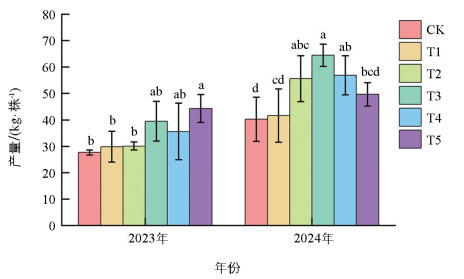
  • 图 1分析可知,2024年、2023年各处理沃柑单株平均产量分别为51.42 kg、34.51 kg,前者比后者提高了49.0%;相较于CK处理,各碱性土改良施肥处理的沃柑产量均有所提升。2023年各碱性土改良施肥处理的沃柑单株平均产量较CK增产了7.8%~60.2%,其中T5处理的产量最高,与CK处理差异显著;2024年各碱性土改良施肥处理的沃柑单株平均产量较CK增产了3.5%~60.2%,以T3最高,与CK处理差异显著。
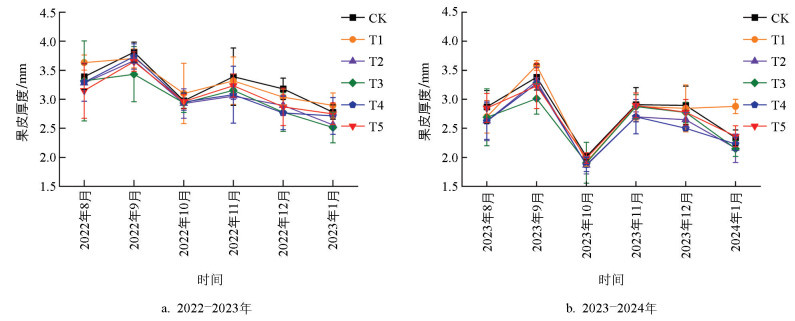
  • 从8月至翌年1月沃柑果皮厚度检测结果表明(图 2),两年试验的动态变化规律一致,即随着时间的推移,呈先增加后降低再增加最后缓慢降低的趋势。2023年1月采收时,T3处理的果皮厚度最薄,为2.51 mm;T1处理最厚,为2.89 mm;但各处理差异均不显著。2024年1月采收时,T3处理果皮厚度最薄,为2.15 mm;T1处理最厚,为2.88 mm;T3处理的果皮厚度比T1降低了25.3%,且两个处理间差异显著。
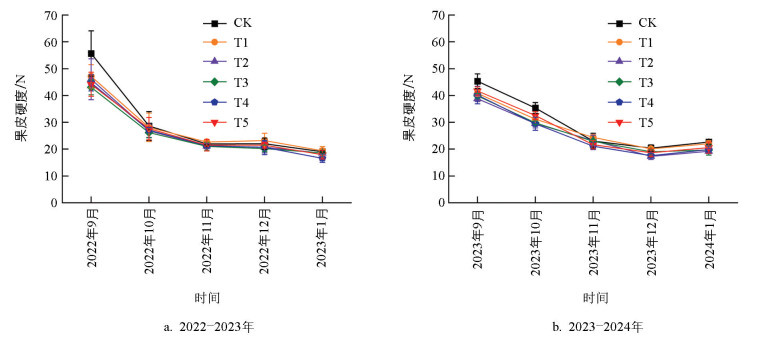
  • 从9月至翌年1月沃柑果皮硬度监测结果表明(图 3),2023年9月至10月果皮硬度迅速降低,10月至12月缓慢降低至平稳,至2023年1月采收时又略有降低;2023年1月果实成熟采收时各处理果皮硬度为16.63~19.44 N,其中T4处理最小,T1处理最大,T4比T1处理显著降低了14.5%。2023年9月至11月果皮硬度快速降低,11月至12月缓慢降低,至2024年1月采收时又略有升高;2024年1月果实成熟采收时各处理果皮硬度为19.21~22.69 N,以T2处理相对最小,CK处理最大,T2比CK处理显著降低了15.4%。
  • 表 2可知,2024年各处理大果型(L级和XL级)级别分布频率以T3、T5、T4处理相对较高,均显著高于CK处理;各处理M级中型果分布频率以T2、T3、T4、T5处理较高,显著高于T1处理;各处理S级小型果分布频率以CK、T1处理显著高于其他处理。

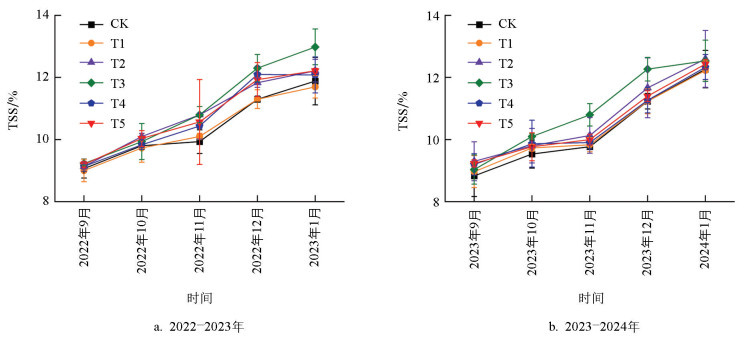
  • 从9月至翌年1月沃柑果实TSS含量检测结果表明(图 4),2022年9月至11月果实TSS含量缓慢升高,11月至12月快速升高,12月至翌年1月缓慢升高至最大值。2023年1月采收时,T3处理的果实TSS含量最大,为12.98%;T1处理最小,为11.70%;T3比T1处理显著提高了11.0%。2024年9月至11月果实TSS含量缓慢升高,11月至翌年1月快速升高至最大值。2023年12月各处理的果实TSS含量,以T3处理相对最高,为12.27%;CK和T1处理最小,为11.23%;T3处理比CK、T1处理均显著增加了9.2%。2024年1月采收时,T2处理的TSS含量最大,比CK处理提高了2.7%,但差异未达显著水平。
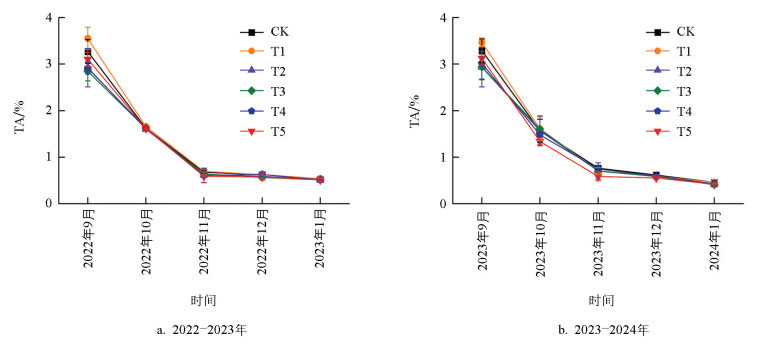
  • 从9月至翌年1月沃柑果实TA含量检测结果表明(图 5),两年试验的动态变化规律一致,即9月至11月果实TA含量快速下降,11月至翌年1月缓慢下降,至采收时达相对最低。2023年1月采收时,T3和T4处理的果实TA含量最小,为0.51%;T1处理最大,为0.54%;T3和T4分别比T1处理降低了5.0%、5.0%,但各处理间无显著性差异。2023年12月,T5处理的果实TA含量相对最小,为0.56%;CK处理最大,为0.62%;T5比CK处理显著降低了10.1%。2024年1月采收时,T3处理的果实TA含量最小,为0.41%,T3比CK处理降低了11.8%,但各处理间无显著差异。
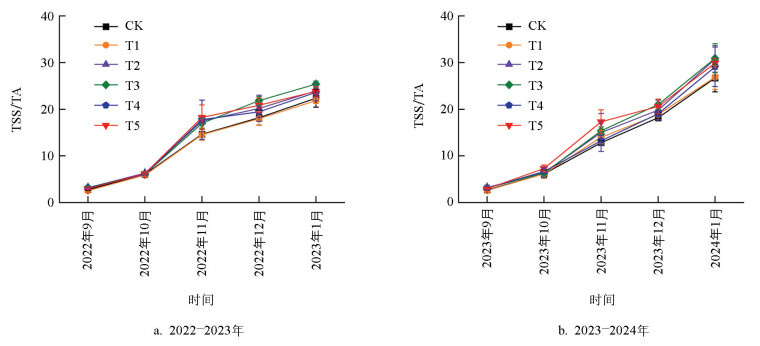
  • 从9月至翌年1月沃柑果实TSS/TA检测结果表明(图 6),2022年9月至10月沃柑果实TSS/TA缓慢升高,10月至11月快速升高,11月至翌年1月缓慢升高至最大值。2023年1月采收时,T3处理的TSS/TA最大,为25.42;T1处理最小,为21.87;T3比TI显著提高了16.2%。2023年9月至10月沃柑果实TSS/TA缓慢升高,10月至翌年1月快速升高至最大值。2023年12月,T3处理的果实TSS/TA最大,为21.02;CK处理最小,为18.20;T3处理比CK显著增加了15.5%。2024年1月采收时,T3处理的TSS/TA最大,为30.94,但各处理间差异不显著。
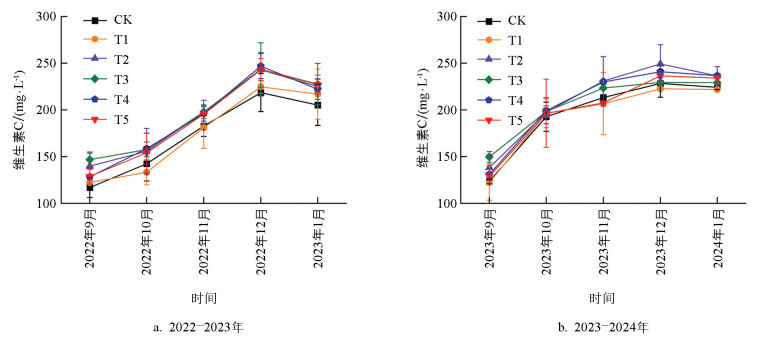
  • 从9月至翌年1月沃柑果实VC含量检测结果表明(图 7),2022年9月至10月沃柑果实VC含量缓慢升高,10月至12月快速升高至最高值,至2023年1月采收时有所降低。2023年1月采收时,T3处理的果实VC含量最大,为227.6 mg/L;CK处理最小,为205.3 mg/L;T3比CK提高10.9%,但不存在显著性差异。2023年9月至10月沃柑果实VC含量迅速升高,10月至12月缓慢升高至最高值,至2024年1月采收时有所下降。2024年1月采收时,T4处理的果实VC含量最大,为236.6 mg/L;T1处理最小,为221.8 mg/L;T4与T1处理差异显著。
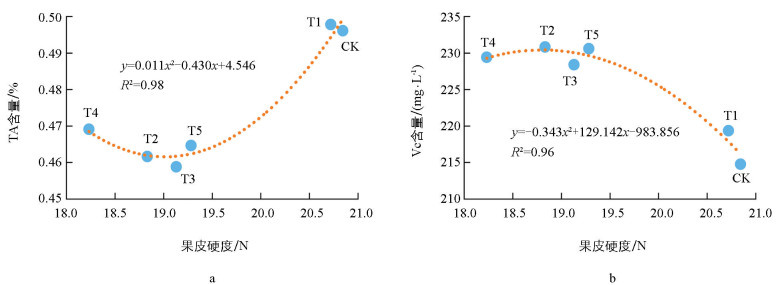
  • 将2023年和2024年1月中旬果实成熟采收期各处理指标的数据取平均值,通过多项式拟合,探究果皮硬度、果皮厚度分别与果实TSS、TA、VC含量之间的相关性。数据分析结果表明,果皮硬度与果实TA含量、果实VC含量之间存在显著的相关性,呈现出较高的曲线拟合度(R2>0.8)。从图 8a可知,果皮硬度与TA含量呈正相关,其变化趋势在T3处理时出现转折。从图 8b可见,果皮硬度与VC含量呈负相关,于T2处理时发生明显转折。由上可见,当果实变软时,TA下降,VC升高。各碱性土改良施肥处理均能有效提高沃柑果实外观内质。
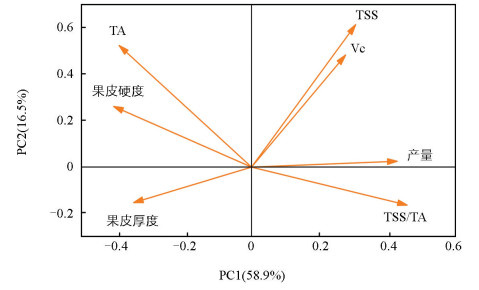
  • 各碱性土改良施肥处理产量及品质指标两年平均值的主成分分析载荷图表明(图 9),主成分1和主成分2贡献率分别为58.9%、16.5%,累计贡献率达75.4%,主成分1中起决定作用的指标有产量、果皮厚度、果皮硬度、TSS/TA,主成分2主要由TSS、TA、VC含量决定。
  • 表 4所示,选取特征值大于1的两个主成分,对不同碱性土改良施肥处理进行综合评价。不同碱性土改良施肥处理的综合得分,由大到小的顺序为T3、T2、T5、T4、CK、T1。

3.   讨论与结论
  • 碱性土改良施肥在保证氮、磷、钾等养分的供应下,配施脱硫石膏降低了土壤含盐量,配施硫磺粉降低了土壤的pH值,为作物创造了适宜其生长的土壤环境,有利于作物的生长发育。2023年和2024年各碱性土改良施肥处理的沃柑产量分别较CK增加了7.8%~60.2%和3.5%~60.2%,且分别以T5和T3处理最高,这与前人[14-15, 30-31]研究结果一致,可能与配施脱硫石膏置换土壤中的Na+,降低土壤含盐量,提高根系活力,有效延长叶片功能期,增加干物质积累量,促进果实生长发育有关。

    果实中的钙以果胶酸钙的形式参与细胞壁和胞间层的构成,从而使果实器官或组织具有一定的机械强度,进而提高了果皮硬度[32]。本试验结果表明,果实成熟采收时各碱性土改良施肥处理的果皮厚度及果皮硬度比单施化肥均有一定程度的改善,其中2024年度果皮厚度以T3处理最薄,以T1处理最厚,T3比T1处理显著降低了25.3%,这可能与脱硫石膏与土壤中的碳酸盐反应生成中性盐和碳酸钙,降低了土壤pH值,提高了土壤有效磷含量,吸收利用的磷促进果肉生长、降低果皮厚度有关。果皮硬度以T2处理相对最小,比CK处理显著降低了15.4%,这可能与硫磺粉氧化生成硫酸氧化物,置换出一定量的氢离子,与土壤中的碳酸钙发生反应生成可溶性钙盐,易随雨水或灌溉水淋失,造成了土壤中钙的流失,间接影响果实中的钙含量,从而降低果皮硬度有关[33]。果实大果型(L级和XL级)比例变化范围为7.00%~42.00%,其中以T3处理的比例最高,与CK相比显著提升,可能与脱硫石膏降低了土壤pH值,提高了土壤有效氮、磷、钾等含量和促进了养分的吸收利用,有利于果实的膨大有关。盐碱地改良试验结果表明,施用脱硫石膏可提高葡萄的叶面积和叶绿素含量,有利于叶片的光合作用,从而促进了果实中光合产物的积累,最终提高了果实品质[34]。连续两年的试验结果表明,果实成熟采收时各碱性土改良施肥处理的沃柑果实内在品质与单施化肥相比均有一定程度的提升,其中2023年和2024年果实TSS含量均以T3处理最高,比T1处理显著增加了11.0%和9.2%,可能与脱硫石膏通过置换Na+,降低了土壤pH值,缓解了碱性土对沃柑的胁迫,提高了土壤中磷、铁、锌等元素的有效性,有利于沃柑根系对土壤矿质元素的吸收利用,促进了叶片光合产物的合成与转运,进而提高了沃柑果实TSS含量有关。T3处理的沃柑果实TA含量分别比T1、CK降低了5.0%、11.8%,可能与脱硫石膏提供了一定量的钙,钙通过稳定细胞膜的结构,减少柠檬酸、苹果酸等有机酸在液泡中的积累,从而降低了沃柑果实TA含量有关。VC含量分别以T3和T4处理相对最大,T4比T1处理显著增加了6.7%,可能与硫磺粉提供了硫,可提高叶片光合效率,增加糖分供应,而糖是VC合成的碳骨架来源,进而提高VC含量有关,这与前人[16-17, 34]的研究结果一致。

    可见,施用酸性肥料及脱硫石膏、硫磺粉等碱性土改良剂,不仅能改善果实外观品质,还显著增加了沃柑产量,提高了果实TSS、VC含量,以及降低了果实TA含量。对沃柑成熟期果实外观内质指标进行曲线拟合,分析发现果皮硬度与果实TA、VC含量之间有较好的相关性,当硬度下降时,TA下降,VC升高,分别以T3和T2处理为最佳。借助果皮硬度与果实内在品质指标的良好相关性量化模型,结合果皮硬度快速监测技术,甚至可以通过触摸果皮“手感”硬度的经验性判断,今后可通过果皮硬度的“触感”来快速、实时、无损估测果实内在品质与成熟度情况。利用主成分分析对成熟期沃柑产量及外观内质指标进行综合评价,分析不同碱性土改良施肥处理对果实品质形成的影响,以T3处理即配方肥(尿素+硫酸钾+过磷酸钙)配施脱硫石膏的综合得分最高。

  • 本试验条件下,与常规单施复合肥相比,酸性肥料(过磷酸钙和硫酸钾)和土壤改良剂(硫磺粉和脱硫石膏)配施,有利于果园碱性土壤的改良培肥,进而提高了沃柑产量,改善了果实外观内质。基于主成分分析的沃柑产量、品质评价得出,T3处理即配方肥(尿素+硫酸钾+过磷酸钙)配施脱硫石膏的综合得分最高,亦即西南地区石灰性紫色土柑橘园通过脱硫石膏结合施用酸性磷、钾肥的综合改良效果为最佳。

Figure (9)  Table (3) Reference (34)

Catalog

    /

    DownLoad:  Full-Size Img  PowerPoint
    Return
    Return