
Message Board

Dear readers, authors and reviewers,you can add a message on this page. We will reply to you as soon as possible!

2026 Volume 48 Issue 7
Article Contents

Zeng Shan, Cui Chaohui, Lu Jiahuan, et al. Parametric design and performance analysis of nonlinear stiffness vibration damping structure for seed-metering device[J]. Journal of Southwest University Natural Science Edition, 2026, 48(7): 226-234. doi: 10.13718/j.cnki.xdzk.2026.07.018
Citation: Zeng Shan, Cui Chaohui, Lu Jiahuan, et al. Parametric design and performance analysis of nonlinear stiffness vibration damping structure for seed-metering device[J]. Journal of Southwest University Natural Science Edition, 2026, 48(7): 226-234. doi: 10.13718/j.cnki.xdzk.2026.07.018

Parametric design and performance analysis of nonlinear stiffness vibration damping structure for seed-metering device

More Information
  • Corresponding author: Wang Yu ; 
  • Received Date: 26/05/2025
    Available Online: 20/07/2026
  • MSC: TB535

  • Forced vibration caused by the undulating terrain leads to a decrease in the seeding uniformity and stability of the seeding machine. In this paper, a vibration damping structure with nonlinear stiffness for the seed-metering device was designed. The continuous structure of four helical rods was employed to replace the multi-component vibration damping structure, achieving the characteristics of high load-bearing capacity and low-frequency vibration damping within a single component. By establishing the finite element model of the vibration damping structure, the influences of structural parameters, such as the cross-sectional radius of the helical rods, the center and radius of the projected curve, on its nonlinear stiffness and vibration damping performance were analyzed. The results indicated that increasing the characteristic parameter of the projected curve center and decreasing the radii of the projected curve or the cross-section of the helical rods could significantly reduce the initial vibration damping frequency, yet this would impair the vibration damping performance or the load-bearing capacity. Based on the concentrated frequency band (4-10 Hz) of the vibration energy distribution of the seed-metering device and the requirements for the supporting stiffness, the geometric characteristic parameters of the vibration damping structure were determined. The static stiffness of the vibration damping structure was 1.13×10⁴ N/m, and the initial vibration damping frequency was 6.89 Hz. The field test results demonstrated that within the field operation speed range of 3-7 km/h of the seeding machine, the vibration damping structure reduced the root mean square of the vibration acceleration by 21.47%-26.37%. Moreover, the vibration damping effect was particularly remarkable for high-speed operation, and the single seed sowing rate was increased by 2.05-13.64 percentage points.

  • 加载中
  • [1] 朱彤, 丛锦玲, 齐贝贝, 等. 机械气力组合式花生精量排种器设计与试验[J]. 中国机械工程, 2020, 31(21): 2592-2600.

    Google Scholar

    [2] 李明生, 谢守勇, 刘凡一, 等. 四行荞麦精量播种机设计与试验[J]. 西南大学学报(自然科学版), 2023, 45(7): 219-228. doi: 10.13718/j.cnki.xdzk.2023.07.019

    CrossRef Google Scholar

    [3] 刘海, 杜铮, 郭翔, 等. 蔬菜种子精量直播技术与装备研究进展[J]. 华中农业大学学报, 2025, 44(1): 225-238.

    Google Scholar

    [4] 陈晔, 董欣. 半球穴形气吸式精准播种机试验研究[J]. 东北农业大学学报, 2016, 47(11): 100-108.

    Google Scholar

    [5] 马广. 气吸滚筒式穴盘精量播种流水线设计[J]. 浙江大学学报(农业与生命科学版), 2018, 44(4): 476-480.

    Google Scholar

    [6] 黄与霞, 韩丹丹, 韩哲, 等. 振动对勺轮式排种器排种性能的影响试验[J]. 河南农业大学学报, 2021, 55(5): 896-905.

    Google Scholar

    [7] 周长安, 郑来臣, 张树明, 等. 高速精密播种机结构原理及先进机型[J]. 山东农业大学学报(自然科学版), 2025, 56(2): 293-301.

    Google Scholar

    [8] 张红梅, 张晨明, 朱晨辉, 等. 玉米免耕播种机振动特性及对排种器排种性能的影响[J]. 中国农机化学报, 2024, 45(5): 1-8, 337.

    Google Scholar

    [9] 廖宜涛, 齐天翔, 廖庆喜, 等. 气力式油菜精量联合直播机振动特性及对排种性能影响[J]. 吉林大学学报(工学版), 2022, 52(5): 1184-1196.

    Google Scholar

    [10] 王奇, 朱龙图, 李名伟, 等. 指夹式玉米免耕精密播种机振动特性及对排种性能的影响[J]. 农业工程学报, 2019, 35(9): 9-18.

    Google Scholar

    [11] 郑娟, 廖宜涛, 齐天翔, 等. 振动对气力式油菜精量排种器性能影响[J]. 华中农业大学学报, 2023, 42(2): 233-242.

    Google Scholar

    [12] Carrella A, Brennan M J, Waters T P, et al. Force and displacement transmissibility of a nonlinear isolator with high-static-low-dynamic-stiffness[J]. International Journal of Mechanical Sciences, 2012, 55(1): 22-29. doi: 10.1016/j.ijmecsci.2011.11.012

    CrossRef Google Scholar

    [13] Huang X C, Liu X T, Sun J Y, et al. Vibration isolation characteristics of a nonlinear isolator using Euler buckled beam as negative stiffness corrector: a theoretical and experimental study[J]. Journal of Sound and Vibration, 2014, 333(4): 1132-1148. doi: 10.1016/j.jsv.2013.10.026

    CrossRef Google Scholar

    [14] 周加喜, 王心龙, 徐道临, 等. 含凸轮-滚轮机构的准零刚度系统隔振特性实验研究[J]. 振动工程学报, 2015, 28(3): 449-455.

    Google Scholar

    [15] Wang Q, Zhou J X, Xu D L, et al. Design and experimental investigation of ultra-low frequency vibration isolation during neonatal transport[J]. Mechanical Systems and Signal Processing, 2020, 139: 106633. doi: 10.1016/j.ymssp.2020.106633

    CrossRef Google Scholar

    [16] Ling P, Miao L L, Zhang W M, et al. Cockroach-inspired structure for low-frequency vibration isolation[J]. Mechanical Systems and Signal Processing, 2022, 171: 108955. doi: 10.1016/j.ymssp.2022.108955

    CrossRef Google Scholar

    [17] Pu H Y, Liu J, Wang M, et al. Bio-inspired quasi-zero stiffness vibration isolator with quasilinear negative stiffness in full stroke[J]. Journal of Sound and Vibration, 2024, 574: 118240. doi: 10.1016/j.jsv.2024.118240

    CrossRef Google Scholar

    [18] Yu K F, Chen Y W, Yu C Y, et al. Origami-inspire quasi-zero stiffness structure for flexible low-frequency vibration isolation[J]. International Journal of Mechanical Sciences, 2024, 276: 109377. doi: 10.1016/j.ijmecsci.2024.109377

    CrossRef Google Scholar

    [19] Wang Y, Zhang W H, Luo X W, et al. Effect of vibration conditions on the seed suction performance of an air-suction precision seeder for small seeds[J]. Agriculture, 2024, 14(4): 559. doi: 10.3390/agriculture14040559

    CrossRef Google Scholar

    [20] Feng X, An E T, Feng J, et al. Nonlinear anti-vibration compliant mechanism with inertia amplification[J]. Proceedings of the Institution of Mechanical Engineers, Part C: Journal of Mechanical Engineering Science, 2024, 238(24): 11190-11199. doi: 10.1177/09544062241281257

    CrossRef Google Scholar

    [21] Dalela S, Balaji P S, Jena D P. Design of a metastructure for vibration isolation with quasi-zero-stiffness characteristics using bistable curved beam[J]. Nonlinear Dynamics, 2022, 108(3): 1931-1971. doi: 10.1007/s11071-022-07301-0

    CrossRef Google Scholar

    [22] 曾山, 文智强, 刘伟健, 等. 气吸式小粒蔬菜种子精量穴播排种器优化设计与试验[J]. 华南农业大学学报, 2021, 42(6): 52-59.

    Google Scholar

    [23] GB/T 6973-2005单粒(精密)播种机试验方法[S].

    Google Scholar

  • 加载中
通讯作者: 陈斌, bchen63@163.com
  • 1. 

    沈阳化工大学材料科学与工程学院 沈阳 110142

  1. 本站搜索
  2. 百度学术搜索
  3. 万方数据库搜索
  4. CNKI搜索

Figures(12)  /  Tables(1)

Article Metrics

Article views(248) PDF downloads(56) Cited by(0)

Access History

Parametric design and performance analysis of nonlinear stiffness vibration damping structure for seed-metering device

    Corresponding author: Wang Yu ; 

Abstract: 

Forced vibration caused by the undulating terrain leads to a decrease in the seeding uniformity and stability of the seeding machine. In this paper, a vibration damping structure with nonlinear stiffness for the seed-metering device was designed. The continuous structure of four helical rods was employed to replace the multi-component vibration damping structure, achieving the characteristics of high load-bearing capacity and low-frequency vibration damping within a single component. By establishing the finite element model of the vibration damping structure, the influences of structural parameters, such as the cross-sectional radius of the helical rods, the center and radius of the projected curve, on its nonlinear stiffness and vibration damping performance were analyzed. The results indicated that increasing the characteristic parameter of the projected curve center and decreasing the radii of the projected curve or the cross-section of the helical rods could significantly reduce the initial vibration damping frequency, yet this would impair the vibration damping performance or the load-bearing capacity. Based on the concentrated frequency band (4-10 Hz) of the vibration energy distribution of the seed-metering device and the requirements for the supporting stiffness, the geometric characteristic parameters of the vibration damping structure were determined. The static stiffness of the vibration damping structure was 1.13×10⁴ N/m, and the initial vibration damping frequency was 6.89 Hz. The field test results demonstrated that within the field operation speed range of 3-7 km/h of the seeding machine, the vibration damping structure reduced the root mean square of the vibration acceleration by 21.47%-26.37%. Moreover, the vibration damping effect was particularly remarkable for high-speed operation, and the single seed sowing rate was increased by 2.05-13.64 percentage points.

  • 开放科学(资源服务)标识码(OSID):

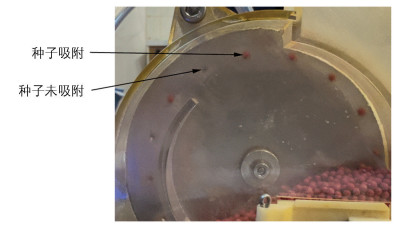
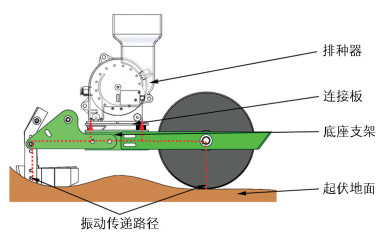
  • 研究精量播种技术是种植业发展的趋势[1-3],实现精量播种的核心是精量播种机,其工作效率和质量直接影响作物的生长和产量[4-7]。然而,田间作业中土壤结构的复杂性与地表起伏引发的机械振动直接影响精量播种机的播种质量[8-10],特别是在高速作业下,气吸式排种器的垂向振动导致种子难以在排种盘上保持吸附状态,产生漏播现象[11],如图 1所示。排种组件通常采用“排种器-连接板-底座支架”三层刚性连接结构,以蔬菜播种机(图 2)为例,连接板与底座支架的连接区域是振动传入排种器的主要路径,因此,如何在此区域设计减振结构是提高播种质量的关键。
    研究表明,具有高承载能力与低频减振的高静-低动非线性刚度减振结构能够实现优异的减振性能[12]。如欧拉屈曲梁减振结构[13],通过引入欧拉屈曲梁结构作为负刚度校正器,抵消系统正刚度分量,形成局部低刚度区,从而抑制共振峰幅值并拓宽减振频带。凸轮-滚轮式减振结构[14],借助凸轮-滚轮机构将横向线性刚度转换为垂向负刚度,并通过线性正刚度补偿实现非线性刚度特性,可有效降低起始减振频率,抑制共振并提高减振效果。永磁体-螺旋弹簧组合减振结构[15],采用相互排斥的永磁体与螺旋弹簧并联的构型设计实现非线性刚度特性,具有超低频减振效果。类似仿生非线性刚度减振结构也展现出巨大的应用潜力。如蟑螂启发减振结构[16],通过菱形腔室和弹簧组分别模拟蟑螂外骨骼和肌肉组织,并利用滑块产生非线性阻尼和惯性效应,实现非线性刚度特性,可有效降低共振频率与峰值传递率。鸟类启发减振结构[17],借鉴鸟类起飞和降落过程中腿-翅协同稳定机制,利用双连杆和斜弹簧产生负刚度,协同垂直弹簧实现非线性刚度特性,在高激励水平下具有良好的减振效果。折纸启发的桁架-弹簧组合减振结构[18],采用轴向弹性连杆模拟折痕并结合线性弹簧补偿机制实现非线性刚度特性,在低频范围内具有优异的减振性能。

    尽管上述减振结构表现出色,但其依赖螺栓连接实现组件装配,导致结构复杂。为此,本文提出一种排种器非线性减振结构,采用四螺旋杆连续体结构代替当前常用的多组件减振结构,在单一构件内实现高静-低动非线性刚度特性,在保证减振性能的同时,实现紧凑设计,为通过减振提高排种质量的相关研究提供依据。

1.   具有非线性刚度的连续体结构设计
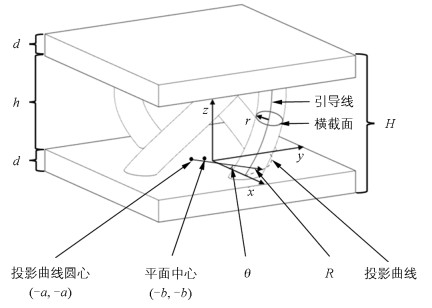
  • 前期研究发现,播种机在田间作业时,起伏地面引起的垂直振动最为明显,其振动能量主要集中在4~10 Hz的低频范围[19],因此,在设计减振结构时,需考量该频段的减振性能,确保在实际工况下对低频振动的有效抑制。本文提出一种非线性刚度减振结构,其原型源于前期研究提出的基于热塑性聚氨酯材料的四螺旋杆结构[20],如图 3所示,其主要参数包括减振结构总高度H、螺旋杆高度h、横截面半径r、投影曲线圆心(-a,-a)及其半径R。通过已知参数可得到投影曲线的参数表达式为:
    式中:θ为圆弧上一点到圆心的连线与x轴正方向的夹角,且$\theta \in\left[\arcsin \frac{a}{R}, \frac{\mathsf{π}}{2}-\arcsin \frac{a}{R}\right]$

    引入无量纲参数t,令$t=\frac{\theta-\arcsin \frac{a}{R}}{\frac{\mathsf{π}}{2}-2 \arcsin \frac{a}{R}}$,即t∈[0, 1],则螺旋杆引导线的参数表达式为:

    上式表明,螺旋杆的形状由投影曲线圆心特征参数a、投影曲线半径R、螺旋杆高度h和螺旋杆横截面半径r共4个结构参数决定。总高度H和螺旋杆高度h由排种器安装区域的高度和安装方式决定。

2.   减振结构的非线性刚度特性与减振性能
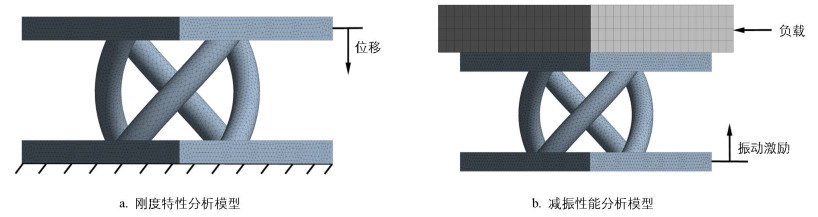
  • 本文通过建立减振结构的有限元模型分析螺旋杆结构参数对减振结构非线性刚度特性和减振性能的影响规律[21]。如图 4所示,首先,在SolidWorks 2021软件中进行几何建模,通过ANSYS静力学分析模块进行刚度特性分析,采用四面体单元对减振结构进行网格划分,网格依赖性分析收敛后共生成264 163个节点与174 325个单元结构。对结构底部6个自由度(3个旋转和3个平移)进行约束,顶部平面施加垂直位移且考虑几何非线性,求解顶部平面的反作用力。通过ANSYS瞬态结构模块分析减振性能,减振结构的网格划分方法与刚度特性分析模型一致,负载采用六面体单元划分网格(7 400个节点,1 444个单元),模型底部施加垂直振动激励,求解负载的激励响应。有限元模型的材料参数与几何参数如表 1所示(材料参数通过拉伸试验获取)。
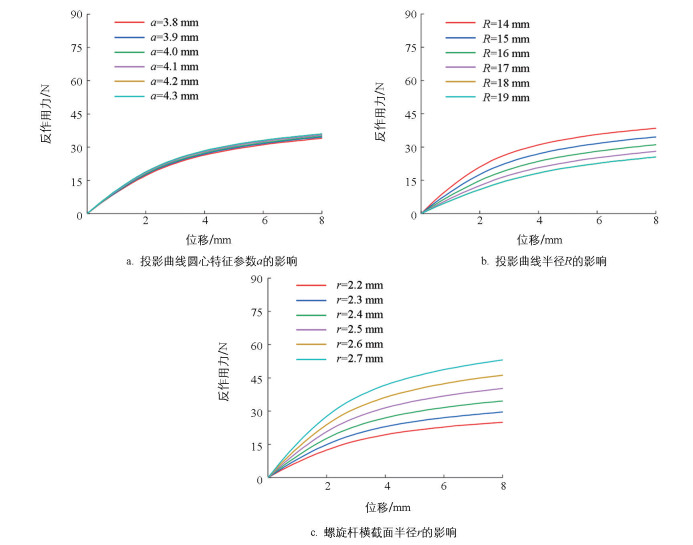
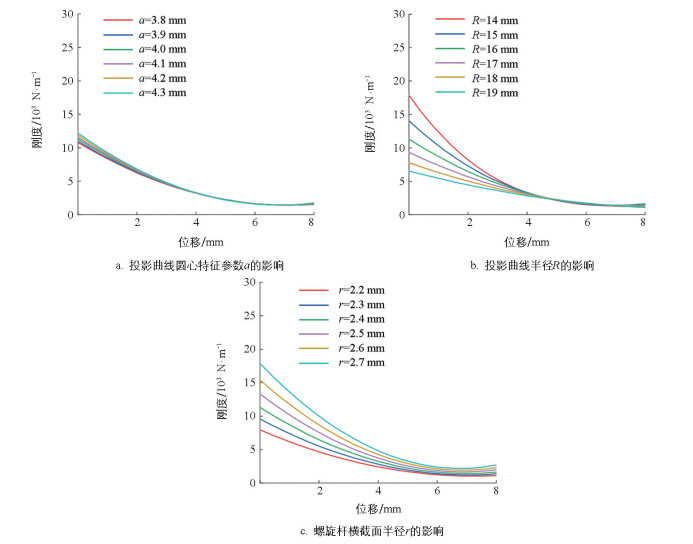
    通过刚度特性分析模型求解垂直位移对应的顶部平面反作用力,分析投影曲线圆心特征参数a、投影曲线半径R及螺旋杆横截面半径r对刚度的影响规律,结果如图 5图 6所示。减振结构呈现非线性刚度特性,当位移较小接近静态时,刚度较大并具有较好的静态承载能力;随着位移增大,刚度降低并具有减振能力。减小投影曲线半径R、增大投影曲线圆心特征参数a和螺旋杆横截面半径r,会使静态刚度增大从而增强承载能力。
    通过位移传递率评估非线性刚度结构的减振性能,结果如图 7所示。当位移传递率小于1时表明系统的振动开始衰减,由图 7可知,增大投影曲线圆心特征参数a、减小投影曲线半径R和螺旋杆横截面半径r可降低起始减振频率,意味着减振结构可以在更低的振动频率下发挥减振作用。然而,增大投影曲线圆心特征参数a、减小投影曲线半径R会增大减振结构在其减振频段的位移传递率,衰减振动能力降低。
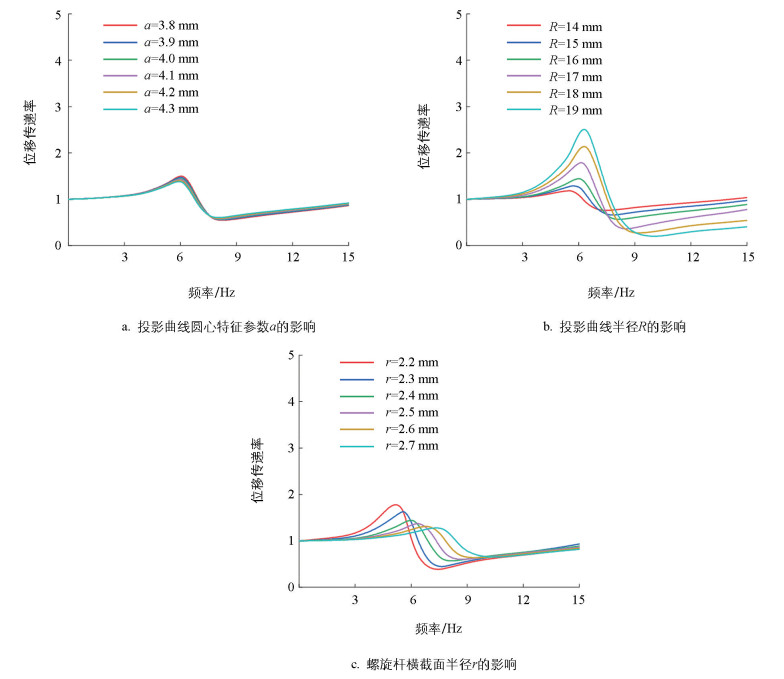
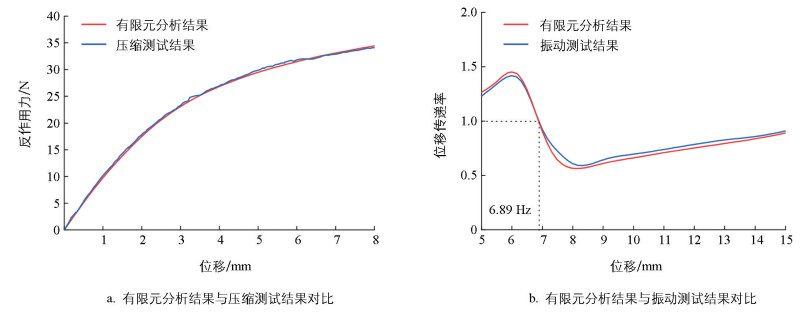
    上述结果显示,增大投影曲线圆心特征参数a、减小投影曲线半径R能够在提升承载能力的同时降低起始减振频率,但在减振频段内位移传递率增大,减振性能下降。减小螺旋杆横截面半径r虽能降低起始减振频率并兼顾一定的减振性能,但承载能力下降。基于此,在确保承载能力的前提下,为实现较低的起始减振频率和良好的减振性能,排种器非线性刚度减振结构的结构参数确定为a=4 mm、R=16 mm、r=2.4 mm,得到静态刚度为1.13×10⁴ N/m,起始减振频率为6.89 Hz。

    依据确定的结构参数试制减振结构样件并进行刚度特性和减振性能测试,如图 8所示。
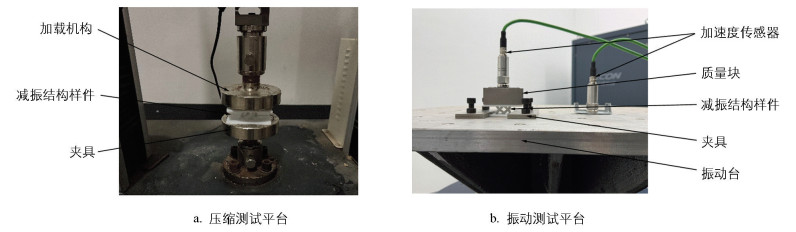
    使用Instron 3400万能试验机(最大加载力为300 kN,位移控制精度为±0.5%)对减振结构进行压缩测试,如图 8a所示。将试验样件用夹具进行固定,以2 mm/min进行准静态压缩,实时记录压力和位移数据,试验重复5次,确保结果准确,获取减振结构的反作用力-位移关系曲线。使用EDM-2000振动试验系统(额定频率为5~3 000 Hz)进行振动测试,如图 8b所示。在减振结构顶部固定一个1.55 kg的质量块模拟实际负载,并采用夹具将结构固定于振动台台面。利用VTall-T163E-A加速度传感器(采样频率为26.7 kHz)同步采集振动台激励信号与质量块响应信号。基于激励与响应数据计算不同频率下的位移传递率,绘制位移传递率曲线。

    图 9a表明,压缩测试结果与有限元分析结果相符。图 9b表明,当振动频率大于6.89 Hz时,位移传递率小于1,说明该减振结构的起始减振频率为6.89 Hz。
3.   田间试验
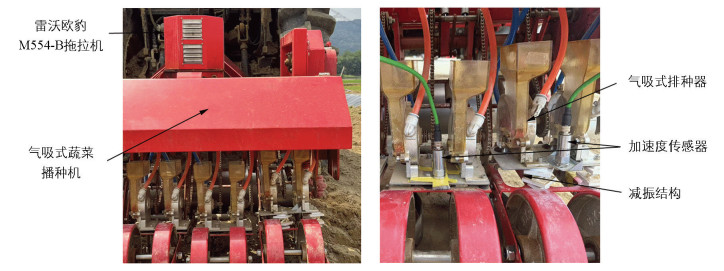
  • 将减振结构安装在气吸式蔬菜播种机上进行田间试验,如图 10所示。试验地点在广东省广州市增城区华南农业大学教学科研基地(23°14′32.69″N、113°38′14.46″E、海拔17.11 m)。根据蔬菜种植农艺规范,采用旋耕机对试验地块进行碎土起垄(垄宽1.1 m,垄高0.25 m),构建典型机械化播种场景。试验材料选用“49菜心”丸粒化包衣种子[22]。“49菜心”种子经丸粒化处理后在几何尺寸、质量、表面特性等方面具有良好的均匀性,考虑到小粒径包衣种子物理特性相近,在排种器内部的受力状态与运动规律具有较强的相似性。播种机采用雷沃欧豹M554-B拖拉机牵引,作业速度为3~7 km/h,以1 km/h作为间隔梯度。
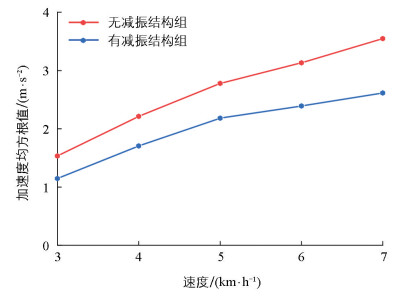
    试验包括振动试验与播种试验。在振动试验中,利用加速度传感器同步采集无减振结构与有减振结构的排种器振动信号,每个速度工况重复测试6次,单次采集时长为机具稳定作业的10 s,通过分析振动加速度均方根值,评估减振结构的减振性能,如图 11所示。结果表明:随着机具速度增加,排种器振动加速度均方根值呈上升趋势,而安装减振结构的排种器振动加速度均方根值较无减振结构组显著降低,降幅达21.47%~26.37%,表明减振结构有效地吸收了传递到排种器的振动能量,具有良好的减振性能。
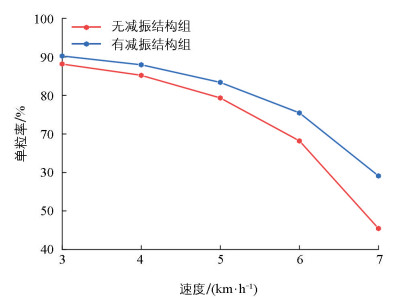
    在播种试验中,种子理论穴距为12 cm,根据《单粒(精密)播种机试验方法》(GB/T 6973—2005)[23],测定区段的最小长度应为30 m,通过拖拉机牵引播种机以稳定速度前进30 m,统计总吸种孔数和单粒穴数,重复3次取平均值,计算播种单粒率[22],评估减振结构对排种均匀性与稳定性的影响,如图 12所示。结果表明:未采取减振措施时,播种单粒率随速度增加由88.18%降至45.45%;采取减振措施后,播种单粒率降幅收窄,随速度增加由90.23%降至59.09%。3 km/h低速工况下播种单粒率提升2.05个百分点,7 km/h高速工况下提升幅度达13.64个百分点,且提升幅度随速度递增呈增长趋势,表明振动能量通过减振结构的衰减传递到排种器,降低了种子在排种盘上的吸附失效概率,提升了播种机排种均匀性与稳定性。
4.   结论
  • 针对田间作业中起伏地面引起排种器受迫振动导致排种均匀性与稳定性下降的问题,本文采用四螺旋杆连续体结构,设计排种器非线性刚度减振结构,通过分析螺旋杆横截面半径、投影曲线圆心及半径等参数对减振性能的影响,确定兼顾高承载能力和低频减振特性的高静-低动非线性刚度构件的结构特征尺寸,实现减振结构在排种器单体有限安装空间内的紧凑设计,减振结构的静态刚度为1.13×10⁴ N/m,起始减振频率为6.89 Hz。田间试验结果表明:在播种机3~7 km/h田间作业速度范围内,减振结构可降低21.47%~26.37%的振动加速度均方根值,且对于高速作业的减振效果尤为显著,播种单粒率提升2.05~13.64个百分点。

Figure (12)  Table (1) Reference (23)

Catalog

    /

    DownLoad:  Full-Size Img  PowerPoint
    Return
    Return