

Message Board

Dear readers, authors and reviewers,you can add a message on this page. We will reply to you as soon as possible!

2020 Volume 42 Issue 7
Article Contents

Wei ZHOU, Qiang WANG, Zhou-qing WU. FPGA Implementation of the Fractional-Order Simplified Lorenz System[J]. Journal of Southwest University Natural Science Edition, 2020, 42(7): 177-183. doi: 10.13718/j.cnki.xdzk.2020.07.018
Citation: Wei ZHOU, Qiang WANG, Zhou-qing WU. FPGA Implementation of the Fractional-Order Simplified Lorenz System[J]. Journal of Southwest University Natural Science Edition, 2020, 42(7): 177-183. doi: 10.13718/j.cnki.xdzk.2020.07.018

FPGA Implementation of the Fractional-Order Simplified Lorenz System

More Information
  • Received Date: 11/09/2018
    Available Online: 01/07/2020
  • MSC: TN914

  • At present, most of the researches on fractional-order chaotic systems are based on the DSP platform. However, due to the complexity of fractional-order chaotic systems, the implementation of DSP has the problem of slow sequence generation, so that it can only be applied to low-speed systems. To solve this problem, an FPGA (field programmable gate array) implementation of fractional-order simplified Lorenz system based on the definition of fractional-order differential Grunwald-Letnikov (GL) is studied and developed. Firstly, it is verified through the maximum Lyapunov exponent and the 0-1 test that the fractional-order simplified Lorenz system based on the GL definition is chaotic. Then, the FPGA implementation structure of the fractional-order simplified Lorenz system based on GL definition is analyzed in detail, and the system is implemented using a fixed-point number format. Finally, the FPGA output results observed through an oscilloscope are shown to be consistent with MATLAB simulation results, which further reveals the feasibility of the fractional-order chaotic system.
  • 加载中
  • [1] PODLUBNY I. Fractional Differential Equation [M]. New York: Academic Press, 1999.

    Google Scholar

    [2] MANDELBRT B B. The Fractal Geometry of Nature [M]. New York: Freeman, 1983.

    Google Scholar

    [3] 贾红艳, 陈增强, 薛薇.分数阶Lorenz系统的分析及电路实现[J].物理学报, 2013, 62(14): 48-54.

    Google Scholar

    [4] 陈向荣, 刘崇新, 王发强, 等.分数阶Liu混沌系统及其电路实验的研究与控制[J].物理学报, 2008, 57(3): 1416-1422.

    Google Scholar

    [5] 陈恒, 雷腾飞, 王震, 等.分数阶Chen混沌系统的动力学分析与电路实现[J].河北师范大学学报(自然科学版), 2015, 39(3): 208-215.

    Google Scholar

    [6] ANNABY M H, AYAD H, RUSHDI M A. On Security of Image CiphersBased on Logic Circuits and Chaotic Permutations [J]. Multimedia Tools and Applications, 2018, 77(16): 20455-20476.

    Google Scholar

    [7] 毛骁骁, 孙克辉, 刘文浩.基于分数阶统一混沌系统的图像加密算法[J].传感器与微系统, 2017, 36(6): 138-141.

    Google Scholar

    [8] 周平, 危丽佳, 程雪峰.一个分数阶混沌系统及其EWB仿真结果[J].西南大学学报(自然科学版), 2009, 31(1): 69-74.

    Google Scholar

    [9] ATAN O. Implementation and Simulation of Fractional Order Chaotic Circuits with Time-Delay [J]. Analog Integrated Circuitsand Signal Processing, 2018, 96(3): 485-494.

    Google Scholar

    [10] HE S B, SUN K H, WANG H H. Complexity Analysis and DSP Implementation of the Fractional-Order Lorenz Hyperchaotic System [J]. Entropy, 2015, 17(12): 8299-8311.

    Google Scholar

    [11] 雷腾飞, 王艳玲, 苏敏, 等.分数阶Qi混沌系统的动力学分析及DSP实现[J].温州大学学报(自然科学版), 2018, 39(1): 32-39.

    Google Scholar

    [12] ZHONG G Q, MAN K F, CHEN G R. A Systematic Approach to Generating N-scroll Attractors [J]. International Journal of Bifurcation and Chaos, 2002, 12(12): 2907-2915.

    Google Scholar

    [13] GOTTWALD G A, MELBOURNE I. ANew Test for Chaos in Deterministic Systems [J]. Proceedings of the Royal Society of London Series A: Mathematical, Physical and Engineering Sciences, 2004, 460(2042): 603-611.

    Google Scholar

    [14] GOTTWALD G A, MELBOURNE I. Testing for Chaos in Deterministic Systems with Noise [J]. Physica D Nonlinear Phenomena, 2004, 212(1): 100-110.

    Google Scholar

  • 加载中
通讯作者: 陈斌, bchen63@163.com
  • 1. 

    沈阳化工大学材料科学与工程学院 沈阳 110142

  1. 本站搜索
  2. 百度学术搜索
  3. 万方数据库搜索
  4. CNKI搜索

Figures(6)

Article Metrics

Article views(2951) PDF downloads(11) Cited by(0)

Access History

Other Articles By Authors

FPGA Implementation of the Fractional-Order Simplified Lorenz System

Abstract: At present, most of the researches on fractional-order chaotic systems are based on the DSP platform. However, due to the complexity of fractional-order chaotic systems, the implementation of DSP has the problem of slow sequence generation, so that it can only be applied to low-speed systems. To solve this problem, an FPGA (field programmable gate array) implementation of fractional-order simplified Lorenz system based on the definition of fractional-order differential Grunwald-Letnikov (GL) is studied and developed. Firstly, it is verified through the maximum Lyapunov exponent and the 0-1 test that the fractional-order simplified Lorenz system based on the GL definition is chaotic. Then, the FPGA implementation structure of the fractional-order simplified Lorenz system based on GL definition is analyzed in detail, and the system is implemented using a fixed-point number format. Finally, the FPGA output results observed through an oscilloscope are shown to be consistent with MATLAB simulation results, which further reveals the feasibility of the fractional-order chaotic system.

  • 分数阶微积分与牛顿莱布尼茨整数阶微积分几乎是同时代被提出,最早可以追溯到Leibniz和Newton提出微积分学的时代,至今已经有300多年的历史.由于当时社会条件的限制,分数阶微积分在相当长的一段时间内并没有取得较显著的成果[1].近几十年来,随着非线性动力学理论的发展,混沌动力学理论的研究也随之发展和完善,从而使得分数阶混沌系统的探讨与研究已成为新的研究领域[2].在分数阶混沌系统的研究中,主要是在经典的混沌系统基础上,引入分数阶微积分算子,如分数阶Lorenz系统[3]、分数阶Liu系统[4]、分数阶Chen系统[5]等.

    混沌系统具有伪随机性、初值敏感性等特征,非常适合应用于密码学领域[6].分数阶混沌系统在混沌系统的基础上,由于具有记忆性,产生的序列伪随机特性更好,在密码学领域与混沌系统相比具有更大的优势[7].电路的实现是分数阶混沌系统应用的基础,目前的实现方法主要有2种:①模拟电路[8-9],②数字电路[10-11].模拟电路由于易受环境、器件老化等影响且电路参数离散性较大、通用性差,从而限制了它的实际应用[12].而数字电路可以很好地解决模拟电路的这些问题.目前,分数阶混沌系统的数字电路实现大多数用DSP实现[10-11],但是由于分数阶混沌系统的复杂度较大,用DSP实现序列的生成速度较慢,只能应用于对速度要求不高的系统. FPGA具有速度快、并行处理等特性,为了提高分数阶混沌系统的性能,可以用FPGA实现.

    分数阶微积分的定义有多种,Grunwald-Letnikov(GL)定义,一次迭代计算没有子迭代过程,并行度较高,非常适合用FPGA实现.本文以分数阶简化Lorenz混沌系统为研究对象,采用GL定义离散化系统,先通过最大Lyapunov指数和0~1测试验证了系统的阶数为分数时系统是混沌状态,然后详细介绍了分数阶混沌系统的FPGA实现.

1.   分数阶简化Lorenz混沌系统
  • 分数阶简化Lorenz混沌系统如系统(1)

    利用分数阶微积分GL定义和短记忆规则,系统(1)可写为离散形式,如系统(2)

    其中,a为系统参数,h为系统离散化取样时间,h=0.001 s,q是系统分数阶阶数,L是短记忆长度,Cj(α)为二项式系数,其迭代公式为

    短记忆规则的长度L可以通过式(4)确定,

    其中,M是系统状态变量的最大值,ε是采用短记忆规则后产生的误差,Γ(·)是gamma函数.式(4)中的M由MATLAB仿真可得,M=20,当误差ε=0.008时,根据式(4),可得L近似值为60.

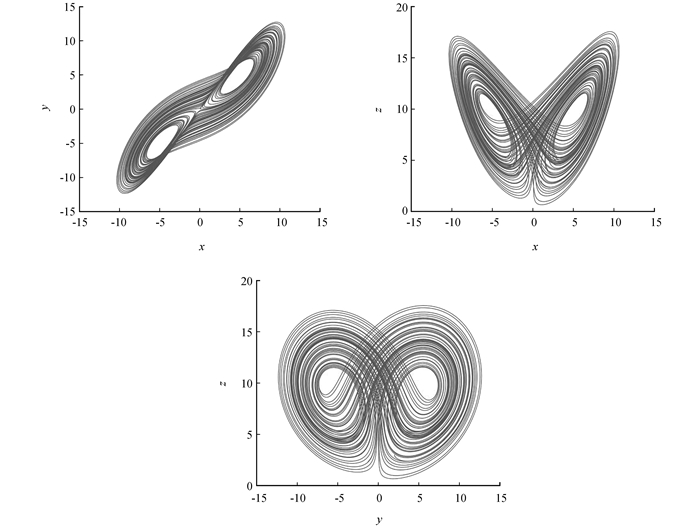
    当初值为[1, 2, 3]a=5,q=0.98时,分数阶Lorenz混沌系统最大Lyapunov指数为0.9,最大Lyapunov指数大于零,所以此时系统是混沌的,其吸引子相图如图 1所示.
2.   最大Lyapunov指数和0~1测试
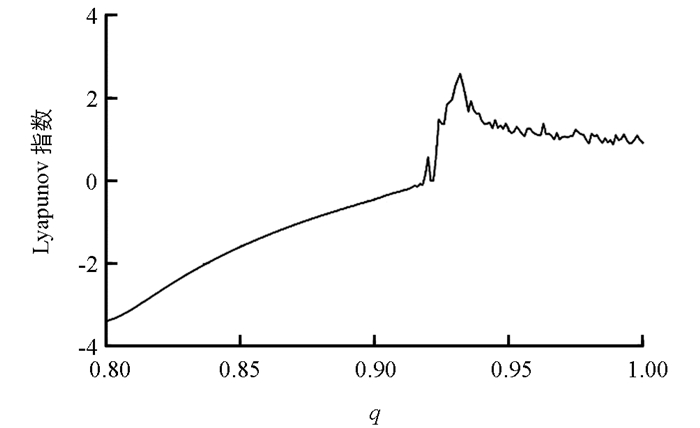
  • 为了验证系统(2)是混沌系统,可以通过MATLAB仿真求该系统的最大Lyapunov指数来验证.当初值为[1, 2, 3]a=5时,系统(2)随分数阶阶数q变化的最大Lyapunov指数谱如图 2所示.从图 2可知,当q∈(0.92,1.00]时,系统最大Lyapunov指数大于零,表明此时系统为混沌状态.
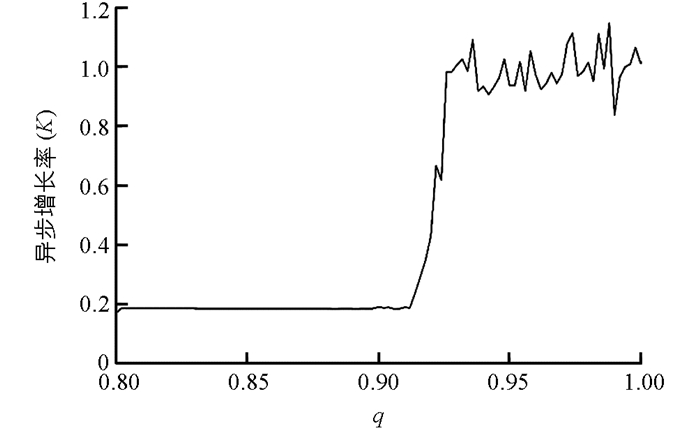
    文献[13]和文献[14]提出了另一种可靠且有效的检验系统是否为混沌的二进制测试方法,称为“0~1测试”,基本思想是为数据建立一个随机动态过程,然后研究该随机过程的规模是如何随着时间推移而变化的.该方法最后是求得数据的异步增长率K,当K接近于0时,运动是规则的(周期的或伪周期的);当K接近于1时,运动是混沌的.利用该方法对分数阶简化Lorenz系统产生的序列进行研究,当初值为[1, 2, 3]a=5时,系统(2)随分数阶阶数q变化的异步增长率如图 3所示.从图 3可知,当q∈(0.92,1.00]时,K接近1,为混沌状态,进一步证明了系统在q∈(0.92,1.00]时是混沌的.
3.   分数阶简化Lorenz系统的FPGA实现
  • 根据系统(2)可以算出分数阶简化Lorenz系统在记忆长度L=60时,进行一次迭代运算需要187次乘法运算和184次加减法运算,计算复杂度非常大.如果用一般的微处理器,由于不具有并行性,产生一个数据输出的延时较大,系统性能不高,不适合速度较高的应用场合. FPGA是一种半定制专用集成电路,内部具有丰富的逻辑资源,可以实现真正的并行性.每个独立的处理任务都配有专用的芯片部分,能在不受其他逻辑块的影响下自主运作,添加更多处理任务时不会影响其他应用性能,非常适合复杂数字系统的实现.因此FPGA非常适合分数阶简化Lorenz系统的实现.

    在FPGA中数据格式有浮点格式和定点格式2种.浮点格式的计算精度高于定点格式,不会有数据溢出,但是消耗的FPGA资源远远大于定点格式,并且一次计算需要几个时钟周期;而定点格式的计算一个时钟周期就可以完成.所以,在工程中往往采用定点格式.

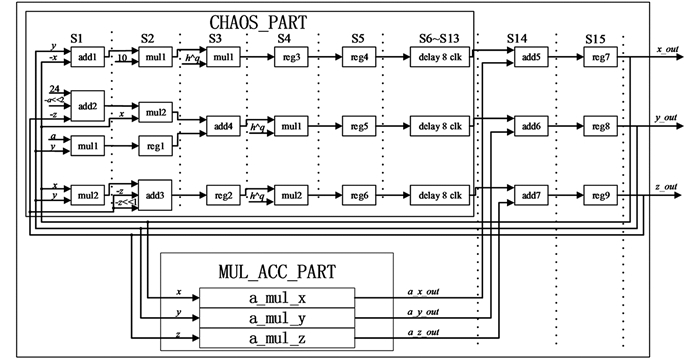
    分数阶简化Lorenz系统的FPGA结构如图 4所示,其中“≪”表示左移,add1-add7为定点数加法运算单元,mul1和mul2为定点数乘法运算知识产权(Intellectual Property,IP)核,reg1-reg9为寄存器.本文中定点数的位宽为35 bit,整数部分为15 bit,小数部分为20 bit. FPGA模块简图主要分为CHAOS_PART和MUL_ACC_PART两个模块,CHAOS_PART计算分数阶简化Lorenz混沌系统的$[10(y(n) - x(n))]{h^q}, [(24 - 4a)x(n) - x(n)z(n) + ay(n)]{h^q}{\rm{和}}[x(n)y(n) - 3z(n)]{h^q}$部分,MUL_ACC_PART计算分数阶简化Lorenz系统的$\sum\limits_{j = 1}^L {C_j^q} x(n - j), \sum\limits_{j = 1}^L {C_j^q} y(n - j){\rm{和}}\sum\limits_{j = 1}^L {C_j^q} z(n - j)$部分.整个模块的实现需要5个always块,一个always块进行状态机状态的转移,一个always块实现CHAOS_PART模块,另外3个always块实现MUL_ACC_PART模块. MUL_ACC_PART模块的a_mul_x,a_mul_y和a_mul_z分别对应一个always块,并且具有相同的结构.状态机总共有15个状态,分别是S1-S15. 图 4中虚线分隔的区域对应每个状态处理的任务,CHAOS_PART模块的计算实际上在S5状态时就已经完成,但是MUL_ACC_PART模块需要13个状态才能完成,所以CHAOS_PART模块需要等待8个状态才能保证时序上对齐,使计算正确.由于CHAOS_PART模块计算时间较充裕,为了减少硬件开销,只使用2个乘法器IP核,分时复用.
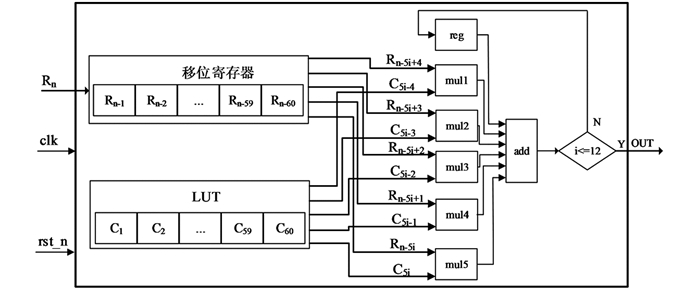
    MUL_ACC_PART模块的FPGA结构如图 5所示,该模块由移位寄存器、查找表(Look up Table,LUT)和乘累加器3个部分组成.由于记忆长度L=60,所以移位寄存器和LUT的长度都为60.移位寄存器每一个寄存器的宽度为35 bit,状态机每执行1次,移位寄存器右移1次,即移入最新的计算结果,移出最老的数据. LUT存储的是式(2)的二项式系数,为常数.乘累加器由5个乘法器IP核组成,分时复用,i表示第几个状态,每一个状态从移位寄存器和LUT中取出5个数进行计算,若没有到S12状态,则将计算的和保存到寄存器用于下一次计算求和,S13状态计算最后一次的和并且输出计算结果. S14状态计算CHAOS_PART和MUL_ACC_PART输出的和;S15状态缓存结果,并且将结果回传,用于下一次计算.
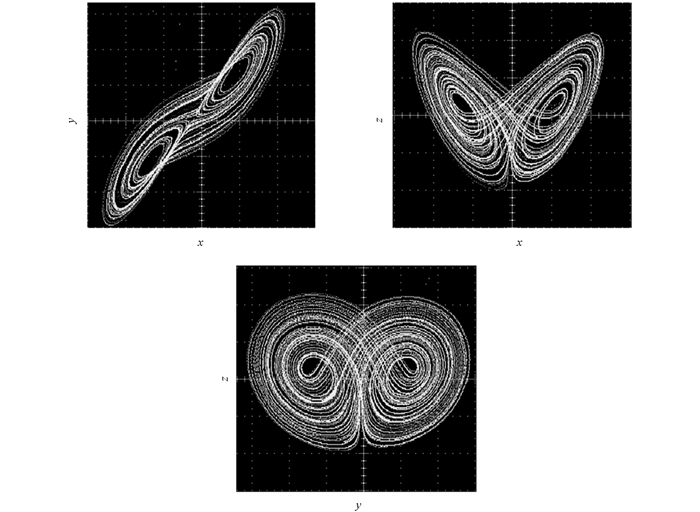
    实验用的FPGA开发板的芯片为Xilinx公司生产的,型号为xc7z020clg400.由于FPGA输出为数字信号,为了用示波器观察实验输出,需要通过数模转换器将数字信号转换为模拟信号.数模转换器型号为AD9767,是一款双口并行最高转换速率为125 MHz的数模转换器.开发软件为VIVADO,根据图 4图 5用VERILOG硬件编程语言编写程序,编译成功后将生成的bin文件下载到FPGA内,通过数模转换器获得连续的模拟信号,使用型号为DPO4102B-L的示波器捕捉到分数阶简化Lorenz系统的混沌相图如图 6所示,实验结果与MATLAB的仿真结果一致,表明该系统可实现.
4.   结语
  • 本文利用GL定义和短记忆规则,先通过MATLAB仿真分析了分数阶简化Lorenz系统的相图和最大Lyapunov指数,并且进行了0~1测试.最大Lyapunov指数和0~1测试都验证了系统分数阶阶数在0.92~1.00时是混沌的.本文还详细介绍了CHAOS_PART和MUL_ACC_PART两个模块,并用FPGA实现了该系统.在示波器上获得了相应的混沌吸引子,验证了基于GL定义的分数阶简化Lorenz系统的硬件可实现性.

Figure (6)  Reference (14)

Catalog

    /

    DownLoad:  Full-Size Img  PowerPoint
    Return
    Return