
Message Board

Dear readers, authors and reviewers,you can add a message on this page. We will reply to you as soon as possible!

2026 Volume 5 Issue 1
Article Contents

LIN Jieying, CUI Yiping, HUANG Feng, et al. Identification of the Pathogen Causing White Scaled Blotch of Citrus × limon Fruit in Guangdong[J]. PLANT HEALTH AND MEDICINE, 2026, 5(1): 51-56. doi: 10.13718/j.cnki.zwyx.2026.01.005
Citation: LIN Jieying, CUI Yiping, HUANG Feng, et al. Identification of the Pathogen Causing White Scaled Blotch of Citrus × limon Fruit in Guangdong[J]. PLANT HEALTH AND MEDICINE, 2026, 5(1): 51-56. doi: 10.13718/j.cnki.zwyx.2026.01.005

Identification of the Pathogen Causing White Scaled Blotch of Citrus × limon Fruit in Guangdong

More Information
  • Corresponding author: SONG Xiaobing
  • Received Date: 12/09/2025
    Available Online: 25/02/2026
  • MSC: S476.1

  • To determine the types of pathogenic fungus of causing suspected white peel disease on the fruits of the Citrus × limon in Guangdong Province, isolated and identification the diseased fruits were collected by using the conventional tissue isolation method. Based on the phylogenetic analysis jointly constructed from the ITS, LSU and TUB2 gene sequences, the results showed that the NM005 strain isolated from Citrus × limon fruits clustered with Didymella americana on an evolutionary branch, with a support rate of 82% on the maximum likelihood phylogenetic tree and 88% on the MrBayes phylogenetic tree. At the same time, the path ogenicity of the isolates was determined according to Koch's rule, and the result showed that this strain could cause diseases in healthy fruits, and the symptoms were similar to those in the field. The strains re-isolated from the inoculated diseased fruits were consistent with the morphological characteristics of the inoculated fungi, indicating that the original isolated fungus were the pathogenic fungi causing white peel disease on Citrus × limon fruits. Through morphological and molecular biological identification, the isolated strain was identificated to be Didymella americana. The results of this study provide a theoretical basis for the field control of white peel disease on Citrus × limon fruits and ensures the healthy development of the perfume lemon industry.

  • 加载中
  • [1] 张树伟. 香水柠檬无籽成因和相关基因的分离与鉴定[D]. 南宁: 广西大学, 2014.

    Google Scholar

    [2] 郗艳丽, 周旋, 霍明洋, 等. 香水柠檬果皮绿色素提取工艺及其稳定性研究[J]. 食品研究与开发, 2019, 40(1): 91-98.

    Google Scholar

    [3] HU G H, ZHENG Y Y, LIU C, et al. First Report of Didymella americana Causing Corn Stalk Rot in China[J]. Plant Disease, 2021, 105(4): 1220.

    Google Scholar

    [4] GORNY A M, KIKKERT J R, SHIVAS R G, et al. First Report of Didymella americana on Baby Lima Bean (Phaseolus Lunatus)[J]. Canadian Journal of Plant Pathology, 2016, 38(3): 389-394. doi: 10.1080/07060661.2016.1195877

    CrossRef Google Scholar

    [5] LUO X X, HU Y F, XIA J W, et al. Morphological and Phylogenetic Analyses Reveal Three New Species of Didymella (Didymellaceae, Pleosporales) from Jiangxi, China[J]. Journal of Fungi, 2024, 10(1): 75. doi: 10.3390/jof10010075

    CrossRef Google Scholar

    [6] 林接英, 吴浩芳, 麦章龙, 等. 澳洲石斛疫病病原菌的鉴定及其杀菌剂毒力测定[J]. 热带作物学报, 2024, 45(3): 614-621.

    Google Scholar

    [7] 张亚鑫, 肖婉, 张峥, 等. 稻田稗属杂草致病菌的分离与鉴定[J]. 中国生物防治学报, 2021, 37(6): 1276-1287.

    Google Scholar

    [8] SUN W M, FENG L N, WEN X L, et al. First Report of Leaf Spot Caused by Didymella americana on Cassia Nomame in China[J]. Plant Disease, 2022, 106(4): 1304.

    Google Scholar

    [9] 刘佳奇. 高寒草地披碱草亚隔孢壳科叶斑病的病原鉴定及杀菌剂筛选[D]. 兰州: 兰州大学, 2023.

    Google Scholar

    [10] 杨远桥. 贵州省果树主要真菌性病害真菌鉴定及系统学分析[D]. 贵阳: 贵州大学, 2023.

    Google Scholar

    [11] 郑放, 李磊, 刘瑶丹, 等. 柑橘果面白癞病病原鉴定[J]. 植物病理学报, 2024, 54(3): 674-678.

    Google Scholar

  • 加载中
通讯作者: 陈斌, bchen63@163.com
  • 1. 

    沈阳化工大学材料科学与工程学院 沈阳 110142

  1. 本站搜索
  2. 百度学术搜索
  3. 万方数据库搜索
  4. CNKI搜索

Figures(3)  /  Tables(1)

Article Metrics

Article views(284) PDF downloads(45) Cited by(0)

Access History

Identification of the Pathogen Causing White Scaled Blotch of Citrus × limon Fruit in Guangdong

    Corresponding author: SONG Xiaobing

Abstract: 

To determine the types of pathogenic fungus of causing suspected white peel disease on the fruits of the Citrus × limon in Guangdong Province, isolated and identification the diseased fruits were collected by using the conventional tissue isolation method. Based on the phylogenetic analysis jointly constructed from the ITS, LSU and TUB2 gene sequences, the results showed that the NM005 strain isolated from Citrus × limon fruits clustered with Didymella americana on an evolutionary branch, with a support rate of 82% on the maximum likelihood phylogenetic tree and 88% on the MrBayes phylogenetic tree. At the same time, the path ogenicity of the isolates was determined according to Koch's rule, and the result showed that this strain could cause diseases in healthy fruits, and the symptoms were similar to those in the field. The strains re-isolated from the inoculated diseased fruits were consistent with the morphological characteristics of the inoculated fungi, indicating that the original isolated fungus were the pathogenic fungi causing white peel disease on Citrus × limon fruits. Through morphological and molecular biological identification, the isolated strain was identificated to be Didymella americana. The results of this study provide a theoretical basis for the field control of white peel disease on Citrus × limon fruits and ensures the healthy development of the perfume lemon industry.

  • 开放科学(资源服务)标识码(OSID):

  • 香水柠檬(Citrus × limon ‘Rosso’)是一种重要的经济作物,属芸香科柑橘属常绿小乔木,果实长圆形,无核,在我国台湾、广东、云南等地均有种植。因其具有香气独特、营养价值高,且完全没有酸涩味道,故被称为“香水柠檬”[1-2]

    近年来,随着香水柠檬的种植面积不断扩大,病虫害问题日益严重。作为一种重要的经济作物,其果实品质直接影响产业发展。近年来,一种在香水柠檬果实上出现的病害暴发成灾,表现为果实表面出现灰白色且粗糙的痂皮状病斑,逐渐扩大直至布满果面,导致果实外观和品质严重下降,口感和营养价值也受到影响,严重影响了果实的商品价值。加之引发该病害的病原菌未得到明确鉴定,导致病害防控缺乏针对性。本研究旨在明确引起该病害的病原菌,以便采取有效的防治措施,为后续病害防治提供科学依据。

1.   材料与方法
  • 马铃薯琼脂培养基(PDA)为广东环凯微生物科技有限公司产品;燕麦琼脂(OA)为上海保藏微生物有限公司产品;麦芽浸粉琼脂培养基(MEA)为青岛高科技工业园海博生物技术有限公司产品。

  • 柠檬果实采自广东省农业科学院植物保护研究所大丰试验基地,从香水柠檬果树上采集具有典型病害症状的果实,观察并记录病害症状及特征。

    采用常规组织分离法分离,取患病果实表皮,切成小块,消毒晾干后移至PDA平板上,于25 ℃恒温培养[3]。5 d后,采用顶端菌丝法对其进行纯化。待菌落长出后,切取边缘菌丝移至新的PDA平板上培养1~2 d后,再次切取边缘菌丝至新的PDA培养基,重复以上操作,直至获得单一菌株,分别于4 ℃和-80 ℃条件下保存备用。

  • 将纯化后的病原菌分别接种至PDA、OA和MEA培养基上,置于27 ℃培养箱中培养5~10 d,观察并记录菌落特征及颜色[4]。待OA平板上的菌落培养至表面长出黑色物质,挑取少量黑色物质至载玻片上,盖上盖玻片,置于光学显微镜上观察其显微形态。

  • 将纯化菌接种至PDA培养基,于27 ℃培养箱中培养4 d,采用SteadyPure植物组DNA提取试剂盒(艾科瑞生物公司产品)提取菌株基因组DNA,以提取的DNA为模板,使用ITS(ITS1/ITS4)、LSU(LSU-LR0R/LSU-LR7)、TUB2(Bt2a/Bt2b)3对引物对该DNA进行PCR扩增[5]

  • 参考Luo等[5]的系统发育树,从NCBI下载相关序列,而后在MAFFT网站(https://mafft.cbrc.jp/)进行序列比对,采用BioEdit软件进行序列剪切,以Epicoccum camelliae(CGMCC 3.18343)作为外群,在CIPRES网站(http://www.phylo.org/)采用两种方法构建系统发育树[5-6],即基于RAxML-HPC2 on XSEDE (v8.2.8)的最大似然法(Maximum Likehood,ML)和基于MrBayes on XSEDE(v3.2.7a)的贝叶斯推断法(Bayesian Inference,BI)。

  • 采用离体刺伤接种法和离体无伤接种法进行致病性测定。将备用菌株置于PDA平板上培养3~5 d,用直径6 mm的打孔器打出菌饼备用。

    离体刺伤接种法:使用无菌牙签在健康的柠檬果实表面以五点法方式打孔,造成伤口,将菌饼的菌丝面贴于伤口处;离体无伤接种法:将菌饼的菌丝面贴于健康的柠檬果实表面。以接种无菌的PDA作为对照,每个处理接种3个果实。接种后的果实放置保鲜盒中,于25 ℃温室中保湿培养,观察并记录发病情况。根据柯赫氏法则,对发病的柠檬果实进行再分离培养,观察分离得到的菌株与接种菌株的形态是否一致。

2.   结果与分析
  • 染病果实表皮颜色异常、质地粗糙。初期出现半透明的不规则病斑,而后病斑逐渐扩大,颜色逐渐加深,变成灰白色,果面呈现出具有粗糙感的痂皮症状,后期从边缘开始出现棕色或浅褐色痂皮,严重影响果实外观和品质(图 1a~1b)。
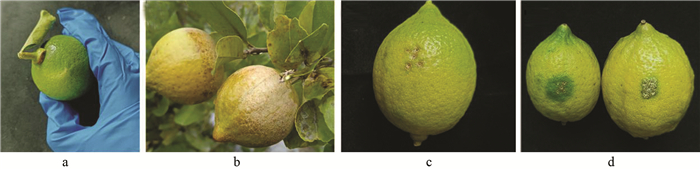
    接种病原菌的果实在接种7 d后呈现出染病症状,果实接种部位初期出现白色半透明的光滑病斑,而后病斑扩大,颜色变成灰白色,质地逐渐粗糙,呈现与田间相似的发病症状(图 1c~1d)。

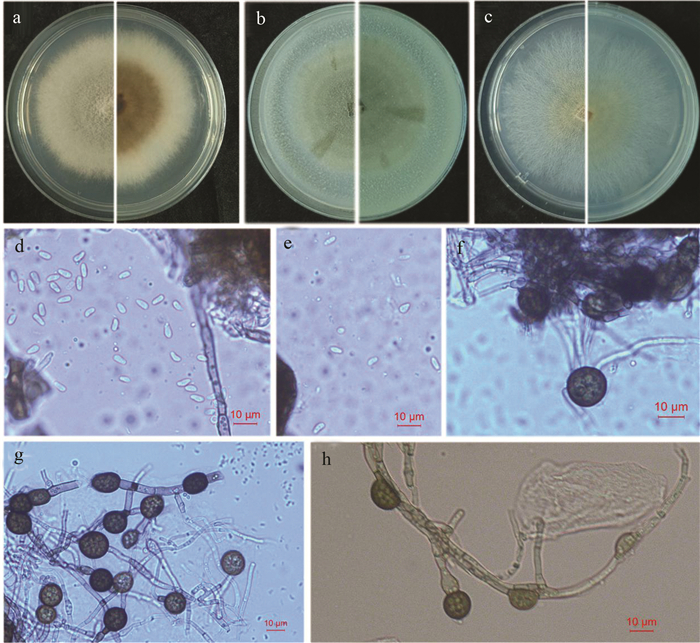
  • 在PDA培养基上NM005菌株,菌落呈圆形(图 2a),正面最初为白色,而后菌落逐渐变成灰白色,且菌丝浓密。背面形似两个同心圆,边缘规则,呈灰白色,中间呈棕褐色;在OA培养基上菌落呈轮纹状(图 2b),由外向内颜色由灰白色逐渐变成褐色,部分位置后期变成黑色;在MEA培养基上,菌落呈轮纹状(图 2c),菌丝稀疏,菌落颜色由外向内由白色变成淡黄色。在OA培养基上培养7 d,菌落长出黑色硬质点状物质和黑色菌丝。挑取黑色硬质点状物质至显微镜下观察,可看到分生孢子,分生孢子呈椭圆形或橄榄球形,无色,大小为1.79 μm×4.37 μm至3.55 μm×6.72 μm(n=35)(图 2d~2e);挑取黑色菌丝至显微镜下观察,可看到厚垣孢子,厚垣孢子散生、间生或顶生,多为单个圆形,黑色或褐色,直径为10.60~16.35 μm(n=35),少量椭圆形或梨形,偶有两个或两个以上粘连的情况(图 2f~2h)。
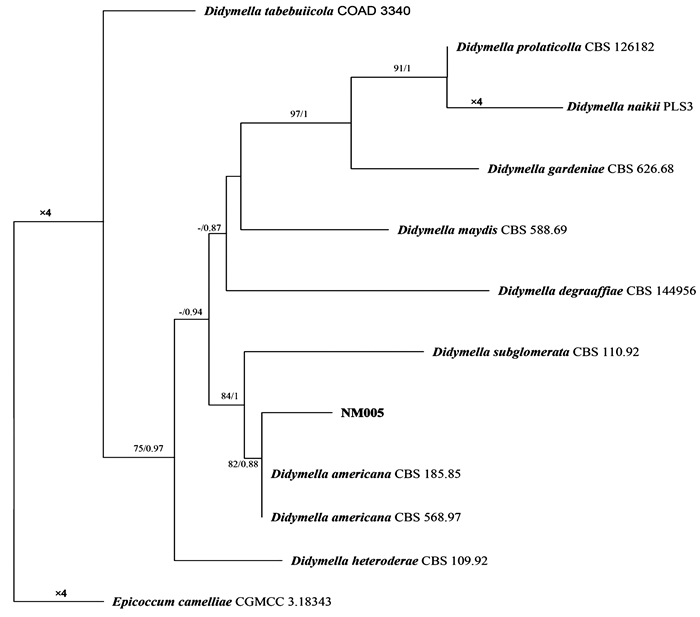
  • 使用ITS(引物ITS1/ITS4)、LSU(引物LSU-LR0R/LSU-LR7)、TUB2(引物Bt2a/Bt2b) 3对引物对NM005菌株的DNA进行PCR扩增,利用NCBI上下载的菌株序列(表 1)与NM005菌株序列,基于ITSLSUTUB2基因序列以最大似然法构建系统发育树,结果显示,NM005菌株与Didymella americana聚在一支,其亲缘关系最近,支持率为82%。基于贝叶斯法构建的系统发育树同样表明,NM005菌株与D. americana聚在同一分支,支持率为88%,因此,将NM005鉴定为D. americana(图 3)。
3.   讨论
  • 在形态学观察的基础上,结合系统发育树分析,将引起广东省柠檬果实白皮病的病原菌鉴定为Didymella americana[7-8]Didymella属真菌是一类常见的植物病原菌,可侵染多种植物并引发病害。张亚鑫等[7]在稗草属杂草致病菌中发现D. americana。刘佳琦[9]在对高寒地区披碱草(Elymus spp.)亚隔孢壳科叶斑病病原菌的研究中发现,其病原菌包括D. boeremae。杨远桥[10]在果腐病的研究中发现Didymella属真菌的存在。在广东省香水柠檬中发现病原菌D. americana,丰富了Didymella属真菌的寄主范围。

    柑橘与香水柠檬同属芸香科柑橘属,柑橘果面白癞病的研究对香水柠檬果实白皮病的研究具有一定的参考价值[11]。柠檬果实白皮病与柑橘果面白癞病存在相似之处,两者均为果面病害,都会出现灰白色病斑;其不同在于,香水柠檬果实白皮病病原菌为Didymella americana,柑橘白癞病病原菌为Zasmidium fructicola,二者为不同的真菌类群。在症状上柠檬果实白皮病发病初期为半透明的不规则病斑,随后出现灰白色粗糙的痂皮症状,后期病斑边缘有棕色或浅褐色痂皮出现;柑橘白癞病初期果面产生黑色油腻状霉斑,并伴随细线状开裂,而后病斑变为灰白色或灰褐色,最后病斑呈灰白色痂皮状、银屑状或牛皮藓状,边缘具黑褐色油墨状霉层[11]。通过对比这两种病害,有助于深入了解香水柠檬果实白皮病的发生机制,为病害防治提供新思路。

    香水柠檬果实白皮病的病原菌被鉴定为D. americana,其侵染机制和致病过程需进一步深入研究。此外,不同病原菌引起的病害需要根据病原菌的特性和病害发生特点来制定相应的防治方案,因此,针对该病原菌的特效防治药剂筛选也是今后研究的重点方向之一。

4.   结论
  • 本研究首次明确引起广东省香水柠檬果实白皮病的病原菌为Didymella americana。该结果丰富了Didymella属真菌的寄主范围,为香水柠檬病害防治提供了理论依据,有助于减轻病害对香水柠檬产业的危害,提升香水柠檬的产量和品质。在未来的研究中,可进一步深入探讨该病原菌的生物学特性、致病机制及其与寄主互作的机制,并研发相关防治技术,为香水柠檬产业的可持续发展提供更有力的支持。

Figure (3)  Table (1) Reference (11)

Catalog

    /

    DownLoad:  Full-Size Img  PowerPoint
    Return
    Return