

Message Board

Dear readers, authors and reviewers,you can add a message on this page. We will reply to you as soon as possible!

2025 Volume 47 Issue 10
Article Contents

CHENG Yujiao, YANG Feiyang, HU Guowei, et al. Effect of Dissolved Oxygen on Storage Flavor Quality of Thermal Sterilized Orange Juice[J]. Journal of Southwest University Natural Science Edition, 2025, 47(10): 27-38. doi: 10.13718/j.cnki.xdzk.2025.10.003
Citation: CHENG Yujiao, YANG Feiyang, HU Guowei, et al. Effect of Dissolved Oxygen on Storage Flavor Quality of Thermal Sterilized Orange Juice[J]. Journal of Southwest University Natural Science Edition, 2025, 47(10): 27-38. doi: 10.13718/j.cnki.xdzk.2025.10.003

Effect of Dissolved Oxygen on Storage Flavor Quality of Thermal Sterilized Orange Juice

More Information
  • Corresponding author: HUANG Linhua
  • Received Date: 31/10/2024
    Available Online: 20/10/2025
  • MSC: TS255.44;S666

  • Orange juice with different dissolved oxygen contents was studied. Solid phase microextraction combined with gas chromatography-mass spectrometry/pulsed flame photometric detector was used for qualitative and quantitative analysis to establish the correlation between volatiles, and to explore the effect of dissolved oxygen content on the flavor quality of orange juice after thermal sterilization during 30 days of storage. The results showed that the dissolved oxygen content in the orange juice of the CK group showed a decreasing trend within 18 days of storage(p < 0.05). A total of 68 volatiles, including 7 volatile sulfur compounds, were identified in orange juice from different treatment groups. At the end of storage, the kinds and contents of volatiles in CK group were lower than those in DEO group. During storage, the contents of limonene and linalool were negatively correlated with α-terpinol content, and the differences were significant (p < 0.05). Forty flavor active components were screened by odor activity values. Dissolved oxygen promoted the production of odor components (α-terpineol, 4-terpineol and dimethyl sulfide) and the loss of aroma (β-myrcene, limonene, geraniol, decanol). Deoxygen group improved the odor of cooked potato (methional) in orange juice. 14 markers related to the flavor quality changes of orange juice during storage were screened out by orthogonal partial least square discriminant analysis combined with the importance of variable projection.

  • 加载中
  • [1] 古广文, 桑文, 林捷新, 等. 梅州市柑桔黄龙病防控实践与思考[J]. 植物医学, 2023, 2(5): 71-79.

    Google Scholar

    [2] USDA. Citrus: World Markets and Trade [Z] //AGRICULTURE U S D O. United States Department of Agriculture. 2024.

    Google Scholar

    [3] FENG S, SUH J H, GMITTER F G, et al. Differentiation between Flavors of Sweet Orange (Citrus sinensis) and Mandarin (Citrus reticulata) [J]. Journal of Agricultural and Food Chemistry, 2018, 66(1): 203-211. doi: 10.1021/acs.jafc.7b04968

    CrossRef Google Scholar

    [4] BAZEMORE R, GOODNER K, ROUSEFF R. Volatiles from Unpasteurized and Excessively Heated Orange Juice Analyzed with Solid Phase Microextraction and GC-Olfactometry [J]. Journal of Food Science, 1999, 64(5): 800-803. doi: 10.1111/j.1365-2621.1999.tb15915.x

    CrossRef Google Scholar

    [5] PEREZ-CACHO P R, ROUSEFF R. Processing and Storage Effects on Orange Juice Aroma: A Review [J]. Journal of Agricultural and Food Chemistry, 2008, 56(21): 9785-9796. doi: 10.1021/jf801244j

    CrossRef Google Scholar

    [6] LI X, REN J N, FAN G, et al. Changes of Aroma Compounds and Qualities of Freshly-Squeezed Orange Juice during Storage [J]. Journal of Food Science and Technology, 2018, 55(11): 4530-4543. doi: 10.1007/s13197-018-3389-2

    CrossRef Google Scholar

    [7] 蔡德萍. NFC橙汁加工贮藏过程中溶解氧对其品质的影响[D]. 重庆: 西南大学, 2020.

    Google Scholar

    [8] 李维. 溶氧量对超高压处理荔枝混合果汁贮藏特性的影响[D]. 广州: 华南农业大学, 2018.

    Google Scholar

    [9] 罗昱. 刺梨果汁褐变与风味调控研究[D]. 贵阳: 贵州大学, 2015.

    Google Scholar

    [10] CHENG Y J, ROUSEFF R, LI G J, et al. Methanethiol, an Off-Flavor Produced from the Thermal Treatment of Mandarin Juices: A Study of Citrus Sulfur Volatiles [J]. Journal of Agricultural and Food Chemistry, 2020, 68(4): 1030-1037. doi: 10.1021/acs.jafc.9b06647

    CrossRef Google Scholar

    [11] 程玉娇. 宽皮柑橘果汁中挥发性硫化物和风味活性组分研究[D]. 重庆: 西南大学, 2020.

    Google Scholar

    [12] CHENG Y J, LI G J, WU H J, et al. Identification of Light-Induced Key Off-Flavors in Ponkan Mandarin Juice Using MDGC-MS/O and GC-MS/PFPD [J]. Journal of Agricultural and Food Chemistry, 2021, 69(47): 14259-14269. doi: 10.1021/acs.jafc.1c05465

    CrossRef Google Scholar

    [13] RUIZ PEREZ-CACHOP, MAHATTANATAWEE K, SMOOT J M, et al. Identification of Sulfur Volatiles in Canned Orange Juices Lacking Orange Flavor [J]. Journal of Agricultural and Food Chemistry, 2007, 55(14): 5761-5767. doi: 10.1021/jf0703856

    CrossRef Google Scholar

    [14] PÉREZ-LÓPEZ A J, SAURA D, LORENTE J, et al. Limonene, Linalool, A-Terpineol, and Terpinen-4-Ol as Quality Control Parameters in Mandarin Juice Processing [J]. European Food Research and Technology, 2006, 222(3): 281-285.

    Google Scholar

    [15] 程玉娇, 李贵节, 欧阳祝, 等. 基于气相色谱-质谱/脉冲火焰检测器和主成分分析对不同品种柚汁挥发性风味组分的分析[J]. 食品与发酵工业, 2022, 48(10): 255-263.

    Google Scholar

    [16] CALLEJÓN R M, MORALES M L, FERREIRA A C S, et al. Defining the Typical Aroma of Sherry Vinegar: Sensory and Chemical Approach [J]. Journal of Agricultural and Food Chemistry, 2008, 56(17): 8086-8095. doi: 10.1021/jf800903n

    CrossRef Google Scholar

    [17] PINO J A, MESA J. Contribution of Volatile Compounds to Mango (Mangifera indica L.) Aroma [J]. Flavour and Fragrance Journal, 2006, 21(2): 207-213. doi: 10.1002/ffj.1703

    CrossRef Google Scholar

    [18] TAMURA H, FUKUDA Y, PADRAYUTTAWAT A. Characterization of Citrus Aroma Quality by Odor Threshold Values [M] //TAKEOKA G R, TERANISHI R, WILLIAMS P J, et al. Biotechnology for Improved Foods and Flavors. Washington: American Chemical Society, 1996.

    Google Scholar

    [19] MOOKDASANIT J, TAMURA H, YOSHIZAWA T, et al. TraceVolatile Components in Essential Oil of Citrus Sudachi by Means of Modified Solvent Extraction Method [J]. Food Science and Technology Research, 2003, 9(1): 54-61. doi: 10.3136/fstr.9.54

    CrossRef Google Scholar

    [20] TAMURA H, BOONBUMRUNG S, YOSHIZAWA T, et al. The Volatile Constituents in the Peel and Pulp of a Green Thai Mango, Khieo Sawoei Cultivar (Mangifera indica L.) [J]. Food Science and Technology Research, 2001, 7(1): 72-77. doi: 10.3136/fstr.7.72

    CrossRef Google Scholar

    [21] BUTTERY R G, TERANISHI R, FLATH R A, et al. Fresh Tomato Volatiles-Composition and Sensory Studies [M] //TERANISHI R, BUTTERY R, SHAHIDI F. Flavor Chemistry: Trends and Developments. Washington: American Chemical Society, 1989.

    Google Scholar

    [22] PUNTER P H. Measurement of Human Olfactory Thresholds for Several Groups of Structurally Related Compounds [J]. Chemical Senses, 1983, 7(3-4): 215-235. doi: 10.1093/chemse/7.3-4.215

    CrossRef Google Scholar

    [23] OKORNÝ J, VELÍŠEK J, TELEVANTOU M, et al. Prediction of Sensory Quality of Orange Beverage on the Basis of Gas Chromatographie Profiles [J]. Food/Nahrung, 1978, 22(8): 661-667. doi: 10.1002/food.19780220802

    CrossRef Google Scholar

    [24] PINO J, TORRICELLA R, ORSI F. Correlation Between Sensory and Gas-Chromatographic Measurements on Grapefruit Juice Volatiles [J]. Nahrung-Food, 1986, 30(8): 783-790.

    Google Scholar

    [25] COMETTO-MUÑIZ J E, CAIN W S, ABRAHAM M H, et al. Trigeminal and Olfactory Chemosensory Impact of Selected Terpenes [J]. Pharmacology Biochemistry and Behavior, 1998, 60(3): 765-770. doi: 10.1016/S0091-3057(98)00054-9

    CrossRef Google Scholar

    [26] TAMURA H, YANG R H, SUGISAWA H. AromaProfiles of Peel Oils of Acid Citrus [M] //Bioactive Volatile Compounds from Plants. Washington, DC: American Chemical Society, 1993: 121-136.

    Google Scholar

    [27] GUADAGNI D G, BUTTERY R G, OKANO S. Odour Thresholds of Some Organic Compounds Associated with Food Flavours [J]. Journal of the Science of Food and Agriculture, 1963, 14(10): 761-765. doi: 10.1002/jsfa.2740141014

    CrossRef Google Scholar

    [28] BUTTERY R G, SEIFERT R M, GUADAGNI D G, et al. Characterization of Additional Volatile Components of Tomato [J]. Journal of Agricultural and Food Chemistry, 1971, 19(3): 524-529. doi: 10.1021/jf60175a011

    CrossRef Google Scholar

    [29] MOYANO L, ZEA L, MORENO J A, et al. Evaluation of the Active Odorants in Amontillado Sherry Wines during the Aging Process [J]. Journal of Agricultural and Food Chemistry, 2010, 58(11): 6900-6904. doi: 10.1021/jf100410n

    CrossRef Google Scholar

    [30] ALEXANDER H C, MCCARTY W M, BARTLETT E A, et al. Aqueous Odor and Taste Threshold Values of Industrial Chemicals [J]. Journal AWWA, 1982, 74(11): 595-599. doi: 10.1002/j.1551-8833.1982.tb05017.x

    CrossRef Google Scholar

    [31] MASANETZ C, GROSCH W. Key Odorants of Parsley Leaves (Petroselinum crispum Mill. Nym. ssp. Crispum) by Odour-Activity Values [J]. Flavour and Fragrance Journal, 1998, 13(2): 115-124. doi: 10.1002/(SICI)1099-1026(199803/04)13:2<115::AID-FFJ706>3.0.CO;2-6

    CrossRef Google Scholar

    [32] MAIS E, ALOLGA R N, WANG S L, et al. A Comparative UPLC-Q/TOF-MS-Based Metabolomics Approach for Distinguishing Zingiber officinale Roscoe of Two Geographical Origins [J]. Food Chemistry, 2018, 240: 239-244. doi: 10.1016/j.foodchem.2017.07.106

    CrossRef Google Scholar

  • 加载中
通讯作者: 陈斌, bchen63@163.com
  • 1. 

    沈阳化工大学材料科学与工程学院 沈阳 110142

  1. 本站搜索
  2. 百度学术搜索
  3. 万方数据库搜索
  4. CNKI搜索

Figures(3)  /  Tables(2)

Article Metrics

Article views(1162) PDF downloads(171) Cited by(0)

Access History

Effect of Dissolved Oxygen on Storage Flavor Quality of Thermal Sterilized Orange Juice

    Corresponding author: HUANG Linhua

Abstract: 

Orange juice with different dissolved oxygen contents was studied. Solid phase microextraction combined with gas chromatography-mass spectrometry/pulsed flame photometric detector was used for qualitative and quantitative analysis to establish the correlation between volatiles, and to explore the effect of dissolved oxygen content on the flavor quality of orange juice after thermal sterilization during 30 days of storage. The results showed that the dissolved oxygen content in the orange juice of the CK group showed a decreasing trend within 18 days of storage(p < 0.05). A total of 68 volatiles, including 7 volatile sulfur compounds, were identified in orange juice from different treatment groups. At the end of storage, the kinds and contents of volatiles in CK group were lower than those in DEO group. During storage, the contents of limonene and linalool were negatively correlated with α-terpinol content, and the differences were significant (p < 0.05). Forty flavor active components were screened by odor activity values. Dissolved oxygen promoted the production of odor components (α-terpineol, 4-terpineol and dimethyl sulfide) and the loss of aroma (β-myrcene, limonene, geraniol, decanol). Deoxygen group improved the odor of cooked potato (methional) in orange juice. 14 markers related to the flavor quality changes of orange juice during storage were screened out by orthogonal partial least square discriminant analysis combined with the importance of variable projection.

  • 开放科学(资源服务)标识码(OSID):

  • 柑橘是芸香科柑橘属植物,品种繁多,主要包括橙类、宽皮柑橘类、柚类、柠檬类等,在巴西、中国、欧盟、墨西哥、埃及、美国等地区广泛种植[1]。橙类是最主要的柑橘品种,全球橙类产量可达4 881.9万t[2],果汁是其主要的加工形式,也是全球消费量最多的品类之一。据美国农业部(United Stated Department of Agriculture,USDA)数据统计[2],2023年全球浓缩橙汁产量达149.8万t,因其风味独特,营养价值丰富,广受消费者的喜爱。

    风味是衡量橙汁品质的重要指标之一,也是影响橙汁感官品质的重要方面。近年来众多研究者针对橙汁风味进行了研究。Feng等[3]采用气相色谱—质谱(Gas Chromatography-Mass Spectrometry,GC-MS)结合气味活性因子分析(Aroma Extract Dilution Analysis,AEDA)对甜橙果汁进行研究,发现丁酸乙酯、2-甲基丁酸乙酯、辛醛、癸醛和乙醛是关键的橙汁风味组分。Bazemore等[4]利用嗅辨仪(Olfactory,O)发现乙醛、己醛、辛醛、癸醛、橙花醛、香叶醛、顺-3-己烯醛、丁酸乙酯、2-甲基丙酸乙酯、芳樟醇、1-辛烯-3-酮、月桂烯、r-蒎烯和柠檬烯是鲜榨橙汁的主要风味组分。橙汁在贮藏过程中,因贮藏时间、温度等因素的影响,导致其风味品质发生变化[5],如在4 ℃贮藏15 d,橙汁中大部分萜烯类物质含量呈降低趋势,且α-松油醇是其重要的异味组分;在高温37 ℃贮藏条件下,橙汁中8种萜烯类物质含量呈现上升趋势,且4-萜烯醇、4-乙烯基愈创木酚和对-乙烯基愈创木酚是导致橙汁风味劣变的重要组分[6]

    溶解氧对果汁品质也具有重要的影响,在橙汁[7]、荔枝汁[8]、刺梨汁[9]等果汁上已有相关报道。橙汁中的抗坏血酸在溶解氧的作用下形成脱氧抗坏血酸,不仅降低了橙汁的营养品质,而且含有α-二羰基的脱氧抗坏血酸,易与含有氨基的蛋氨酸等物质发生Strecker降解反应,形成具有煮土豆味的3-甲硫基丙醛等异味物质[10],加速了橙汁风味的劣变。溶解氧也易氧化橙汁中的酚类物质,导致褐变现象的出现。因此,在橙汁加工过程中会有“脱氧”工艺,以此降低溶解氧对橙汁品质的影响。然而,针对橙汁贮藏过程中溶解氧对其风味品质的影响还未有全面的探究。

    为了明确贮藏期间溶解氧对热杀菌橙汁风味品质的影响规律,本研究拟通过不同溶解氧含量(以下简称“溶氧量”)的橙汁为研究对象,利用固相微萃取(Solid Phase Microextraction,SPME)结合GC-MS/脉冲火焰检测器(Pulsed Flame Photometric Detector,PFPD)对贮藏期间的橙汁风味品质进行定性和定量分析,气味活性值(Odor Activity Value,OAV,以VOA表示)筛选橙汁中特征风味组分并探究溶解氧对橙汁风味品质的影响,最后通过多元数据统计分析探究橙汁风味品质与贮藏期之间的关系,明确溶解氧是否影响橙汁贮藏风味品质,且为优化橙汁加工工艺提供理论依据。

1.   材料与方法
  • 甜橙(Citrus sinensis)购买于重庆市北碚区歇马镇宜客乐超市。

  • C5~C20正构烷烃,美国Honeywell公司;环己酮(纯度99%)、甲基乙基硫醚(纯度96%)、二异丙基二硫醚(纯度98%),上海阿拉丁公司。

  • S9溶氧仪,梅特勒托利多(上海)有限公司;Agilent 7890B GC-5977A MS气相色谱—质谱联用仪、DB-5色谱柱(30 m×0.25 mm×0.25 μm),美国安捷伦科技有限公司;OI 5380 PFPD脉冲火焰光度检测仪,美国OI公司;全果锥式压榨机,江苏拜杰有限公司;50/30 μm二乙烯基苯/碳分子筛/聚二甲基硅氧烷萃取头(Divinylbenzene/Carboxen/Polydimethylsiloxane,DVB/CAR/PDMS),美国Supelco公司;DF101S集热式恒温加热磁力搅拌器,上海力辰科技有限公司;WAY-2S阿贝折光仪,上海精密科学仪器有限公司。

  • 将购买的甜橙果实用清水冲洗干净,自然晾干,用刀将甜橙果实切分成两半,使用全果锥式压榨机进行压榨,纱布过滤(100目)制得鲜榨橙汁。将鲜榨橙汁样品置于灭菌锅中,于95 ℃下保持30 s杀菌,随后装瓶,将杀菌后的果汁倒置5 min,随后将瓶装果汁放置于冰水中进行冷却至室温。将瓶装橙汁分为两组:一组未做任何处理,为溶氧组(CK组);另一组利用超声波细胞粉碎机对瓶中橙汁进行脱气处理,为脱氧组(DEO组)。随后将不同处理组的橙汁样品放置于40 ℃条件下进行贮藏,分别在0、7、18、30 d取样进行指标测定。

  • 采用S9溶氧仪测定,将电极棒插入待测橙汁样品中,读取仪器显示值,即为溶解氧浓度。

  • 参考文献[11]的方法,略作修改。将5 mL橙汁样品置于20 mL顶空瓶中,加入转子、1.80 g氯化钠、内标环己酮5.0 μL(9.423 mg/mL)、甲基乙基硫醚5 μL(8.42 mg/mL)和二异丙基二硫醚5 μL(0.943 mg/mL)混匀,采用聚四氟乙烯材质的隔垫进行密封。将顶空瓶置于40 ℃水浴中平衡20 min,再采用2 cm的50/30 μm DVB/CAR/PDMS固相微萃取头插入顶空瓶中吸附30 min。

    GC-MS/PFPD的测定:将萃取完成的固相微萃取纤维置于GC进样口,200 ℃解析5 min,挥发性组分经DB-5色谱柱分离后进入MS和PFPD检测器中进行测定。柱温设定程序:初始温度为35 ℃,保持6 min,按7 ℃/min升至210 ℃,保持9 min。载气为氦气,流速为1.5 mL/min。传输线温度280 ℃。m/z扫描范围为33~500 amu。PFPD检测器温度为250 ℃,PMT电压为498 V,载气和燃气分别为氦气、空气和氢气。每个样品重复3次。

  • 参考文献[10, 12]中的方法,橙汁中挥发性非硫化物的定性分析可通过线性保留指数(Linear Retention Index,LRI)与已发表文献中的LRI进行匹配,也可通过匹配NIST11、W10N14库中MS质谱图进行,挥发性硫化物(Volatile Sulfur Compounds,VSCs)可通过PFPD和LRI进行。挥发性非硫化物的定量分析主要通过内标环己酮进行,VSCs可通过内标甲基乙基硫醚和二异丙基二硫醚进行。

  • OAV是挥发性物质的浓度与感官阈值的比值,通常当VOA≥1时,表明该挥发性物质对整体风味呈现具有影响。

  • 化学工作站F.01.01.2317对挥发性组分进行定性分析,采用Origin 7.5绘图和Unscrambler 10.4软件进行多元数据统计分析。

2.   结果与分析
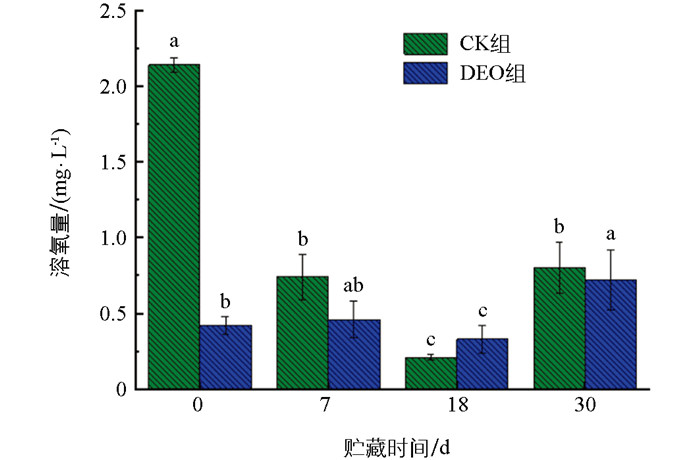
  • 贮藏期间橙汁中溶解氧发生了显著变化,如图 1。在贮藏初期,CK组和DEO组橙汁中溶氧量分别为(2.14±0.05) mg/L和(0.42±0.06) mg/L;贮藏18 d时,CK组橙汁中溶氧量下降明显,与贮藏初期差异有统计学意义(p<0.05)。DEO组橙汁中溶氧量在第7 d时略有上升,与贮藏初期差异无统计学意义(p>0.05);在18 d时,DEO组溶氧量下降,且变化有统计学意义(p<0.05)。在贮藏末期,CK组和DEO组橙汁中溶氧量均呈上升趋势,这可能与包装材料的透氧性有关。结果与蔡德萍[7]研究结果基本一致。
    利用固相微萃取(SPME)对贮藏期间橙汁样品中挥发性组分进行萃取和浓缩,DB-5色谱柱上进行分离,结合GC-MS/脉冲火焰检测器(PFPD)进行检测。通过LRI、MS、PFPD和标品(Std)4种不同方式,对橙汁中检测到的色谱峰进行定性分析,结果如表 1。在橙汁中共鉴定出68种挥发性组分,包括18种醇类、16种萜烯类、13种醛类、7种挥发性硫化物(VSCs)、5种酯类、3种酮类和6种其他类。7种VSCs,即甲硫醇、甲硫醚、二硫化碳、二甲基二硫醚、3-甲基噻吩、二甲基三硫醚和3-甲硫基丙醛,仅在PFPD检测器上检测到,常被报道是导致柑橘汁风味劣变的重要异味组分[12-13],其余61种挥发性非硫化物可通过MS检测器检测到。贮藏初期,在CK组和DEO组橙汁中分别检测到54种、52种挥发性物质,且二硫化碳和正己酸乙酯仅在CK组中检测到,这主要与超声脱氧处理有关。随着贮藏时间的延长,CK组和DEO组橙汁中挥发性物质的种类也呈现出不同的变化。在贮藏末期,CK组中挥发性物质种类减少,而DEO组中挥发性物质种类增多,其中β-石竹烯、β-古巴烯、香叶醇、3-甲基噻吩、二甲基三硫醚和3-甲硫基丙醛仅在DEO组检测到。贮藏末期DEO组中3-甲硫基丙醛(煮土豆味)的出现,表明了蛋氨酸与脱氢抗坏血酸之间的Strecker降解反应并非是橙汁中3-甲硫基丙醛产生的主要途径。

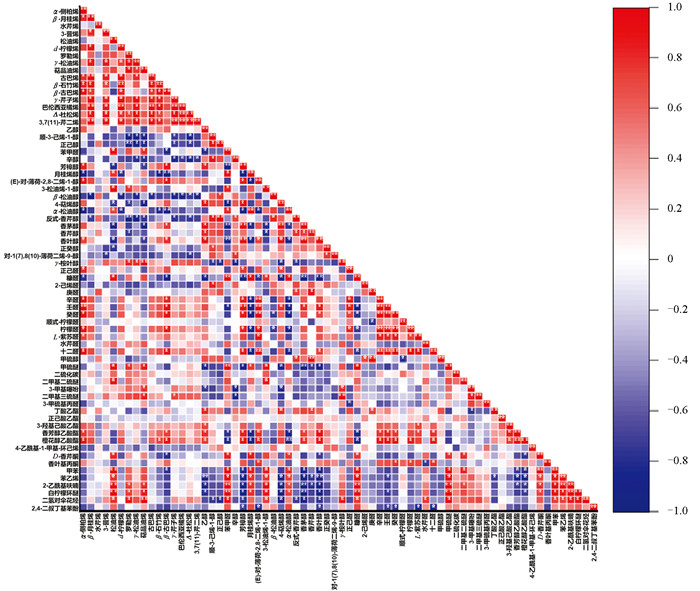
  • 采用3种内标,即环己酮、甲基乙基硫醚和二异丙基二硫醚,分别对橙汁中挥发性非硫化物和挥发性硫化物进行定量分析。与贮藏初期相比,贮藏7 d后CK组橙汁中挥发性物质的质量分数升高了4.95%,而在18 d和30 d时分别降低了4.78%和1.77%;贮藏7 d和18 d时DEO组橙汁中挥发性物质的质量分数分别降低了12.86%和8.03%,在贮藏30 d时升高了4.29%,说明溶氧量可以影响橙汁中不同类型挥发性物质质量分数的占比。在贮藏初期,萜烯类是CK组和DEO组最主要的挥发性物质类型,分别占62.72%和60.67%;随着贮藏时间延长,在18 d时CK组和DEO组中萜烯类占比逐渐降低,CK组醇类和醛类占比逐渐升高,DEO组酮类占比逐渐升高,即CK组萜烯类占比降至41.56%,醇类和醛类占比分别上升至53.33%和3.03%;DEO组萜烯类占比下降至42.78%,酮类占比升至1.40%。d-柠檬烯、α-松油醇、芳樟醇、4-萜烯醇是橙汁中含量较高的挥发性物质,对橙汁风味具有重要的影响。相关性分析热图用于展示多个变量之间相关性的强度和方向,其中相关系数用于衡量两个连续变量之间的线性关系,其值为-1~1,-1表示完全负相关,1表示完全正相关,0表示没有线性相关。在橙汁贮藏过程中,各个挥发性物质的相关系数如图 2

    图 2可知,d-柠檬烯含量分别与β-月桂烯、γ-松油烯、β-古巴烯、β-石竹烯、γ-芹子烯、巴伦西亚橘烯、Δ-杜松烯、3,7(11)-芹二烯、月桂烯醇、β-松油醇和α-松油醇差异有统计学意义(p<0.05);α-松油醇含量与21种(p<0.05)和3种(p<0.01)挥发性物质差异有统计学意义;芳樟醇含量与23种(p<0.05)和5种(p<0.01)挥发性物质差异有统计学意义;4-萜烯醇含量与18种(p<0.05)和1种(p<0.01)挥发性物质差异有统计学意义。贮藏期间橙汁中d-柠檬烯和芳樟醇发生降解,形成α-松油醇,也是衡量橙汁贮藏品质的重要指标。本研究中,橙汁中α-松油醇含量变化与d-柠檬烯和芳樟醇含量呈显著负相关(p<0.05),这与Pérez-López等[14]的研究结果相一致。甲硫醇、甲硫醚和3-甲硫基丙醛是柑橘汁中常见的异味组分[11, 15],橙汁中甲硫醇含量与反式-香芹醇、香芹醇、2-己烯醛、庚醛呈显著正相关(p<0.05),与顺式-柠檬醛呈显著负相关(p<0.05);甲硫醚和3-甲基噻吩含量与乙醇呈显著负相关(p<0.05),3-甲硫基丙醛与正己醛呈显著负相关(p<0.05)。

  • 为了筛选橙汁中特征风味活性组分,明确溶解氧对其影响及其在贮藏期间的变化规律,通过橙汁中各个风味活性组分浓度与感官阈值的比值,计算其OAV值。通常,当风味组分的VOA≥1时被认为是橙汁的特征风味活性组分[16],结果如表 2。在贮藏期间橙汁中共检测到40种挥发性组分,包括11种醛类、10种醇类、9种萜烯类、4种酯类、3种挥发性硫化物、1种酮类和2种其他类。在贮藏初期,CK组和DEO组橙汁均检测出了33种风味活性组分,其中β-月桂烯、d-柠檬烯、芳樟醇、香叶醇、正癸醇、辛醛、壬醛、癸醛和丁酸乙酯是关键的风味活性组分(VOA>100);随着贮藏时间延长,CK组和DEO组的气味活性物质种类呈降低趋势,且CK组的种类多于DEO组(贮藏18 d);随后DEO组的气味活性物质种类呈上升趋势,且CK组的种类少于DEO组(贮藏30 d)。油脂味的癸醛仅在贮藏初期对橙汁的整体风味具有重要影响;随着贮藏时间的增加,花香味的芳樟醇风味贡献逐渐降低,其中DEO组降低速率快于CK组。贮藏末期CK组中呈橘香的辛醛、果香的丁酸乙酯的OAV值高于DEO组,而DEO组中呈果香的β-月桂烯、橘香的d-柠檬烯、花香的香叶醇、油脂味的正癸醇的OAV值高于CK组。α-松油醇、4-萜烯醇、甲硫醇、甲硫醚、3-甲硫基丙醛是橙汁中常见的异味组分[5],其中贮藏末期CK组呈白菜味的3种异味组分(甲硫醚、α-松油醇、4-萜烯醇)的OAV值高于DEO组,而DEO组仅呈煮土豆味的3-甲硫基丙醛的OAV值高于CK组,表明溶解氧促进了贮藏期间橙汁的风味劣变。

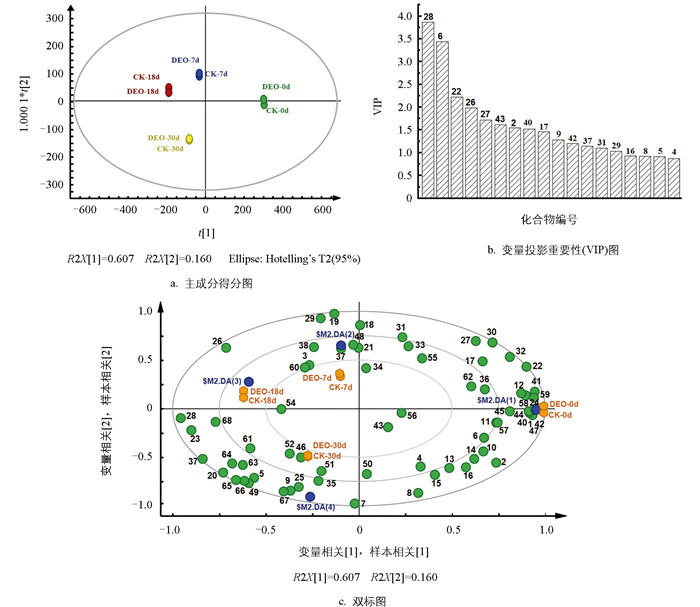
  • 采用正交偏最小二乘法判别分析(Orthogonal Partial Least Squares Discriminant Analysis,OPLS-DA)的多元数据,解析CK组和DEO组橙汁在贮藏30 d内的风味品质变化规律,并筛选出贮藏期内橙汁中风味变化的关键标识物。图 3a显示,第1主成分和第2主成分分别占总变量的60.7%和16.0%。与贮藏初期相比,贮藏7 d和18 d时的橙汁中挥发性物质变化逐渐变大,而贮藏30 d时的橙汁中挥发性物质变化有变小的趋势,这可能与贮藏30 d时果肉中挥发性物质的释放有关。双标图(图 3c)可以表明挥发性物质和贮藏时间的关系,贮藏初期橙汁风味的呈现主要与癸醛、十二醛、(E)-对-薄荷-2,8-二烯-1-醇、辛醛、柠檬醛、α-侧柏烯、橙花醇乙酸酯和芳樟醇有关;贮藏18 d的橙汁风味呈现主要与α-松油醇、糠醛、月桂烯醇、2,4-二叔丁基苯酚和β-松油醇有关;贮藏30 d的橙汁风味呈现主要与水芹醛、3-甲基噻吩、二甲基二硫醚、γ-桉叶醇和3-松油烯-1-醇有关。通常变量投影重要性(Variable Importance in Projection,VIP)大于1时被认为是筛选标记物的临界值[32],结果如图 3b,14个风味标识物被筛选,即α-松油醇、d-柠檬烯、芳樟醇、β-松油醇、4-萜烯醇、顺式-柠檬醛、β-月桂烯、辛醛、乙醇、萜品油烯、癸醛、糠醛、香芹醇和反式-香芹醇,可以区分不同贮藏期橙汁风味品质的变化。
3.   讨论与结论
  • 研究溶解氧对热杀菌橙汁贮藏风味品质的影响,通过气相色谱GC结合质谱MS和脉冲火焰检测器PFPD,共鉴定出68种挥发性物质,包括61种挥发性非硫化物和7种挥发性硫化物。贮藏期橙汁中挥发性物质的种类也呈现不同,在贮藏末期,CK组中挥发性物质种类比DEO少,其中β-石竹烯、β-古巴烯、香叶醇、3-甲基噻吩、二甲基三硫醚和3-甲硫基丙醛仅在DEO组中检测到。随着贮藏时间的延长,CK组挥发性物质含量呈降低的趋势,而DEO组挥发性物质含量呈先降低后上升的趋势。橙汁中d-柠檬烯、α-松油醇和芳樟醇的含量较高,且贮藏期间d-柠檬烯、芳樟醇与α-松油醇含量呈显著负相关(p<0.05)。通过OAV值筛选出40种对贮藏期间橙汁整体风味具有贡献的挥发性组分,其中贮藏末期CK组异味组分甲硫醚、α-松油醇和4-萜烯醇的OAV值高于DEO组,DEO组中呈果香的β-月桂烯、橘香的d-柠檬烯、花香的香叶醇、油脂味的正癸醇OAV值高于CK组。OPLS-DA结合VIP筛选了14种与贮藏期间橙汁风味品质发生有关的标识物,因此,溶解氧对热杀菌橙汁贮藏风味品质具有重要影响,对橙汁加工工艺优化和包装形式等方面都具有重要的指导意义。

Figure (3)  Table (2) Reference (32)

Catalog

    /

    DownLoad:  Full-Size Img  PowerPoint
    Return
    Return