

Message Board

Dear readers, authors and reviewers,you can add a message on this page. We will reply to you as soon as possible!

2025 Volume 47 Issue 12
Article Contents

CHEN Kaili, BAN Wenzhuo, TANG Na, et al. Analysis and Identification of Alternative Splicing and Expression of stra8 Gene and Its Promoter in Chinese Soft-Shelled Turtle (Pelodiscus sinensis)[J]. Journal of Southwest University Natural Science Edition, 2025, 47(12): 88-98. doi: 10.13718/j.cnki.xdzk.2025.12.009
Citation: CHEN Kaili, BAN Wenzhuo, TANG Na, et al. Analysis and Identification of Alternative Splicing and Expression of stra8 Gene and Its Promoter in Chinese Soft-Shelled Turtle (Pelodiscus sinensis)[J]. Journal of Southwest University Natural Science Edition, 2025, 47(12): 88-98. doi: 10.13718/j.cnki.xdzk.2025.12.009

Analysis and Identification of Alternative Splicing and Expression of stra8 Gene and Its Promoter in Chinese Soft-Shelled Turtle (Pelodiscus sinensis)

More Information
  • Corresponding author: XU Hongyan
  • Received Date: 25/02/2025
    Available Online: 20/12/2025
  • MSC: Q785; S917.4

  • Stra8 (stimulated by retinoic acid gene 8) is a specific marker gene that initiates meiosis in germ cells and plays a crucial role in the transition from mitosis to meiosis. To elucidate the role of the stra8 gene in the germ cell development of Chinese soft-shelled turtle (Pelodiscus sinensis), based on the genomic and transcriptomic databases from NCBI (https://www.ncbi.nlm.nih.gov/), we preliminarily found that alternative splicing exists in stra8 gene, resulting in multiple transcript isoforms. To identify the most representative transcript and its encoding protein, we characterized the gene structure, detected mRNA expression levels by using quantitative PCR, and cloned both the stra8 gene and its promoter sequence via PCR technology. The results showed that the stra8 gene in P. sinensis comprised 10 exons and 9 introns, generating 19 mRNA isoforms by 5′ end alternative splicing, 3′ end alternative splicing, and exon skipping events, thus a total of 5 kinds of polypeptide sequences were predicted to be translated. Stra8 was specifically expressed in the gonads with higher expression levels in testes than in ovaries. Notably, the transcript encoding the fourth polypeptides sequence exhibited the highest expression, indicating it may be used as main functional transcript. Furthermore, the cloned cDNA fragment of stra8 was 1 113 bp in length, including a 54 bp 3′ untranslated region and a 1 059 bp open reading frame, encoding 352 amino acids. The amino acid sequence contained a conserved HLH domain at the N terminus and three BOX domains at the C terminus, which shared over 80% identity with reptiles' homologous proteins, but only 30% identity with those of bony fishes. Additionally, we obtained a 1 052 bp stra8 promoter fragment, which contained a TATA box promoter core element and binding sites for transcription factors such as RAR/RXR and Sp1, indicating that the transcription of stra8 may be regulated by retinoic acid signal and multiple factors.

  • 加载中
  • [1] 农业农村部渔业渔政管理局, 全国水产技术推广总站, 中国水产学会. 2024中国渔业统计年鉴[M]. 北京: 中国农业出版社, 2024.

    Google Scholar

    [2] TELETIN M, VERNET N, GHYSELINCK N B, et al. Chapter Seven Roles of Retinoic Acid in Germ Cell Differentiation [J]. Current Topics in Developmental Biology, 2017, 125: 191-225.

    Google Scholar

    [3] FENG C W, BURNET G, SPILLER C M, et al. Identification of Regulatory Elements Required for Stra8 Expression in Fetal Ovarian Germ Cells of the Mouse [J]. Development, 2021, 148(5): dev194977. doi: 10.1242/dev.194977

    CrossRef Google Scholar

    [4] ZHOU Q, LI Y, NIE R, et al. Expression of Stimulated by Retinoic Acid Gene 8(Stra8) and Maturation of Murine Gonocytes and Spermatogonia Induced by Retinoic Acid in Vitro [J]. Biology of Reproduction, 2008, 78(3): 537-545. doi: 10.1095/biolreprod.107.064337

    CrossRef Google Scholar

    [5] OULAD-ABDELGHANI M, BOUILLET P, DÉCIMO D, et al. Characterization of a Premeiotic Germ Cell-Specific Cytoplasmic Protein Encoded by Stra8, a Novel Retinoic Acid-Responsive Gene [J]. The Journal of Cell Biology, 1996, 135(2): 469-477. doi: 10.1083/jcb.135.2.469

    CrossRef Google Scholar

    [6] MIYAMOTO T, SENGOKU K, TAKUMA N, et al. Isolation and Expression Analysis of the Testis-Specific Gene, STRA8, Stimulated by Retinoic Acid Gene 8 [J]. Journal of Assisted Reproduction and Genetics, 2002, 19(11): 531-535. doi: 10.1023/A:1020963919596

    CrossRef Google Scholar

    [7] 何庆玲. 猪Stra8基因的克隆、表达和体外转染精原干细胞的初步研究[D]. 扬州: 扬州大学, 2012.

    Google Scholar

    [8] SMITH C A, ROESZLER K N, BOWLES J, et al. Onset of Meiosis in the Chicken Embryo; Evidence of a Role for Retinoic Acid [J]. BMC Developmental Biology, 2008, 8: 85. doi: 10.1186/1471-213X-8-85

    CrossRef Google Scholar

    [9] DONG R R, YANG S J, JIAO J, et al. Characterization of Stra8 in Southern Catfish(Silurus meridionalis): Evidence for Its Role in Meiotic Initiation [J]. BMC Molecular Biology, 2013, 14: 11. doi: 10.1186/1471-2199-14-11

    CrossRef Google Scholar

    [10] LI M H, FENG R J, MA H, et al. Retinoic Acid Triggers Meiosis Initiation via Stra8-Dependent Pathway in Southern Catfish, Silurus meridionalis [J]. General and Comparative Endocrinology, 2016, 232: 191-198. doi: 10.1016/j.ygcen.2016.01.003

    CrossRef Google Scholar

    [11] SKAFTNESMO K O, CRESPO D, KLEPPE L, et al. Loss of stra8 Increases Germ Cell Apoptosis but Is still Compatible with Sperm Production in Atlantic Salmon (Salmo salar) [J]. Frontiers in Cell and Developmental Biology, 2021, 9: 657192. doi: 10.3389/fcell.2021.657192

    CrossRef Google Scholar

    [12] GRISWOLD M D, HOGARTH C A, BOWLES J, et al. Initiating Meiosis: The Case for Retinoic Acid [J]. Biology of Reproduction, 2012, 86(2): 35.

    Google Scholar

    [13] FENG C W, BOWLES J, KOOPMAN P. Control of Mammalian Germ Cell Entry into Meiosis [J]. Molecular and Cellular Endocrinology, 2014, 382(1): 488-497. doi: 10.1016/j.mce.2013.09.026

    CrossRef Google Scholar

    [14] POTTER S J, DEFALCO T. Role of the Testis Interstitial Compartment in Spermatogonial Stem Cell Function [J]. Reproduction, 2017, 153(4): R151-R162. doi: 10.1530/REP-16-0588

    CrossRef Google Scholar

    [15] SABA R E, WU Q, SAGA Y. CYP26B1 Promotes Male Germ Cell Differentiation by Suppressing STRA8-Dependent Meiotic and STRA8-Independent Mitotic Pathways [J]. Developmental Biology, 2014, 389(2): 173-181. doi: 10.1016/j.ydbio.2014.02.013

    CrossRef Google Scholar

    [16] BALTUS A E, MENKE D B, HU Y C, et al. In Germ Cells of Mouse Embryonic Ovaries, the Decision to Enter Meiosis Precedes Premeiotic DNA Replication [J]. Nature Genetics, 2006, 38(12): 1430-1434. doi: 10.1038/ng1919

    CrossRef Google Scholar

    [17] BOWLES J, KNIGHT D, SMITH C, et al. Retinoid Signaling Determines Germ Cell Fate in Mice [J]. Science, 2006, 312(5773): 596-600. doi: 10.1126/science.1125691

    CrossRef Google Scholar

    [18] ANDERSON E L, BALTUS A E, ROEPERS-GAJADIEN H L, et al. Stra8 and Its Inducer, Retinoic Acid, Regulate Meiotic Initiation in both Spermatogenesis and Oogenesis in Mice [J]. Proceedings of the National Academy of Sciences of the United States of America, 2008, 105(39): 14976-14980.

    Google Scholar

    [19] VERNET N, DENNEFELD C, ROCHETTE-EGLY C, et al. Retinoic Acid Metabolism and Signaling Pathways in the Adult and Developing Mouse Testis [J]. Endocrinology, 2006, 147(1): 96-110. doi: 10.1210/en.2005-0953

    CrossRef Google Scholar

    [20] CHEN L, TOVAR-CORONA J M, URRUTIA A O. Alternative Splicing: A Potential Source of Functional Innovation in the Eukaryotic Genome [J]. International Journal of Evolutionary Biology, 2012, 2012: 596274.

    Google Scholar

    [21] 周先文. 中华鳖性别相关基因的筛选及其对性别分化的影响研究[D]. 长沙: 湖南农业大学, 2021.

    Google Scholar

    [22] PAN Q, SHAI O, LEE L J, et al. Deep Surveying of Alternative Splicing Complexity in the Human Transcriptome by High-Throughput Sequencing [J]. Nature Genetics, 2008, 40(12): 1413-1415. doi: 10.1038/ng.259

    CrossRef Google Scholar

    [23] WANG E T, SANDBERG R, LUO S J, et al. Alternative Isoform Regulation in Human Tissue Transcriptomes [J]. Nature, 2008, 456(7221): 470-476. doi: 10.1038/nature07509

    CrossRef Google Scholar

    [24] KIM M S, PINTO S M, GETNET D, et al. A Draft Map of the Human Proteome [J]. Nature, 2014, 509(7502): 575-581. doi: 10.1038/nature13302

    CrossRef Google Scholar

    [25] BARALLE F E, GIUDICE J. Alternative Splicing as a Regulator of Development and Tissue Identity [J]. Nature Reviews Molecular Cell Biology, 2017, 18(7): 437-451. doi: 10.1038/nrm.2017.27

    CrossRef Google Scholar

    [26] 兰伟康, 李光, 高保全, 等. 三疣梭子蟹IAG基因结构及不同剪切体时空表达[J]. 广东海洋大学学报, 2023, 43(3): 26-34.

    Google Scholar

    [27] 罗朋娜. 鸡GLUT4基因可变剪切体鉴定与主要转录本的功能分析[D]. 郑州: 河南农业大学, 2023.

    Google Scholar

    [28] 焦静. 南方鲇stra8分子克隆、表达和转录调控的初步研究[D]. 重庆: 西南大学, 2011.

    Google Scholar

    [29] CHEN W, JIA W W, WANG K, et al. Distinct Roles for CBP and P300 on the RA-Mediated Expression of the Meiosis Commitment Gene Stra8 in Mouse Embryonic Stem Cells [J]. PLoS One, 2013, 8(6): e66076. doi: 10.1371/journal.pone.0066076

    CrossRef Google Scholar

    [30] WANG X Y, CHEN T F, SONG C Y, et al. Cloning and Expression Characteristics of the Pig Stra8 Gene [J]. International Journal of Molecular Sciences, 2014, 15(7): 12480-12494. doi: 10.3390/ijms150712480

    CrossRef Google Scholar

    [31] 李罗刚, 王淑燕, 潘伟荣, 等. 版纳微型猪近交系STRA8基因克隆及功能生物信息学分析[J]. 云南农业大学学报(自然科学), 2019, 34(3): 432-439.

    Google Scholar

    [32] KOJIMA M L, DE ROOIJ D G, PAGE D C. Amplification of a Broad Transcriptional Program by a Common Factor Triggers the Meiotic Cell Cycle in Mice [J]. eLife, 2019, 8: e43738. doi: 10.7554/eLife.43738

    CrossRef Google Scholar

    [33] ENDO T, ROMER K A, ANDERSON E L, et al. Periodic Retinoic Acid-STRA8 Signaling Intersects with Periodic Germ-Cell Competencies to Regulate Spermatogenesis [J]. Proceedings of the National Academy of Sciences of the United States of America, 2015, 112(18): E2347-E2356.

    Google Scholar

    [34] 牛长敏. Stra8在精子发生中的作用及机制研究[D]. 扬州: 扬州大学, 2020.

    Google Scholar

  • 加载中
通讯作者: 陈斌, bchen63@163.com
  • 1. 

    沈阳化工大学材料科学与工程学院 沈阳 110142

  1. 本站搜索
  2. 百度学术搜索
  3. 万方数据库搜索
  4. CNKI搜索

Figures(6)  /  Tables(2)

Article Metrics

Article views(844) PDF downloads(99) Cited by(0)

Access History

Other Articles By Authors

Analysis and Identification of Alternative Splicing and Expression of stra8 Gene and Its Promoter in Chinese Soft-Shelled Turtle (Pelodiscus sinensis)

    Corresponding author: XU Hongyan

Abstract: 

Stra8 (stimulated by retinoic acid gene 8) is a specific marker gene that initiates meiosis in germ cells and plays a crucial role in the transition from mitosis to meiosis. To elucidate the role of the stra8 gene in the germ cell development of Chinese soft-shelled turtle (Pelodiscus sinensis), based on the genomic and transcriptomic databases from NCBI (https://www.ncbi.nlm.nih.gov/), we preliminarily found that alternative splicing exists in stra8 gene, resulting in multiple transcript isoforms. To identify the most representative transcript and its encoding protein, we characterized the gene structure, detected mRNA expression levels by using quantitative PCR, and cloned both the stra8 gene and its promoter sequence via PCR technology. The results showed that the stra8 gene in P. sinensis comprised 10 exons and 9 introns, generating 19 mRNA isoforms by 5′ end alternative splicing, 3′ end alternative splicing, and exon skipping events, thus a total of 5 kinds of polypeptide sequences were predicted to be translated. Stra8 was specifically expressed in the gonads with higher expression levels in testes than in ovaries. Notably, the transcript encoding the fourth polypeptides sequence exhibited the highest expression, indicating it may be used as main functional transcript. Furthermore, the cloned cDNA fragment of stra8 was 1 113 bp in length, including a 54 bp 3′ untranslated region and a 1 059 bp open reading frame, encoding 352 amino acids. The amino acid sequence contained a conserved HLH domain at the N terminus and three BOX domains at the C terminus, which shared over 80% identity with reptiles' homologous proteins, but only 30% identity with those of bony fishes. Additionally, we obtained a 1 052 bp stra8 promoter fragment, which contained a TATA box promoter core element and binding sites for transcription factors such as RAR/RXR and Sp1, indicating that the transcription of stra8 may be regulated by retinoic acid signal and multiple factors.

  • 开放科学(资源服务)标识码(OSID):

  • 爬行动物中华鳖(Pelodiscus sinensis)隶属于龟鳖目鳖科鳖属,进化分支位于动物的中间位置,是物种进化和发育生物学研究的重要模式物种。中华鳖因其营养丰富、药用价值高成为我国两栖爬行类水产品中养殖规模最大的经济物种[1]。近年来,随着对珍稀野生动物种质资源的收集保护、集约型规模化养殖以及人工杂交、胚胎移植等繁殖调控技术的普遍应用,对中华鳖产业提出了更精准可控的发展要求。生殖细胞作为遗传信息传递的唯一途径,通过减数分裂产生单倍体配子,将遗传信息代代相传,是物种优良性状传递的载体[2-3]。因此,深入了解和探讨中华鳖生殖细胞发育分化机制尤为重要。

    Stra8 (Stimulated by retinoic acid gene 8)是启动生殖细胞减数分裂的特异标记基因,在有丝分裂向减数分裂转变的过程中发挥重要作用[4]Stra8基因首先在小鼠(Mus musculus)中被鉴定出来[5],随后在人(Homo sapiens)[6]、猪(Sus scrofa)[7]等其他哺乳动物和鸡(Gallus gallus)[8]等鸟类以及南方鲇(Silurus meridionalis)[9-10]、大西洋鲑(Salmo salar)[11]等硬骨鱼类中也发现了其同源基因。在哺乳动物中,stra8的表达受视黄酸(RA)诱导[12]。视黄酸进入细胞核后,结合其特异性核受体(RARs)和视黄酸X受体(RXRs)形成异二聚体,该异二聚体再结合stra8启动子上的视黄酸反应元件(RAREs)调控stra8的表达[13-15]。通过对stra8启动子上RAREs进行突变和缺失,明确了RAREs是RA诱导stra8表达的重要元件[3]。在小鼠胚胎卵巢中,RA通过诱导stra8在雌性生殖细胞中启动减数分裂[16-18]。在胚胎睾丸中,视黄酸降解酶(Cyp26b1)通过降解RA阻断RA信号,使stra8表达缺失。13.5 d后胚胎中Cyp26bl的表达逐渐降低,Nanos2被激活并抑制stra8的表达,从而阻止雄性生殖细胞启动减数分裂[15, 17]。在出生后至成年的睾丸中,精原细胞附近的支持细胞产生RA,诱导stra8表达促使精原细胞增殖和分化[19]

    可变剪切又叫选择性剪切,在真核生物中普遍存在,指基因在转录后和mRNA形成前,被剪切形成不同的mRNA异构体,而这些mRNA异构体可能被翻译成不同的蛋白质构体。选择性剪切主要有以下5种方式:外显子跳跃、外显子互斥、5′端选择性剪切、3′端选择性剪切、内含子保留[20]。选择性剪切在真核生物的生殖繁殖、信号传导等过程中发挥重要的生物学作用。前期研究发现中华鳖stra8基因存在选择性剪切现象,本研究通过对中华鳖基因组和转录组中获取的stra8序列进行分析,发现其有19个剪切体。首先分析stra8基因结构和选择性剪切类型以及不同剪切体的转录表达水平,以获得该基因主要行使功能的转录本; 接着通过PCR克隆得到该基因的cDNA片段和启动子序列并对其进行了生物信息学分析。

1.   材料与方法
  • 本研究供试中华鳖购自重庆市某中华鳖养殖场。暂养后随机选取健康的1冬龄雌、雄中华鳖各3只,经酒精消毒后在无菌环境中采用MS222麻醉,然后放血解剖。收集雌、雄性的中华鳖心脏、肝脏、脾脏、肾脏、脑、卵巢和精巢组织,将其迅速在液氮中冷冻后置于-80 ℃冰箱保存用于RNA的提取。

  • 中华鳖总RNA和DNA的提取采用Trizol法。将保存的中华鳖组织(心脏、肝脏、脾脏、肾脏、脑、卵巢和精巢)经冷冻研磨后,加入Trizo RNAiso Plus(Takara)进行总RNA提取,使用TlANamp Genomic DNA Kit(Tiangen)提取DNA,方法参考说明书。提取的RNA和DNA用NanoDrop 2000微量分光光度计和1%琼脂糖凝胶电泳进行检测,以确定其浓度和质量。质检合格的RNA使用Takara PrimeScript RT reagent Kit with gDNA Eraser Kit反转录获得cDNA(用于RT-PCR和RT-qPCR),于-20 ℃冰箱保存备用。

  • 为了明确中华鳖stra8基因不同转录本的组织表达情况,根据NCBI中stra8的序列,设计RT-PCR定量引物,选择中华鳖的ef1α作为内参基因,引物序列见表 1。RT-PCR反应体系为:上、下游引物各0.8 μL,2×Taq Master Mix(Tiangen)10 μL,ddH2O 7.4 μL,模板cDNA 1 μL,共20 μL。反应程序为:95 ℃ 3 min,95 ℃ 10 s,60 ℃ 15 s,72 ℃ 10 s,第2-4步进行35个循环。PCR产物用2%琼脂糖电泳检测。

    RT-qPCR采用CFX ConnectTM荧光定量PCR检测系统(Bio-Rad,USA)测定。不同转录异构体的特异引物序列见表 1。反应体系为上、下游引物各0.8 μL,2×TB Green® Premix Ex TaqTM(Tli RNaseH Plus)10 μL,ddH2O 7.4 μL,模板cDNA 1 μL,共20 μL。扩增程序为:在95 ℃高温环境中进行30 s预变性,5 s变性,随后在60 ℃下进行30 s扩增,变性与扩增重复40个循环。扩增程序结束后,在95 ℃下进行10 s变性,再按每0.05 s升高0.5 ℃的速度,将反应温度从65 ℃升到95 ℃,生成溶解曲线。试验设置3个生物学重复,基因的相对表达量采用2-ΔΔCT方法计算,使用SPSS 20.0对数据进行Turkey方差分析,采用GraphPad Prism 8.0作图。

  • 根据NCBI stra8基因序列,分别设计stra8基因克隆和启动子克隆引物(表 1)。基因克隆以中华鳖雌、雄性腺cDNA等量混合物为模板,启动子克隆以提取的DNA为模板,均使用PrimerSTAR® Max DNA Polymerase(Takara)进行PCR。PCR产物采用rTaq酶在72 ℃下反应30 min加A后连接pGEM-T easy载体,转化大肠杆菌感受态(Top10)后进行蓝白斑筛选。挑取白色单克隆菌斑在LB(Luria-Bertani)液体培养基、37 ℃摇床180 r/min转速下过夜培养。采用2×Taq Master Mix(Tiangen)进行菌液PCR后获得阳性克隆,送重庆擎科生物科技有限公司测序。

  • 本研究采用的生物信息学分析软件如表 2所示。用Vector NTI 10.0软件对推导的中华鳖Stra8氨基酸序列与NCBI数据库中其他物种Stra8的氨基酸序列进行多重比对分析。采用MEGA 7.0软件构建系统进化树,计算方法为Neighbour-Joining(NJ),boostrap值设置为1 000。使用Neural Network Promoter Prediction预测中华鳖stra8基因5′端转录起始位点(TSS); 使用PROMO、AliBaba 2.1对潜在转录因子结合位点进行预测。

2.   结果与分析
  • 从NCBI数据库中获取了中华鳖stra8基因的19个mRNA序列及其参考基因组,锚定了stra8基因在基因组序列中的位置,确定了stra8基因的DNA序列全长为28 476 bp,包括10个外显子和9个内含子(图 1a),遵循GT-AG剪切规律。序列比对发现stra8基因19个转录本的第Ⅲ、Ⅴ-Ⅹ个外显子未发生剪切; 第Ⅰ个外显子在第2-5、7、10、12、16、18、19号转录本上发生了3′端选择性剪切,在第17号转录本上既发生了5′端选择性剪切又发生了3′端选择性剪切; 第Ⅱ个外显子在第1、2、5、7、9、10、14、16、18、19号转录本中发生了跳跃; 第Ⅳ个外显子在第11-19号转录本发生了跳跃,且仅在第4号转录本发生3′端选择性剪切。由此可见,stra8基因主要发生了5′端和3′端选择性剪切以及外显子跳跃等剪切事件。
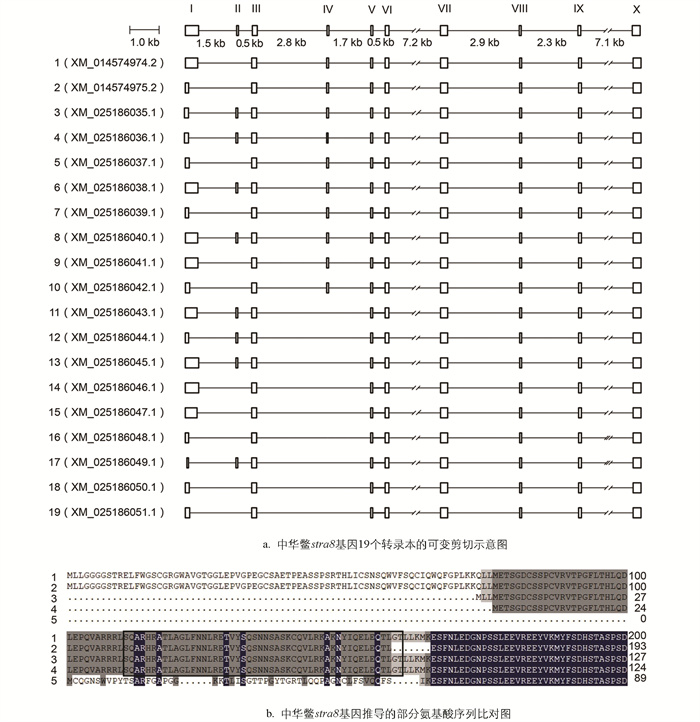
  • 为挖掘出stra8主要行使功能的转录本和相应的多肽序列,首先对stra8不同转录本编码的氨基酸序列进行比对,结果发现19个转录本共翻译5种多肽序列:第3号转录本编码第1种多肽序列,第4号转录本编码第2种多肽序列,第5号转录本编码第3种多肽序列,第1、2、6-10号转录本编码第4种多肽序列,第11-19号转录本编码第5种多肽序列(图 1b)。由图 1b可见,第5种多肽序列N端不再具有典型的HLH结构域。

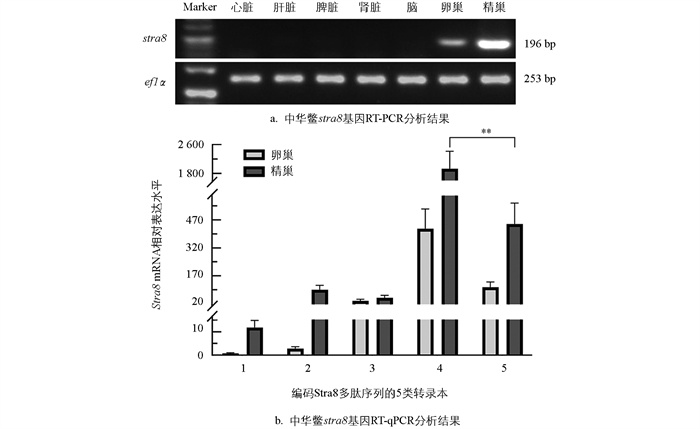
    根据中华鳖stra8 19个转录本的共有序列,设计定量引物(表 1),获取1冬龄中华鳖各组织的cDNA,以ef1α作为内参基因,利用特异性引物进行RT-PCR,检测stra8基因在不同组织中的表达情况。结果显示,未在心脏、肝脏、脾脏、肾脏、脑组织中观察到stra8产物条带,仅在卵巢、精巢中分别检测到较弱、较强的条带,表明stra8 mRNA在性腺组织中特异表达,且在精巢中的表达水平高于卵巢(图 2a)。针对编码这5种多肽序列对应的转录本序列设计特异引物(表 1),在中华鳖雌、雄性腺中进行RT-qPCR。结果表明,检测的5类转录本在精巢中的表达量均高于卵巢(图 2b),与RT-PCR检测结果一致(图 2a)。在雌、雄性腺中的表达水平都最高的是编码第4种多肽序列的转录本,其次是编码第5种多肽序列的转录本,且前者在精巢中的表达水平极显著高于后者(图 2b)。由此推测,编码第4种多肽序列的转录本是stra8中主要行使生物学功能的转录本,其编码的蛋白为功能性蛋白。
  • 根据2.2节的研究结果可知,编码第4种多肽序列的转录本是stra8中主要行使生物学功能的转录本。根据其序列信息,设计stra8基因cDNA扩增引物(表 1)。以中华鳖性腺cDNA为模板,进行RT-PCR扩增,获得的stra8基因cDNA 1 113 bp(图 3a)包含3′端非编码区54 bp以及一个长度为1 059 bp的开放阅读框,开放阅读框共编码352个氨基酸。
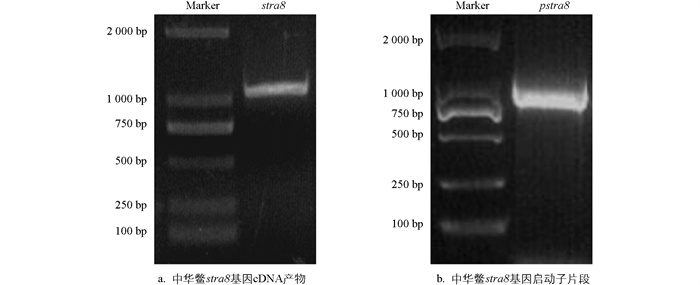
    此外,为获得stra8启动子片段,根据中华鳖基因组序列设计引物,以基因组DNA为模板进行PCR扩增,得到的启动子片段长度为1 052 bp(图 3b)。

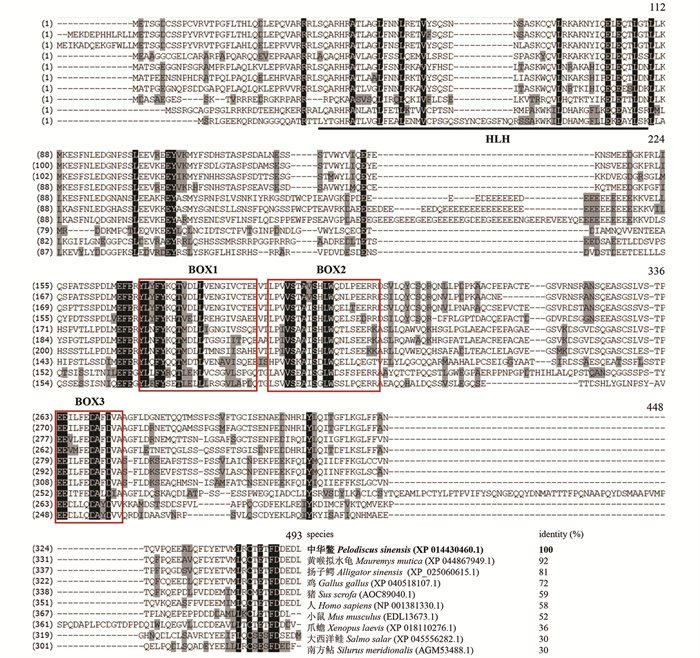
  • 采用Vector NTI 11.0软件对中华鳖与其他物种Stra8蛋白进行多重序列比对(图 4)。结果表明,中华鳖Stra8蛋白N端含有一个保守的HLH结构域。HLH结构域是Stra8与其他bHLH转录因子互作的结构域。此外,3个BOX结构域是Stra8蛋白在脊椎动物中的保守结构域。由此可见,Stra8氨基酸序列在进化中较保守,但是因物种进化程度不同而呈现出一定的差异。中华鳖与黄喉拟水龟(Mauremys mutica)Stra8序列一致性最高,达92%; 其次与爬行动物扬子鳄(Alligator sinensis)Stra8序列一致性较高,为81%; 与鸟类鸡Stra8序列一致性可达72%; 与哺乳类动物猪、人和小鼠等Stra8序列一致性较低,分别为59%、58% 和52%; 与两栖类爪蟾(Xenopus laevis)Stra8序列一致性低至36%; 与硬骨鱼类大西洋鲑和南方鲇Stra8序列一致性最低,均为30%。
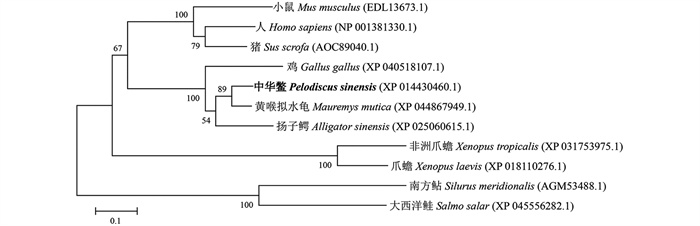
    基于中华鳖和其他物种Stra8的氨基酸序列,在Mega 7.0软件中采用邻接法进行1 000次bootstraps验证构建了系统发育树,展示了中华鳖与其他物种Stra8之间的进化关系(图 5)。进化分析表明Stra8主要聚为四足动物类和硬骨鱼类两大分支。中华鳖Stra8聚类到爬行类,并与黄喉拟水龟聚类到一个分支; 与鸟类、哺乳类、两栖类亲缘关系依次降低,与硬骨鱼类亲缘关系最远。
  • 本研究扩增得到的中华鳖stra8基因启动子片段长度为1 052 bp(图 3b),而设计目标长度为1 044 bp。通过序列比对发现,获得的启动子序列有8 bp的碱基插入(图 6红色矩形框所示),其他序列相同。生物信息学分析显示stra8基因启动子区存在1处TATA box,无GAAT box; 通过Neural Network Promoter Prediction分析预测到共3个可能的TSS。结合上游-25~30 bp的TATA box位置分析,最有可能的TSS位于第993位,定为+1位(图 6)。
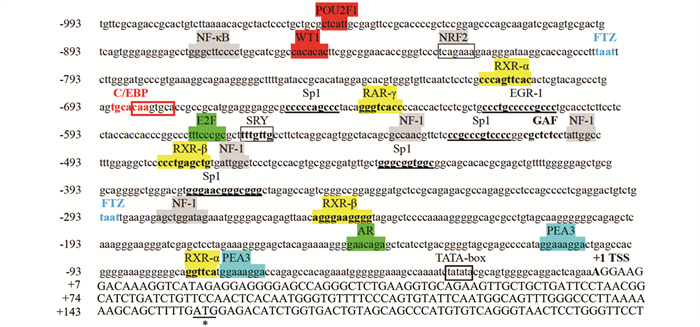
    为预测stra8启动子上游潜在的转录因子结合位点,本研究采用PROMO、AliBaba 2.1等在线数据库进行检索与分析,结果见图 6。如图 6所示,部分预测蛋白与转录调控活性直接相关:Sp1作为序列特异性DNA结合蛋白,可调控启动子中富含GC序列的基因转录; GAF与靶基因结合并移除核小体,使启动子区域暴露,从而促进转录激活; C/EBP也被证实广泛参与转录调控过程。此外,部分蛋白主要涉及细胞生长、增殖、分化及保护等功能:RAR/RXR通过响应视黄酸信号直接调控细胞减数分裂启动; AR通过与雄激素配体结合,诱导具有性别依赖性相关基因的转录激活; E2F转录因子参与细胞周期的调控; PEA3是多种细胞的增殖、迁移、分化中重要的转录调控因子; WT1参与多个器官的发育调控,可能与性腺体细胞分化、性别控制等有关; EGR-1参与调控细胞生长、分化、应激反应及免疫反应; FTZ在类固醇的生成和性别分化过程中发挥着重要的作用; NF-1在调控细胞生长、增殖和分化过程中扮演重要角色; NRF2参与氧化还原平衡、线粒体自噬、DNA修复、屏障修复、脂质代谢等,通过解毒机制产生细胞保护作用。

3.   讨论与结论
  • 目前,中华鳖是我国两栖爬行类水产养殖规模最大的经济物种,且具有明显的性别差异,雄性相比雌性具有体型大、生长速度快、脂肪少的特点[21]。已有研究表明减数分裂启动时间与性别决定和分化密切相关。减数分裂在胚胎期启动,则生殖细胞向雌性方向发育; 减数分裂在出生后启动,则生殖细胞向雄性方向发育。而stra8基因是减数分裂启动的“守门员”,在减数分裂启动中发挥重要的作用。

    据统计,90%~95%的人类基因经历了一定程度的选择性剪切[22-23]。人类蛋白质编码基因的37%产生了多种蛋白亚型[24],这表明选择性剪切有助于蛋白质组复杂性的维持、细胞分化及其谱系的决定、组织身份的获取和维持、器官的发育[25]。不同物种中基因的选择性剪切均影响其生长发育,如三疣梭子蟹(Portunus trituberculatus)iag存在不同剪切体,在三疣梭子蟹雄性分化及维持中具有重要功能[26]。鸡的glut4基因通过多种剪切机制共产生14个转录本,编码12种氨基酸序列,具有明显不同的亚细胞定位,推测glut4在鸡的生长发育过程中发挥了重要的生理功能[27]。在幼年小鼠的两性性腺中,stra8缺陷(外显子2~7缺失)的生殖细胞都无减数分裂启动的分子特征,并且不能进入减数分裂[16, 18]。本研究中,stra8基因主要通过5′端选择性剪切、3′端选择性剪切和外显子跳跃等剪切事件共产生19个剪切体,共可翻译形成5种多肽序列。剪切位置主要发生在序列的5′端,尤其是在第Ⅰ个外显子上。通过序列比对发现,部分序列的第Ⅱ个外显子发生了跳跃,但不影响翻译; 而第Ⅳ个外显子发生了跳跃,导致编码蛋白的N端发生了变化。由图 1b所示,第5种多肽序列N端氨基酸序列不再具有HLH结构域。由此可见,虽然stra8基因剪切转录本多达19个,但最终只翻译形成了5种多肽序列,其目的是保证stra8的成功转录,确保功能性蛋白的形成,进而维持生命活动正常进行。但不同的蛋白异构体也可能在不同的时空发挥不同的功能,该问题有待进一步探究。

    RT-PCR结果显示stra8基因在1冬龄雌、雄中华鳖性腺中特异表达,RT-qPCR结果表明所有转录本在精巢中的表达量高于卵巢。这与南方鲇stra8在精巢和卵巢的表达水平相似这一结果不同[28],与鼠、猪stra8仅在成体组织精巢中表达[29-31]的情况也不同。此外,本研究中,中华鳖stra8基因的转录表达水平在1冬龄精巢中显著高于卵巢,说明此时中华鳖卵巢绝大部分雌性生殖细胞减数分裂启动已完成,而精巢雄性生殖细胞减数分裂启动正处在高峰期,生殖细胞向雄性方向发育。中华鳖Stra8蛋白在进化中较保守,与其他物种同源蛋白一样,在N端均含有一个保守的HLH结构域,在C端均含有3个BOX结构域。其中HLH结构域是Stra8与其他bHLH转录因子互作的结构域,预示着Stra8常与其他蛋白互作发挥作用。Stra8是RA的靶基因之一,其启动子区域包含推测的RAREs[18, 32-33],在小鼠中已证实RARs直接与出生后小鼠睾丸中Stra8启动子区域的RAREs结合[34]。本研究中,RAR、RXR视黄酸受体结合位点的存在表明RA-Stra8信号的保守性,推测stra8的表达也受控制RA水平的酶Aldh1a和Cyp26a1的间接调控。

    综上,本研究明确了中华鳖stra8基因含有10个外显子和9个内含子,基因在转录过程中主要发生了5′端选择性剪切、3′端选择性剪切和外显子跳跃等剪切事件。Stra8基因在性腺中特异表达,且在精巢中的表达量高于卵巢,编码第4种多肽序列的转录本是stra8主要行使功能的转录本。克隆得到了stra8基因cDNA和启动子片段:CDS编码的氨基酸序列与爬行类同源蛋白具有很高的相似性,与鱼类一致性较低,但仍比较保守。启动子片段中含有RAR、RXR等转录因子结合位点,表明stra8的转录可能受视黄酸途径相关蛋白的调控。

Figure (6)  Table (2) Reference (34)

Catalog

    /

    DownLoad:  Full-Size Img  PowerPoint
    Return
    Return