

Message Board

Dear readers, authors and reviewers,you can add a message on this page. We will reply to you as soon as possible!

2019 Volume 44 Issue 5
Article Contents

Li-juan ZHAO, Zheng-bo XIE, Ya-li WANG, et al. Stress Release-Induced Cobalt Phthalocyanine Rotor Array[J]. Journal of Southwest China Normal University(Natural Science Edition), 2019, 44(5): 19-23. doi: 10.13718/j.cnki.xsxb.2019.05.004
Citation: Li-juan ZHAO, Zheng-bo XIE, Ya-li WANG, et al. Stress Release-Induced Cobalt Phthalocyanine Rotor Array[J]. Journal of Southwest China Normal University(Natural Science Edition), 2019, 44(5): 19-23. doi: 10.13718/j.cnki.xsxb.2019.05.004

Stress Release-Induced Cobalt Phthalocyanine Rotor Array

More Information
  • Corresponding author: Jun-zhong WANG
  • Received Date: 15/04/2018
    Available Online: 20/05/2019
  • MSC: O485

  • It is very important to study the artificial molecular motors or rotors, not only for grasping of movement laws of molecular motors, but also for the understanding of the microscopic driving mechanisms of molecular motors. In the natural world, however, most molecular motors work near the interface or surface. Thus it will be more practical to study the molecular motors or rotors on the solid surface in contrast with the precious work. In this paper, the adsorption and self-assembly of cobalt phthalocyanine (CoPc) on Cd(0001) surface have been investigated by low temperature scanning tunneling microscopy. By low temperature growth, it has been found that there are three kinds of randomly distributed vacant structures in the CoPc monolayer:single-molecule vacancy, two-molecule vacancy and three-molecule vacancy. It has been observed that annealing at room temperature causes spontaneous phase separation:the above three vacant structures are transformed into uniformly distributed single-molecule vacancy arrays. Of particular interest, it is found that there is a CoPc rotor which is inside each single-molecule vacancy. At the temperature of liquid nitrogen (78 K), the mobile CoPc performs the off-center rotation inside the cavity; at liquid helium temperature (4.7 K), the rotors is frozen at the edge of the vacancy. The above results provide a new idea for the large-scale preparation of nano-rotating arrays.
  • 加载中
  • [1] KELLY T R, SILVA R A, DE SILVA H, et al.A Rationally Designed Prototype of a Molecular Motor[J]. Journal of the American Chemical Society, 2000, 122(29):6935-6949. doi: 10.1021/ja001048f

    CrossRef Google Scholar

    [2] KOUMURA N, ZIJLSTRA R W J, van DELDEN R A, et al. Light-driven Monodirectional Molecular Rotor[J]. Nature, 1999, 401(6749):152-155. doi: 10.1038/43646

    CrossRef Google Scholar

    [3] STIPE B C, REZAEI M A, HO W. Inducing and Viewing the Rotational Motion of a Single Molecule[J]. Science, 1998, 279(5358):1907-1909. doi: 10.1126/science.279.5358.1907

    CrossRef Google Scholar

    [4] GAO L, LIU Q, ZHANG Y Y, et al. Constructing an Array of Anchored Single-Molecule Rotors on Gold Surfaces[J]. Physical Review Letters, 2008, 101(19):197209-1-197209-4. doi: 10.1103/PhysRevLett.101.197209

    CrossRef Google Scholar

    [5] PALMA CA, BJÓRK J, RAO F, et al. Topological Dynamics in Supramolecular Rotors[J]. Nano Letters, 2014, 14(8):4461-4468. doi: 10.1021/nl5014162

    CrossRef Google Scholar

    [6] 罗吉勇, 张瑶, 王纯杰, 等.充电态和氢键诱导的超分子转子和马达[J].西南大学学报(自然科学版), 2016, 38(7):127-132.

    Google Scholar

    [7] LU X, HIPPS K W, WANG X D, et al. Scanning Tunneling Microscopy of Metal Phthalocyanines:d7 and d9 Cases[J]. Journal of the American Chemical Society, 1996, 118(30):7197-7202. doi: 10.1021/ja960874e

    CrossRef Google Scholar

    [8] WANG Y F, KRÖGER J, BERNDT R, et al. Pushing and Pulling a Sn Ion Through an Adsorbed Phthalocyanine Molecule[J].Journal of the American Chemical Society, 2009, 131(10):3639-3643. doi: 10.1021/ja807876c

    CrossRef Google Scholar

    [9] CHANG S H, KUCK S, BREDE J, et al. Symmetry Reduction of Metal Phthalocyanines on Metals[J]. Physical Review B, 2008, 78(23):233409-1-233409-4. doi: 10.1103/PhysRevB.78.233409

    CrossRef Google Scholar

    [10] FRANKEK J, SCHULZE G, PASCUAL J I. Competition of Superconducting Phenomena and Kondo Screening at the Nanoscale[J]. Science, 2011, 332(6032):940-944. doi: 10.1126/science.1202204

    CrossRef Google Scholar

    [11] STRÓŽECKA A, SORIANO M, PASCUAL J I, et al. Reversible Change of the Spin State in a Manganese Phthalocyanine by Coordination of CO Molecule[J]. Physical Review Letters, 2012, 109(14):147202-1-147202-5. doi: 10.1103/PhysRevLett.109.147202

    CrossRef Google Scholar

    [12] BAZARNIK M, BREDE J, DECKER R, et al. Tailoring Molecular Self-assembly of Magnetic Phthalocyanine Molecules on Fe-and Co-intercalated Graphene[J]. ACS Nano, 2013, 7(12):11341-11349. doi: 10.1021/nn405172q

    CrossRef Google Scholar

    [13] WANG Y F, KRÖGER J, BERNDT R, et al. Molecular Nanocrystals on Ultrathin NaCl Films on Au(111)[J]. Journal of the American Chemical Society, 2010, 132(36):12546-12547. doi: 10.1021/ja105110d

    CrossRef Google Scholar

    [14] TAO M L, XIAO H F, SUN K, et al. Visualizing Buried Silicon Atoms at the Cd-Si(111)-7×7 Interface with Localized Electrons[J]. Physical Review B, 2017, 96(11):125410-1-125410-6.

    Google Scholar

    [15] 蔡田田, 孙凯, 谢佳乐, 等.量子尺寸效应诱导的选择性分子吸附和自组装结构[J].西南师范大学学报(自然科学版), 2012, 37(9):28-31. doi: 10.3969/j.issn.1000-5471.2012.09.007

    CrossRef Google Scholar

  • 加载中
通讯作者: 陈斌, bchen63@163.com
  • 1. 

    沈阳化工大学材料科学与工程学院 沈阳 110142

  1. 本站搜索
  2. 百度学术搜索
  3. 万方数据库搜索
  4. CNKI搜索

Figures(4)

Article Metrics

Article views(1973) PDF downloads(261) Cited by(0)

Access History

Stress Release-Induced Cobalt Phthalocyanine Rotor Array

    Corresponding author: Jun-zhong WANG

Abstract: It is very important to study the artificial molecular motors or rotors, not only for grasping of movement laws of molecular motors, but also for the understanding of the microscopic driving mechanisms of molecular motors. In the natural world, however, most molecular motors work near the interface or surface. Thus it will be more practical to study the molecular motors or rotors on the solid surface in contrast with the precious work. In this paper, the adsorption and self-assembly of cobalt phthalocyanine (CoPc) on Cd(0001) surface have been investigated by low temperature scanning tunneling microscopy. By low temperature growth, it has been found that there are three kinds of randomly distributed vacant structures in the CoPc monolayer:single-molecule vacancy, two-molecule vacancy and three-molecule vacancy. It has been observed that annealing at room temperature causes spontaneous phase separation:the above three vacant structures are transformed into uniformly distributed single-molecule vacancy arrays. Of particular interest, it is found that there is a CoPc rotor which is inside each single-molecule vacancy. At the temperature of liquid nitrogen (78 K), the mobile CoPc performs the off-center rotation inside the cavity; at liquid helium temperature (4.7 K), the rotors is frozen at the edge of the vacancy. The above results provide a new idea for the large-scale preparation of nano-rotating arrays.

  • 分子马达或分子转子是指能够把外界的化学能[1]、光能[2]或电能[3]转化为机械运动的纳米机器.在一个生物体内就存在亿万个分子马达,因此,研究人工制造的分子马达,不仅有助于人们掌握分子马达的运转规律,而且还能加深对分子马达的微观运转机制的理解.在自然界中,大多数分子马达都工作在界面或表面附近,因此研究固体表面上的分子马达或转子更具有实际意义.目前,人们虽然已经制造出了大量的分子机器,但是还缺乏在动力学方面的研究,而后者又会使纳米技术攀登到一个崭新的台阶.已有的报道大多是关于存在于溶液和三维材料当中的分子马达或转子,而关于存在于表面与界面上的大规模的分子马达阵列的实验结果则很少.高鸿钧小组利用应力诱导的Au(111)表面重构,构筑了大规模的酞菁金属分子的转子阵列,发现在液氮温度下每个转子在做偏心转动[4];德国Barth小组在金属有机网格组成的纳米孔中也制备出了超分子转子阵列[5].

    扫描隧道显微镜(STM)是一种独特的工具,可以在原子尺度上表征和操纵固体表面上的单个原子或分子.除了观察分子马达的结构和形貌,它还可以测量和调控分子马达的运转速率.把STM针尖置于分子马达的上方并施加一个负偏压,电子从STM针尖隧穿进入分子内部,电子携带的角动量会驱动分子马达的旋转[6].同时,测量隧穿电流随时间的变化关系(I-t谱),还可以测量分子马达转动的快慢.

    金属酞菁分子是一种典型的四重对称的单分子磁体,常作为研究金属有机化合物和固体表面相互作用的模型.现已有很多关于酞菁分子在多种固体表面的吸附和自组装的研究[7-13],例如Au,Ag,Cu,Pb,Bi,Graphene和NaCl等.与其他典型的贵金属相比,二价的六角密排金属Cd明显不同于自由电子金属.其4 d电子与导带电子之间具有一定程度的库仑排斥,导致其电子平均自由程和热传导具有很强的各向异性.此外,由于具有较强的自旋-轨道耦合,相对论效应会在Cd金属中发挥重要作用.笔者所在实验室在Si(111)基底上成功制备了高质量的Cd(0001)薄膜,在该薄膜中发现一些新奇的量子效应[14].本研究首次在金属性较强的Cd(0001)表面发现了酞菁钴转子.由于较强的分子-衬底相互作用,酞菁钴分子单层中存在较强的应力.局部的应力释放产生了3种不同的空位结构:分别是单分子空位、二分子空位和三分子空位.经过高温退火,3种空位演变为均匀分布的单分子空位阵列.特别有趣的是,在每一个空位内部都存在一个酞菁钴转子.在液氮温度下转子围绕空位中心做偏心转动,在液氦温度下转子被冻结在空位的边缘.

1.   实验部分
  • 本实验使用的仪器是超高真空-低温扫描隧道显微(LT-STM),其本底真空为1.2×10⁻¹⁰Torr.首先,将金属Cd以0.15 ML/min的速率(本研究把首次铺满Si(111)-7×7表面的Cd覆盖度定义为一个原子单层,记为“1 ML”.)从自制的钽舟沉积到处于室温的Si(111)-7×7表面上,形成非常平坦和光滑的Cd(0001)薄膜,酞菁钴分子先经650 K的温度除气,再在600 K温度下,以有机分子束沉积的方式生长到处于低温的Cd(0001)薄膜上,然后转移至STM腔进行形貌表征.实验所用的STM针尖是由多晶钨丝制作的.且在传入STM腔之前,针尖用电子束轰击处理以除去表面的氧化层. STM在恒流模式下工作,针尖和样品之间的电压控制在-3~+3 V之间.所有的STM图像是在液氮或液氦温度下获得.

2.   结果与讨论
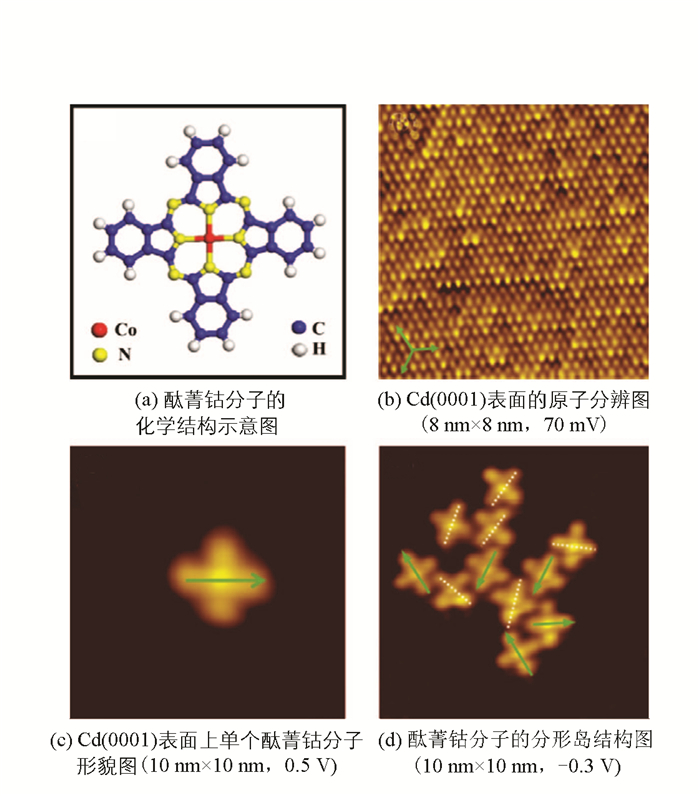
  • 在液氮(78 K)温度下,将少量的酞菁钴分子沉积到处于低温(100 K)的Cd(0001)薄膜上,发现单个酞菁钴分子以平躺的姿态吸附在Cd(0001)表面上(图 1(c)).从图 1(c)中可以看到酞菁钴分子呈现出“十字架”形状,这与图 1(a)所示的化学结构一致. 图 1(b)为Cd(0001)表面的原子分辨图,其晶格方向由绿色箭头标出.通过对比可以看出图 1(c)酞菁钴分子中相对的两瓣平行于Cd(0001)的一个晶格方向.另外,发现一些酞菁钴分子形成自组装的分形岛结构(图 1(d)).有趣的是,分形岛结构中有5个酞菁钴分子的吸附取向(绿色箭头标示)保持与Cd(0001)的晶格方向一致,但其他6个酞菁钴分子的吸附取向(白色虚线标示)则偏离Cd衬底的晶格方向(形成5~10°的夹角).这说明对于单个分子而言,分子-衬底相互作用较强,使得分子的取向沿着衬底的晶格方向.但随着分子数的增加,相邻分子之间的相互作用也可以改变分子的取向,使之偏离衬底的晶格方向.
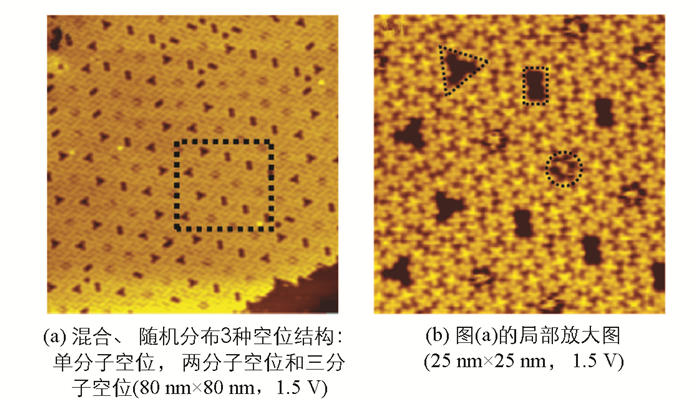
    继续增加酞菁钴分子的覆盖度到1 ML时,酞菁钴分子在Cd(0001)表面上形成了自组装单层薄膜(图 2(a)).研究发现,在单层薄膜中CoPc分子并没有形成常见的密堆积结构,而是出现了3种混合、随机分布的分子空位. 图 2(b)展示了局部放大的高分辨STM图,从中可以看到这些空位结构按尺寸大小可分为:单分子空位(圆形虚线),两分子空位(矩形虚线)和三分子空位(三角形虚线).分子空位的出现是由于较强的分子-衬底相互作用导致单层薄膜中出现了较强的拉伸应力.随着分子自组装畴区面积的增大,拉伸应力会随分子数的增加而逐渐积累.当拉伸应力超过分子薄膜的承受程度就会造成常见的应力释放,导致薄膜局部出现断裂和空位结构[15].
    接下来对样品进行几个小时的高温(~100 ℃)退火,发现酞菁钴单层薄膜发生了结构相变.退火后三分子空位和两分子空位从单层薄膜中消失,只剩下均匀分布的单分子空位结构的二维阵列(图 3(a)).空位阵列的排列周期用菱形原胞标出,对应的晶格常数为6.20±0.05 nm,分子的堆积密度为0.48 nm-2. 图 3(b)给出了单个原胞的高分辨STM图,原胞包含15个具有不同吸附取向的静止的分子和一个单分子空位.其中,9个分子的吸附取向和Cd(0001)面的晶格相同,而另外6个的吸附取向则偏离了衬底晶格方向.值得注意的是,在每个空位中都有一个模糊的“花瓣”图案,并且在极低的偏压(50 mV)下,“花瓣”图案会变得非常清晰:每个“花瓣”包含6个对称分布的扇叶和6个小亮点组成的同心圆(图 3(c)).由于样品生长、表征都是在超高真空的环境下进行的,所以花瓣结构不可能是外来杂质引起的干扰.我们推测分子空位中出现花瓣图案是由于一个多余的酞菁钴分子做偏心转动引起的.为了验证我们的推测,对“花瓣”状分子进行了I-t谱测量.所谓I-t谱是指在把STM针尖固定在分子的上方,在关闭反馈回路的条件下测量隧道电流随时间变化的曲线.当针尖固定在“花瓣”外端(图 3(c)中红色圆点)的正上方,在0~10 s内所记录的隧道电流(图 3(d)).可以看到,在给定时间内隧道电流在两个电流值之间不断地跳跃.而隧道电流的跳变与针尖下分子的旋转快慢有关,这表明花瓣图案确实是由于分子的快速转动引起的,这类似于高鸿钧小组报道的Au(111)表面上生长的(tBu)4-ZnPc单分子转子[4].
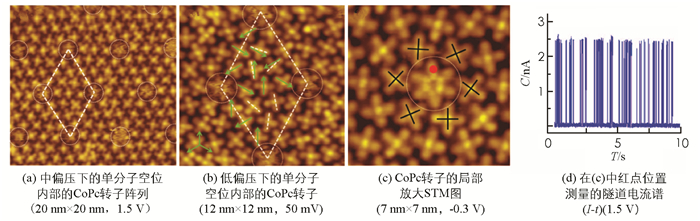
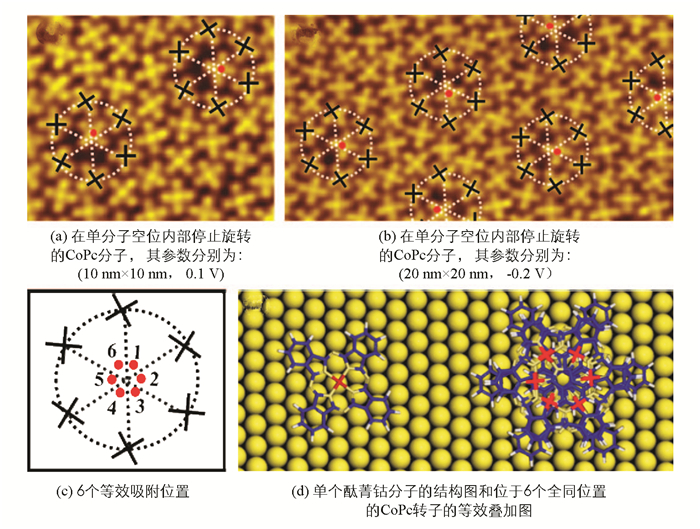
    进一步把样品置于液氦(4.7 K)温度下,这时单分子空位中的转子停止了转动(图 4(a)). STM图清晰地显示了图 3(c)中的“花瓣”状图案就是转动的酞菁钴分子.在图 4(a)图 4(b)中,观察到8个酞菁钴转子并没有出现在空位的中心位置,而是停留在空位的边缘上.这表明转子和周围的分子存在范德瓦尔斯吸引力.仔细分析发现,这8个转子分别出现在空位边缘的6个不同方位上(图中红色圆点标出),具有一定的随机性.但是通过对大量转子的统计分析,发现转子出现在6个方位的几率是相等的(大约等于0.17).这再次表明了图 3(c)中酞菁钴转子在液氮温度下确实在转动,而且其转动轴是偏心的(图 4(c)).根据Cd(0001)的六重对称性,酞菁钴转子在空位中有6个不同的吸附位置,这与实验观察基本吻合.由于分子在这6个位置中出现的概率相同,则可以对分子在这6个不同位置进行等效叠加,即图 4(d).可以看到,通过叠加还原出了图 3(c)中的花瓣状图案.在液氮温度下,分子热运动能量可以克服由衬底Cd原子高低不平引起的转动势垒高度的阻碍;液氦温度下,则无法克服.同时隧穿电子携带的角动量可以驱动分子转动,因此酞菁钴转子的能量主要是分子热运动和隧穿电子共同作用的结果.
3.   结论
  • 在高质量的Cd(0001)薄膜上,利用低温生长方法制备出酞菁钴分子单层.由于较强的分子-衬底作用,分子单层出现了应力诱导的分子空位(单分子空位,两分子空位和三分子空位).经过高温退火3种空位结构发生了相变,演变为均匀分布的单分子空位阵列.更为有趣的是,在每一个单分子空位内部都存在一个酞菁钴转子.液氮温度下酞菁钴转子在空位内部做偏心转动,在6个位置的叠加形成“花瓣”状图案.在液氦温度下,酞菁钴转子被冻结在空位的边缘.上述结果表明转子的驱动机制来自于分子的热运动和隧穿电子的共同作用.

Figure (4)  Reference (15)

Catalog

    /

    DownLoad:  Full-Size Img  PowerPoint
    Return
    Return