




-
令[n]={1,2,…,n},
$ {\mathscr{S}_n} $ 表示[n]上所有排列的集合. 设$ A \subseteq {\mathscr{S}_n} $ ,我们考虑拟对称生成函数其中对
$ \tau = {\tau _1}{\tau _2} \cdots {\tau _n} \in {\mathscr{S}_n} $ ,Des(τ) ={i:1≤i≤n-1,τi>τi+1}表示排列τ的降序集. 对S⊆[n-1],表示基本拟对称函数. 文献[1]提出如下问题:
$ {\mathscr{S}_n} $ 的哪些子集A对应的拟对称生成函数$ \mathscr{Q}\left( A \right) $ 是对称函数?该问题提出后,很多组合学者对此进行了深入的研究. 如果$ \mathscr{Q}\left( A \right) $ 是对称函数,则称集合A是对称的. 如果$ \mathscr{Q}\left( A \right) $ 展开成Schur函数后的系数都为非负数,则称集合A是Schur-正的. 对J⊆[n-1],文献[2]证明了逆降序类是对称的. 文献[3-4]结合排列的模式避免问题,研究了排列集是对称集的条件. 基于几何网格和乘法运算,文献[5]给出了一种构造Schur-正的排列集的一般方法.
本文结合排列的弱Bruhat偏序结构,研究了主理想及对偶主理想对应的拟对称生成函数. 主要结果如下(相关定义和记号见本文第1节):
定理1 若
$ \pi \in {\mathscr{S}_n}\left( {132, 213} \right) $ ,则定理2 若
$ \pi \in {\mathscr{S}_n}\left( {231, 312} \right) $ ,则
HTML
-
为了讨论方便,我们需要引入一些基本概念和记号.
给定正整数n,如果正整数序列α=(α1,α2,…,αk)满足α1+α2+…+αk=n,则称α为n的一个合成,记为
$ \alpha \left| = \right.n $ . 我们知道n的所有合成与[n-1]的所有子集之间是一一对应的. 具体而言,给定合成α=(α1,α2,…,αk)|=n,记Sα={α1,α1+α2,…,α1+α2+…+αk-1}是α对应的集合,反之,对于集合S={s1,s2,…,sk-1} < ⊆[n-1],它对应的合成为(s1,s2-s1,…,sk-1-sk-2,n-sk-1),记为αS. 设α=(α1,α2,…,αk),β=(β1,β2,…,βl)是n的合成,如果Sβ⊆ Sα,则称α是β的细分,记为$ \alpha \preceq \beta $ .给定合成α=(α1,α2,…,αk)|=n,记单项式拟对称函数为Mα,即
由等式(1)可得
基于上述双射
$ \alpha \mapsto {{S}_{\alpha }} $ ,我们既可以用集合也可以用合成作为指标来标记拟对称函数. 事实上,$ {{M}_{S}}\triangleq {{M}_{{{\alpha }_{S}}}}, {{F}_{\alpha }}\triangleq {{F}_{{{S}_{\alpha }}}} $ ,其中S⊆[n-1],α|=n. 于是等式(2)等价于给定正整数n,如果正整数序列λ=(λ1,λ2,…,λk)满足λ1≥λ2≥…≥λk且λ1+λ2+…+λk=n,则称λ为n的一个分拆,记为λ├n. 对称函数的各组经典的基(见文献[7])可用整数分拆来标记. 给定λ├n,记mλ为单项式对称函数,即
其中α取遍λ的所有排列. 对正整数k,令
给定分拆λ=(λ1,λ2,…,λl),定义完全齐次对称函数hλ=hλ1hλ2… hλl及初等对称函数eλ=eλ1eλ2… eλl.
给定排列
$ \pi = {\pi _1}{\pi _2} \cdots {\pi _n} \in {\mathscr{S}_n} $ ,如果π中不存在i < j < k使得πi < πk < πj,则称π是避免132模式的排列. 令$ {\mathscr{S}_n}\left( {132} \right) $ 表示$ {\mathscr{S}_n} $ 中避免132模式的所有排列构成的集合. 类似地,我们也可以定义避免213模式的排列. 令$ {\mathscr{S}_n}\left( {132, 213} \right) $ 表示$ {\mathscr{S}_n} $ 中既避免132模式也避免213模式的所有排列构成的集合. 集合$ {\mathscr{S}_n}\left( {231, 312} \right) $ 也有类似的定义(参见文献[8-9]). 设$ \pi = {\pi _1}{\pi _2} \cdots {\pi _n} \in {\mathscr{S}_n} $ ,称πc=(n+1-π1)(n+1-π2)…(n+1-πn)为π的补排列. 显然,$ \pi \in {\mathscr{S}_n}\left( {132, 213} \right) $ 当且仅当$ {\pi ^c} \in {\mathscr{S}_n}\left( {231, 312} \right) $ . 不难验证$ \left| {{\mathscr{S}_n}\left( {132, 213} \right)} \right| = {2^{n - 1}} $ ,事实上,对$ \pi \in {\mathscr{S}_n}\left( {132, 213} \right) $ ,有Des(π)⊆[n-1],反之,对S={s1,s2,…,sk} < ⊆[n-1],记s0=0,sk+1=n,α=αS,令其中·为连接运算,Iα(i)表示集合
中元素按递增方式得到的排列. 则显然πS是
$ {\mathscr{S}_n}\left( {132, 213} \right) $ 中唯一满足条件Des(πS)=S的排列. 例如,令n=11,S={2,5,7}⊆[10],则$ {\pi _S} = \begin{array}{*{20}{c}} {10}&{11}&7&8&9&5&6&1&2&3&4 \end{array} \in {\mathscr{S}_n}\left( {132, 213} \right) $ .给定
$ \pi = {\pi _1}{\pi _2} \cdots {\pi _n} \in {\mathscr{S}_n} $ ,称Inv(π)={(πi,πj):1≤i < j≤n,πi>πj}为排列π的逆序集. 集合$ {\mathscr{S}_n} $ 上的右弱Bruhat序≤R定义如下:π≤Rσ当且仅当Inv(π)⊆ Inv(σ). 由于$ {\mathscr{S}_n} $ 中的排列π可以看成如下双射:则该双射的逆映射也对应一个排列,记为π-1. 集合
$ {\mathscr{S}_n} $ 上的左弱Bruhat序≤L定义如下:π≤Lσ当且仅当π-1≤Rσ-1(见文献[10]). 令及
分别表示π在右弱Bruhat序下的主理想及对偶主理想.
在证明本文的主要结果时,我们需要用到以下引理:
引理1[11] 给定S⊆[n-1],设πS的定义由等式(3)给出. 则对任意
$ \tau \in {\mathscr{S}_n}, {\rm{Des}}\left( \tau \right) \subseteq S $ 的充要条件是τ≤LπS.证 首先证明必要性. 设Des(τ)=T⊆S,令T={t1,t2,…,tk} < ,t0=0,tk+1=n. 由πT及πT-1的定义知
其中·为连接运算,
$ \bar I_T^{\left( i \right)} $ 表示集合中元素按递增方式得到的排列. 于是
显然Inv(τ-1)⊆Inv(πT-1),即τ≤LπT. 由等式(5)易知πT≤LπS当且仅当T⊆S. 因此τ≤LπS.
反之,设τ≤LπS. 对∀i∈Des(τ)有(τi,τi+1)∈Inv(τ),即(i+1,i)∈Inv(τ-1). 而Inv(τ-1)⊆Inv(πS-1),于是(i+1,i)∈Inv(πS-1),所以((πS)i,(πS)i+1)∈Inv(πS),即i∈Des(πS)=S. 因此,Des(τ)⊆ S.
由引理1的证明容易推出以下引理:
引理2 设
$ \tau \in {S_n}, \sigma \in {\mathscr{S}_n}\left( {132, 213} \right) $ . 则τ≤Lσ的充要条件是Des(τ)⊆ Des(σ),即
-
给定
$ \pi \in {\mathscr{S}_n} $ ,将αDes(π)中元素按递减方式排列得到的分拆记为λπ.定理1的证明 由引理2可得
设α=αDes(π-1)=(α1,α2,…,αk+1)|=n,记
$ {\mathscr{H}_\alpha } $ 表示大小为n的水平带形,其中第k+2-i行有αi个方格,例如,当n=8,α=(2,3,1,2)时,它所对应的水平带形如图 1所示.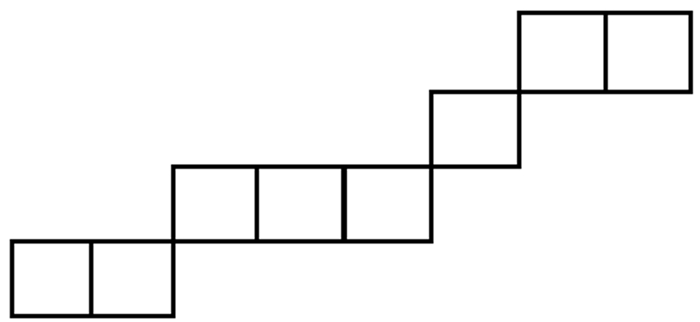
令
$ {\rm{SYT}}\left( {{\mathscr{H}_\alpha }} \right) $ 表示所有形状为$ {\mathscr{H}_\alpha } $ 的标准杨表的集合. 根据文献[2],对$ \forall T \in {\rm{SYT}}\left( {{\mathscr{H}_\alpha }} \right) $ ,对T从下到上且每行从左到右进行读数可以唯一地得到一个排列τT满足Des(τT)⊆ Des(π-1). 显然$ T \longmapsto {{\tau }_{T}} $ 是一个双射且满足Des(τT-1)=Des(T). 因此令
$ {{s}_{{{\mathscr{H}}_{\alpha }}}} $ 表示形状为$ {\mathscr{H}_\alpha } $ 的斜Schur函数,即形式幂级数其中T取遍所有形状为
$ {\mathscr{H}_\alpha } $ 的半标准杨表(见文献[7]的定义7.10.1). 由文献[7]的定理7.19.7知容易验证,若
$ \pi \in {{\mathscr{S}}_{n}}\left( 132, 213 \right), 则 {{\pi }^{-1}}\in {{\mathscr{S}}_{n}}\left( 132, 213 \right) $ 且αDes(π)=(αk+1,αk,…,α1),故λπ=λπ-1. 因此,由斜Schur函数及完全齐次对称函数的定义可得上述证明方法主要通过斜Schur函数将
$ \mathscr{Q}\left( {{\mathit{\Lambda} }_{\pi }} \right)与 {{h}_{{{\lambda }_{\pi }}}} $ 联系起来. 下面我们借用单项式拟对称函数与单项式对称函数给出定理1的另一种证明方法.定理1的另一证明 根据文献[11],映射
$ \tau \longmapsto \text{Des}\left( \tau \right) $ 可以诱导出从排列上的Hopf代数$ \mathscr{S}Sym $ 到拟对称函数的Hopf代数$ \mathscr{Q}Sym $ 之间的一个同态$ \mathscr{D} $ 如下:$ \coprod\nolimits_{n\ge 0}{\left\{ {{\mathscr{F}}_{\tau }}:\tau \in {{\mathscr{S}}_{n}} \right\}} $ 表示$ \mathscr{S}Sym $ 的基本基. 根据文献[11]中的等式(1.12)可定义$ \mathscr{S}Sym $ 的单项式基$ \coprod\nolimits_{n\ge 0}{\left\{ {{\mathscr{M}}_{\sigma }}:\sigma \in {{\mathscr{S}}_{n}} \right\}} $ 为其中
$ {{\mu }_{{{\mathscr{S}}_{n}}}} $ (•, •)表示$ {{\mathscr{S}}_{n}} $ 上左弱Bruhat偏序的莫比乌斯函数. 由莫比乌斯反演公式可得因此,我们有
由文献[11]的定理7.3知
又由引理2可得
设α=αDes(π)=(α1,α2,…,αk+1)|=n,因为
$ \pi \in {{\mathscr{S}}_{n}}\left( 132, 213 \right) $ ,则由等式(3)知对∀β=(β1,β2,…,βl+1)|=n,记
给定两个各项互异的正整数列u=u1u2… um,v=v1v2… vn,其中{u1,u2,…,um}∩{v1,v2,…,vn}=Ø. 如果w=w1w2… wm+n是集合{u1,u2,…,um,v1,v2,…,vn}上的一个排列,且存在1≤i1 < i2 < … < im≤m+n使得子列wi1wi2… wim=u,wj1wj2… wjn=v,其中{j1,j2,…,jn} < =[m+n]\{i1,i2,…,im},则称w为u和v的一个洗牌,记uШv表示u和v的所有洗牌的集合,见文献[12]. 由≤R的定义及等式(6)易知τ≤Rπ当且仅当
令Sβ={s1,s2,…,sl},s0=0,sl+1=n. 对任意τ∈Xπ,β,记
$ \mathscr{J}_{\tau }^{\left( j \right)}=\left\{ {{\tau }_{{{s}_{j-1}}+1}}, {{\tau }_{{{s}_{j-1}}+2}}, \cdots , {{\tau }_{{{s}_{j}}}} \right\}, 1\le j\le l+1 $ . 由Des(τ)⊆ Sβ可知其中·为连接运算,
$ J_{\tau }^{\left( j \right)} $ 表示集合$ \mathscr{J}_{\tau }^{\left( j \right)} $ 中元素按递增方式得到的排列. 令其中
$ \mathscr{I}_{\alpha }^{\left( i \right)} $ 的定义见等式(4). 于是可以得到矩阵Aτ=(ai,j)i,j≥1,容易看出且
因此矩阵Aτ的行和向量row(Aτ)=α,列和向量col(Aτ)=β. 例如,设
$ \pi =789562341\in {{\mathscr{S}}_{9}}\left( 132, 213 \right), \beta =\left( 2, 4, 3 \right)\left| = \right.9 $ . 于是α=αDes(π)=(3,2,3,1),Sβ={2,6}. 对τ=275689134∈Xπ,β,有且满足行和向量row(Aτ)=(3,2,3,1)=α,列和向量col(Aτ)=(2,4,3)=β.
记
易知
$ \tau \longmapsto {{\boldsymbol{A}}_{\tau }} $ 是Xπ,β到Yα,β的双射. 于是从而由文献[7]的命题7.5.1知
$ \mathscr{Q}\left( {{\mathit{\Lambda} }_{\pi }} \right)={{h}_{{{\lambda }_{\pi }}}} $ .定理2的证明 设α=αDes(πc)=(α1,α2,…,αk+1). 首先由条件知
$ {{\pi }^{c}}\in {{\mathscr{S}}_{n}}\left( 132, 213 \right) $ ,因此由等式(3)易知π=π-1. 此外,不难验证:对$ \forall \sigma , \tau \in {{\mathscr{S}}_{n}}, \sigma {{\le }_{L}}\tau $ 当且仅当τc≤Lσc. 基于这两个事实,接下来的证明过程与定理1的第一种证明方法类似,只需将其中的水平带形改为大小为n的垂直带形$ {{\mathscr{V}}_{\alpha }} $ ,则可推出再由斜Schur函数和初等对称函数的定义得,
$ {{s}_{{{\mathscr{V}}_{\alpha }}}}={{e}_{{{\lambda }_{{{\pi }^{c}}}}}} $ ,从而定理2得证.类似于定理1的第二种证明方法,我们可以给出定理2的另一证明. 证明过程主要应用以下两个等式:
-
本文分别给出了拟对称生成函数
$ \mathscr{Q}\left( {{\Lambda }_{\pi }} \right)\And \mathscr{Q}\left( {{V}_{\pi }} \right) $ )是对称函数的一个充分条件,通过计算机编程计算,我们发现当n≤8时,该充分条件也是必要条件,但尚未找到合适的证明方法. 因此,在本文最后,我们提出下列猜想:猜想1 设
$ \pi \in {{\mathscr{S}}_{n}}, 则 \mathscr{Q}\left( {{\Lambda }_{\pi }} \right) $ 是对称函数的充要条件是$ \pi \in {{\mathscr{S}}_{n}}\left( 132, 213 \right) $ .猜想2 设
$ \pi \in {{\mathscr{S}}_{n}}, 则 \mathscr{Q}\left( {{V}_{\pi }} \right) $ 是对称函数的充要条件是$ \pi \in {{\mathscr{S}}_{n}}\left( 231, 312 \right) $ .
 DownLoad: