
Message Board

Dear readers, authors and reviewers,you can add a message on this page. We will reply to you as soon as possible!

2019 Volume 41 Issue 3
Article Contents

Qing LIU, Yue-qiang SHANG. The Finite Element Operator Splitting Method for the Incompressible Navier-Stokes Equations[J]. Journal of Southwest University Natural Science Edition, 2019, 41(3): 75-83. doi: 10.13718/j.cnki.xdzk.2019.03.011
Citation: Qing LIU, Yue-qiang SHANG. The Finite Element Operator Splitting Method for the Incompressible Navier-Stokes Equations[J]. Journal of Southwest University Natural Science Edition, 2019, 41(3): 75-83. doi: 10.13718/j.cnki.xdzk.2019.03.011

The Finite Element Operator Splitting Method for the Incompressible Navier-Stokes Equations

More Information
  • Corresponding author: Yue-qiang SHANG
  • Received Date: 22/03/2018
    Available Online: 20/03/2019
  • MSC: O241.82

  • Under the regularity assumptions on the continuous solution, we provide a finite element operator splitting method for the simulation of unsteady incompressible Navier-Stokes equations, which is based on the subgrid model. It is a two-step scheme in which the nonlinearity and incompressibility are split into different steps. First, a linear Burger's system is solved, and the solution of the finite element uhn+1/2 is obtained. Then a Stokes problem is solved, and its solution uhn+1 is obtained. We derive the error bound of the approximate velocity which is first-order in time. Numerical experiments have verified the correctness of the theoretical analysis.
  • 加载中
  • [1] CHORIN A J. Numerical Solution of the Navier-Stokes Equations[J]. Computational Fluid Mechanics, 1968, 22(104):745-762.

    Google Scholar

    [2] GIRAULT V, RAVIART P A. Finite Element Methods for Navier-Stokes Equations: Theory and Algorithms[M]//Finite Element Methods for Navier-Stokes Equations: Theory and Algorithms. New York: Springer-Verlag, 1986.

    Google Scholar

    [3] GLOWINSKI R. Finite Element Methods for Incompressible Viscous Flow[J]. Handbook of Numerical Analysis, 2003, 9:3-1176.

    Google Scholar

    [4] BLASCO J, CODINA R. Error Estimates for an Operator-Splitting Method for Incompressible Flows[J]. Applied Numerical Mathematics, 2004, 51(1):1-17.

    Google Scholar

    [5] QUARTERONI A, SALERI F, VENEZIANI A. Factorization Methods for the Numerical Approximation of Navier-Stokes Equations[J]. Computer Method in Applied Mechanics and Engineering, 2000, 188(1-3):505-526. doi: 10.1016/S0045-7825(99)00192-9

    CrossRef Google Scholar

    [6] SHEN J. On Error Estimates of Projection Methods for Navier-Stokes Equations:First-Order Schemes[J]. SIAM Journal on Numerical Analysis, 1992, 29(1):57-77.

    Google Scholar

    [7] GUERMOND J L, QUARTAPELLE L. On the Approximation of the Unsteady Navier-Stokes Equations by Finite Element Projection Methods[J]. Numerische Mathematik, 1998, 80(2):207-238. doi: 10.1007/s002110050366

    CrossRef Google Scholar

    [8] BLASCO J, CODINA R, HUERTA A. A Fractional-Step Method for the Incompressible Navier-Stokes Equations Related to a Predictor-Multicorrector Algorithm[J]. International Journal for Numerical Methods in Fluids, 2015, 28(10):1391-1419.

    Google Scholar

    [9] KIM J, MOIN P. Application of a Fractional-Step Method to Incompressible Navier-Stokes Equations[J]. Journal of Computational Physics, 1985, 59(2):308-323.

    Google Scholar

    [10] DONEA J, GIULIANI S, LAVAL H, et al. Finite Element Solution of the Unsteady Navier-Stokes Equations by a Fractional Step Method[J]. Computer Methods in Applied Mechanics and Engineering, 1982, 30(1):53-73.

    Google Scholar

    [11] HECHT F. New Development in Freefem++[J]. Journal of Numerical Mathematics, 2012, 20(3-4):251-266.

    Google Scholar

    [12] 杨晓成, 尚月强. Navier-Stokes方程的回溯两水平有限元变分度尺度方法[J].西南大学学报(自然科学版), 2017, 39(10):47-57.

    Google Scholar

  • 加载中
通讯作者: 陈斌, bchen63@163.com
  • 1. 

    沈阳化工大学材料科学与工程学院 沈阳 110142

  1. 本站搜索
  2. 百度学术搜索
  3. 万方数据库搜索
  4. CNKI搜索

Figures(3)  /  Tables(2)

Article Metrics

Article views(2719) PDF downloads(363) Cited by(0)

Access History

Other Articles By Authors

The Finite Element Operator Splitting Method for the Incompressible Navier-Stokes Equations

    Corresponding author: Yue-qiang SHANG

Abstract: Under the regularity assumptions on the continuous solution, we provide a finite element operator splitting method for the simulation of unsteady incompressible Navier-Stokes equations, which is based on the subgrid model. It is a two-step scheme in which the nonlinearity and incompressibility are split into different steps. First, a linear Burger's system is solved, and the solution of the finite element uhn+1/2 is obtained. Then a Stokes problem is solved, and its solution uhn+1 is obtained. We derive the error bound of the approximate velocity which is first-order in time. Numerical experiments have verified the correctness of the theoretical analysis.

  • 不可压缩流体是流体力学中的一个重要问题,广泛用于天气、海洋以及血液循环等方面. Navier-Stokes方程正好为描述这种流体运动规律提供了一种数学模型.近几十年来,很多作者研究了Navier-Stokes方程的有限元解法[1-3].本文考虑的是非定常Navier-Stokes方程的有限元算子分裂算法.算子分裂方法主要思想是在时间上分为若干步,使得不同的算子出现在不同的方程中,从而降低难度.该方法最开始由文献[2-3]提出,已经用于空间离散、有限差分和谱方法中.文献[4]给出的算子分裂方法是将非线性项和不可压缩性项分开处理.本文在文献[4]的基础上给出稳定化的有限元算子分裂算法,该方法主要分为两步:第一步是线性椭圆型问题,可看作是线性化的Burger's问题;第二步是一般的Stokes问题.通过理论推导,给出了速度的误差估计和收敛精度,并用数值实验验证了方法的正确性.相比标准的有限元方法,我们的方法得到的误差估计更小.

1.   预备知识
  • 考虑下面的Navier-Stokes方程:

    其中:Ω是在$ \mathbb{R}^2$上具有利普希茨连续边界的有界区域,u(xt)∈$ \mathbb{R}$d表示速度矢量,p(xt)∈$ \mathbb{R}$是压力,f(xt)是流体驱动的体积力,ν>0为流体粘性系数, u0是使得∇·u=0的初始速度,并且${\mathit{\boldsymbol{u}}_t} = \frac{{\partial u}}{{\partial t}} $.

    对于上面给出的Navier-Stokes方程,我们引入下面的希尔伯特空间:

    其中:(·,·)表示空间L2(Ω)2L2(Ω)的标准内积,(∇u,∇u)和‖∇u0为空间V的一般标量和范数.在这篇文章中,我们用字母C表示一个与时间步长和网格参数无关的正数.

    up满足下面的条件:

    (R1) uC0(0,TH)∩L(0,TH2(Ω)),∇pL(0,TL2(Ω)).

    (R2a) utL2(0,TL2(Ω)).

    (R2b) utL2(0,TH01(Ω)).

    (R3) ∫0T tutt(t)‖-12dtC.

    (R4) ∫0Tutt(t)‖V2dtC.

    定义三线性项c(·,·,·)为c(uvw)=((u·∇)vw),∀uH1(Ω),vH1(Ω),wH01(Ω),它有如下的性质:

    并且定义:

2.   有限元算子分裂算法
  • 步骤一  寻找解${\mathit{\boldsymbol{u}}^{n + \frac{1}{2}}} $使得

    步骤二  根据(5)式解得的${\mathit{\boldsymbol{u}}^{n + \frac{1}{2}}} $求解un+1pn+1使得

    其中δt是时间步长,满足0<δt<1,tn=tn=0,1,…,N-1,和$ N = \left[ {\frac{T}{{\delta t}}} \right]$.

  • 对于方程(5)-(9)的有限元离散,我们假设Tμ={K}(μ=h)是准均匀的三角形网格剖分并且网格尺寸0<μ<1.定义数值格式中出现的亚格子模型为:

    其中α>0是稳定化参数,根据算子Πh的定义,下列关系式成立:

    我们定义R0={vL2(Ω):v|KP0,∀KTμ(Ω)},Lμ=R02×2L=L2(Ω)2×2,其中P0是常量元素K的空间,那么标准的L2-正交投影ΠμLLμ有如下性质:

    下面给出亚格子稳定化的有限元算子分裂算法:

    步骤一  对于给定的uhnVh使得对于所有的vhnVh,有

    步骤二  寻找解uhn+1Vhphn+1Qh使得对于所有的(vhqh)∈Vh×Qh

    上述提到的方法中,步骤二可以看作是一般的Stokes问题.其中有限元空间VhH01(Ω),QhL02(Ω)且VhQh要求满足下面的条件:

    (H1) 存在与h无关的β>0,使得对于所有的h>0有:

    其中BhVhQhBhtQhVh定义如下:

    (H2) 存在与h无关的γ>0,使得对于所有的vHr(Ω)和qHs(Ω)以及任意的h>0有:

    (H3) 存在与δth无关的C>0,使得:

3.   误差估计
  • 定义速度误差函数为:

    定理1[4]  假设(R1),(R2b),(R3)和(R4)成立,那么对$ N = 0, \cdots , \left[ {\frac{T}{{\delta t}}} \right] - 1$,和足够小的δt,有下面的估计:

  • 设有限元解$ ({\mathit{\boldsymbol{u}}_h}^{n + \frac{1}{2}}, \mathit{\boldsymbol{u}}_h^{n + 1}, \mathit{\boldsymbol{p}}_h^{n + 1})$是半离散分步解$ ({\mathit{\boldsymbol{u}}^{n + \frac{1}{2}}}, {\mathit{\boldsymbol{u}}^{n + 1}}, {\mathit{\boldsymbol{p}}^{n + 1}})$的逼近解,我们定义如下误差:

    引入与有限元空间有关的误差函数:

    引理1[4]  设VhQh满足inf-sup条件(H1),则对于uV满足:

    定理2  设(R1),(R2b),(R3),(H1)和(H3)成立,那么对于$ N = 0, \cdots , \left[ {\frac{T}{{\delta t}}} \right] - 1$和足够小的δth,满足:

      让(5)式和(14)式与vh做内积,且让两式相减得:∀(vhqh)∈Vh×Qh

    对于任意给定的(vhwhqh)∈Vh×ker(BhQh,由(15)式可得:

    下面对(22)式右端各项估计:

    因为∇·un+1=0且wh∈ker(Bh).

    对于三线性项有:

    在(25)式中右端第一项为0,对其余各项估计:

    由定理1可知,$ {\left\| {{\mathit{\boldsymbol{e}}_c}^{n + \frac{1}{2}}} \right\|_1} \le C\delta {t^{\frac{1}{2}}}$,且由(R1)可得:

    同理,可得:

    将(23),(24),(26),(27),(28)式代入(22)式,并且两边同时取下确界可得:

    然后将(29)式两端从0加到N-1,当时间足够小时,得:

    对于足够小的δth,由离散的Gronwall引理,(H3)和三角不等式得证定理2成立.

    结合定理1和定理2,我们可估计

    推论  设(R1),(R2b),(R3),(H1),(H2)和(H3)成立,设对于所有的$n = 0, \cdots , \left[ {\frac{T}{{\delta t}}} \right] - 1 $un+1$ {\mathit{\boldsymbol{u}}^{n + \frac{1}{2}}}$Hk(Ω)和pn+1Hk-1(Ω)且一致有界,那么对于$n = 0, \cdots , \left[ {\frac{T}{{\delta t}}} \right] - 1 $,以及足够小的δt>0和h,有如下估计:

4.   数值实验
  • 利用FreeFem++软件[11]进行一些实验验证理论预测的正确性.

  • 选择Navier-Stokes方程的精确解为:

    其中解的区域Ω=[0, 1]×[0, 1]⊂$ \mathbb{R}$2,在这个问题中P1b-P1元用于空间离散,并且取ν=1.0×10⁻⁷T=0.1,α=0.1 h. 表 1给出了数值结果.从表 1可知:我们的方法对空间和时间离散是一阶收敛的,同时数值结果也表明我们的理论预测是正确的.为了对比我们现在的方法和标准的有限元方法,当网格尺寸$ h = \frac{1}{{128}}$,时间步长$\mathit{\Delta }t = \frac{1}{{800}} $时,我们分别计算ν=1,0.1,0.01,0.001时方程的解.从表 2可以看出我们的有限元算子分裂算法得到的误差估计更小.

  • 考虑一个定义在Ω=[0,2.2]×[0,0.41]上的圆柱绕流问题,其中圆心为(xy)=(0.2,0.2),半径为0.05,取入流速度为

    并且在其他边界上满足无滑边界条件.

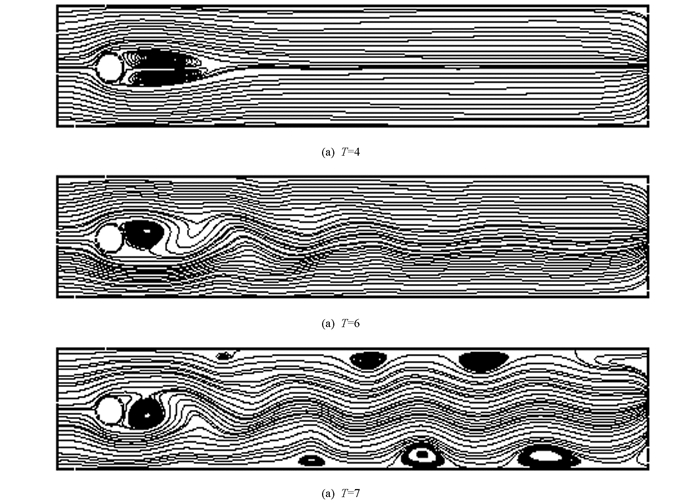
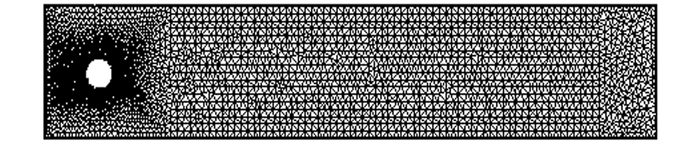
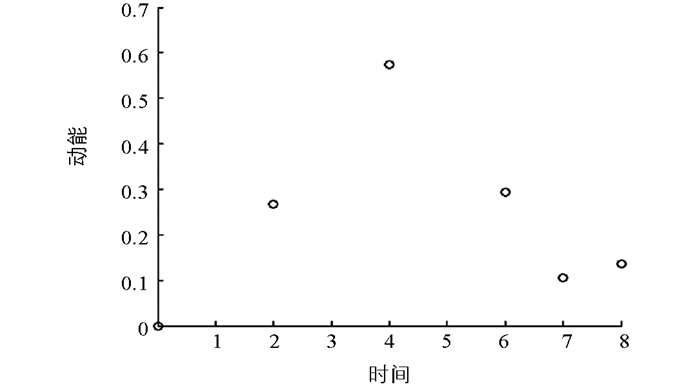
    在这个问题中,Hood-Taylor元用于空间离散,粘性系数ν=0.001,网格大小为$ h = \frac{1}{{32}}$,稳定化参数α=0.1h2,时间步长Δt=0.001,分别取得最后时刻T=4,6,7. 图 1给出了区域Ω的网格剖分,图 2描述了算法关于动能和时间T的关系,图 3对比了不同时刻的流线图.
5.   结论
  • 本文主要结合亚格子稳定模型和有限元算子分裂算法,理论上给出了全离散速度的误差估计,并用数值实验验证了理论的正确性和方法的有效性.对比标准的有限元方法,我们的方法得到的误差估计更小.

Figure (3)  Table (2) Reference (12)

Catalog

    /

    DownLoad:  Full-Size Img  PowerPoint
    Return
    Return