


Message Board

Dear readers, authors and reviewers,you can add a message on this page. We will reply to you as soon as possible!

2020 Volume 45 Issue 5
Article Contents

Jing ZHU, Xing-lan LIU, Cheng-kang XIE. A New Strategy to Stabilize the Temperature in a Cylinder[J]. Journal of Southwest China Normal University(Natural Science Edition), 2020, 45(5): 45-50. doi: 10.13718/j.cnki.xsxb.2020.05.008
Citation: Jing ZHU, Xing-lan LIU, Cheng-kang XIE. A New Strategy to Stabilize the Temperature in a Cylinder[J]. Journal of Southwest China Normal University(Natural Science Edition), 2020, 45(5): 45-50. doi: 10.13718/j.cnki.xsxb.2020.05.008

A New Strategy to Stabilize the Temperature in a Cylinder

More Information
  • Corresponding author: Cheng-kang XIE
  • Received Date: 03/06/2019
    Available Online: 20/05/2020
  • MSC: O231.2

  • Stabilization of a cascaded system has been considered in this paper. In industrial production, the system can be used to represent the cascade of chemical reactions and biological fermentation and other issues. Firstly, a control law has been established by backstepping. And secondly, through the exponential stability of the target system and the boundedness of the backstepping transformation and its inverse transformation, the exponential stability of the closed-loop system controlled by the control law has been established.
  • 加载中
  • [1] KRSTIC M, SMYSHLYAEV A.Boundary Control of PDEs[M].Philadelphia, PA:Society for Industrial and Applied Mathematics, 2008.

    Google Scholar

    [2] KRSTIC M.Compensating Actuator and Sensor Dynamics Governed by Diffusion PDEs[J].Systems & Control Letters, 2009, 58(5):372-377.

    Google Scholar

    [3] VAZQUEZ R, KRSTIC M.Boundary Control and Estimation of Reaction-Diffusion Equations on the Sphere under Revolution Symmetry Conditions[J].International Journal of Control, 2019, 92(1):2-11. doi: 10.1080/00207179.2017.1286691

    CrossRef Google Scholar

    [4] BAI Y X, XIE C K.Temperature Control of Reaction-diffusion Process in Ball[C]//2011 Chinese Control and Decision Conference. New York: IEEE Press, 2011: 2291-2295.

    Google Scholar

    [5] LI G P, XIE C K.Feedback Stabilization of Reaction-diffusion Equation in a Two-dimensional Region[C]//49th IEEE Conference on Decision and Control, New York: IEEE Press, 2010: 2985-2989.

    Google Scholar

    [6] VAZQUEZ R, KRSTIC M.Boundary Control of a Singular Reaction-Diffusion Equation on a Disk[J].IFAC-PapersOnLine, 2016, 49(8):74-79. doi: 10.1016/j.ifacol.2016.07.421

    CrossRef Google Scholar

    [7] KRSTIC M.Delay Compensation for Nonlinear, Adaptive, and PDE Systems[EB/OL].2009.

    Google Scholar

    [8] TANG S X, XIE C K.State and Output Feedback Boundary Control for a Coupled PDE-ODE System[J].Systems & Control Letters, 2011, 60(8):540-545.

    Google Scholar

    [9] TANG S X, XIE C K.Stabilization for a Coupled PDE-ODE Control System[J].Journal of the Franklin Institute, 2011, 348(8):2142-2155. doi: 10.1016/j.jfranklin.2011.06.008

    CrossRef Google Scholar

    [10] ZHAO A L, XIE C K.Stabilization of Coupled Linear Plant and Reaction-Diffusion Process[J].Journal of the Franklin Institute, 2014, 351(2):857-877. doi: 10.1016/j.jfranklin.2013.09.012

    CrossRef Google Scholar

    [11] HE C H, XIE C K, ZHEN Z Y.Explicit Control Law of a Coupled Reaction-Diffusion Process[J].Journal of the Franklin Institute, 2017, 354(5):2087-2101. doi: 10.1016/j.jfranklin.2017.01.013

    CrossRef Google Scholar

    [12] 邓静, 谢成康, 刘忠诚.一类耦合反应扩散系统的边界控制[J].西南大学学报(自然科学版), 2017, 39(5):126-131.

    Google Scholar

  • 加载中
通讯作者: 陈斌, bchen63@163.com
  • 1. 

    沈阳化工大学材料科学与工程学院 沈阳 110142

  1. 本站搜索
  2. 百度学术搜索
  3. 万方数据库搜索
  4. CNKI搜索

Figures(1)

Article Metrics

Article views(1964) PDF downloads(453) Cited by(0)

Access History

Other Articles By Authors

A New Strategy to Stabilize the Temperature in a Cylinder

    Corresponding author: Cheng-kang XIE

Abstract: Stabilization of a cascaded system has been considered in this paper. In industrial production, the system can be used to represent the cascade of chemical reactions and biological fermentation and other issues. Firstly, a control law has been established by backstepping. And secondly, through the exponential stability of the target system and the boundedness of the backstepping transformation and its inverse transformation, the exponential stability of the closed-loop system controlled by the control law has been established.

  • 本文考虑固态化学反应或生物发酵材料的温度稳定问题.工程上,装材料的容器一般为圆柱体.如果控制器设置在圆柱体的上下面,侧面绝热,那么其温度的控制由1维反应扩散方程的边界控制模型描述[1-2].如果控制器设置在圆柱体的侧面,上、下面与侧面绝热,那么其温度的控制由圆形区域上的2维反应扩散方程的边界控制模型描述,其控制律也有一些结果[3-4].但物理上还存在如图 1(a)所示的设置圆柱体的温度控制方法,其中的传热介质设为流体.
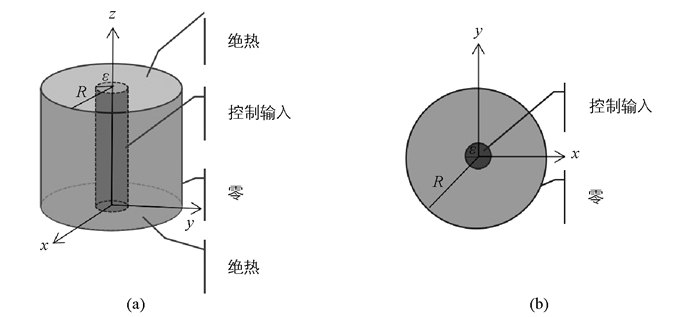
    由于圆柱体上下两面绝热,且仅考虑材料的化学和物理性质是均匀的情况,所以,材料的温度u只依赖xy和时间t,记为u(xyt).根据热传导的数学模型,温度u(xyt)满足如下反应扩散方程

    设流体的控制系统模型为

    其中:状态X (t)∈${{\mathbb{R}}^{n}}$表示流体的温度、密度、压力等物理参数;U(t)∈ $\mathbb{R}$表示待设计的状态反馈控制输入;矩阵A${{\mathbb{R}}^{n\times n}}$B${{\mathbb{R}}^{n}}$,且(AB)能稳.

    根据热交换的傅里叶定律,在半径为ε的圆柱界面上的热交换由下面的模型给出

    其中CT${{\mathbb{R}}^{n}}$CB ≠0.

    于是根据(1)-(3)式,整个控制系统可以用一个常微分与偏微分方程的级联模型

    来表示,其中边界条件(4d)的工程意义是在圆柱体的外侧面设置一开环控制器.子系统(4a)是一常微分方程表示的线性控制系统.如果把(4c)中的CX (t)视为子系统(4b)-(4d)的控制输入,那么这一子系统就是圆环上的反应扩散方程的边界控制系统[5-6].然而,这两个单独的子系统级联而成的控制系统(4a)-(4d)的控制设计及稳定性却与以往已经研究过的级联或者耦合系统不同.其区别在于已经研究过的级联或者耦合系统[7-12]的控制输入是在反应扩散方程的边界上,而级联系统(4a)-(4d)的控制输入是常微分方程表示的线性控制系统(4a)的输入,其能控性的研究都还是空白,也未见关于控制律及稳定性的结果.因此,研究级联系统(4a)-(4d)的控制设计及稳定性具有较强的实际和理论价值.

1.   控制律
  • 由于圆柱体容器中的物质是均匀的,其中的温度也是对称的,因此,利用极坐标更方便.通过极坐标变换x=rcosθy=rsinθ,注意到状态u不依赖于θ,可记为u=u(rt),于是系统(4)变换为

    系统(5b)-(5d)形式上是一维的空间变量.式(5b)中的$\frac{1}{r}{{u}_{r}}$可以用Gauge变换消除[12].然而,这将会导致u的系数依赖r,因此我们倾向于保留这一项.

    为了设计一个控制来使闭环系统u(xyt)达到指数稳定,用Backstepping变换

    将系统(5b)-(5d)转换为一个指数稳定的目标系统

    其中$c\ge \frac{1}{4{{\varepsilon }^{2}}}$,核函数k待定.后面将会证明目标系统的指数稳定性.

    通过变换(6),为了满足目标系统的边界条件(7b),u需要满足以下条件

    通过方程(5c),还需要满足

    将(9)式对t求导,得到

    由于u满足方程(5b),利用分部积分,通过子系统(5a),控制输入U(t)需要满足

    因为α= CB是一个不为零的常数,所以取控制律为

    接下来导出核函数满足的方程.对(6)式关于t进行求导时,因为u满足方程(5b),再通过分部积分和u(Rt)=0,得到

    式(6)两边关于r求偏导,可得

    其中

    将(11),(12)和(13)式带入(7)式,得到

    令核函数k(rs)满足以下条件

    于是w满足目标系统(7a).

    因为方程(14a)的系数依赖于rs,要得到核函数方程组(14)的解析解在数学上存在一定困难,~所以本文考虑证明解的存在性.在参考文献[5]中已经给出此类核函数方程解存在性的证明方法.具体步骤如下:首先,利用变换$\widetilde{k}\left(r\text{, }s \right)=\sqrt{\frac{r}{s}}k\left(r, s \right)$消去kr(rs)和ks(rs)项;然后,通过变量替换ξ=r-s+R以及ηa=r+s-R可以将偏微分方程转化为一个积分方程;最后,运用迭代法可以证明积分方程解的存在性,从而证明核函数方程组(14)的解的存在性.

2.   闭环系统的稳定性
  • 要得到闭环系统(5b)-(5d)的稳定性,需要证明目标系统(7)的稳定性以及变换(6)的可逆性.由于目标系统(7)不同于以前的任何系统,因此,接下来证明目标系统(7)的稳定性.

    令函数f(rθ)定义在以ΓεΓR为边界的区域Ω上.如果f不依赖θ,那么它在极坐标下的L2范数‖f‖为

    引理1 对于目标系统(7),有

    其中‖w(t)‖表示w(rt)在Ω上的L2范数,即目标系统在L2范数意义下指数稳定.

     选取李雅普诺夫函数

    V(t)对t求导,由于w满足方程(7a),利用边界条件(7b),(7c),可得

    通过分部积分,利用边界条件(7b)和(7c),有

    通过庞家来不等式以及边界条件(7b)和(7c),有

    因此由方程(16),(17),(18)和$c\ge \frac{1}{4{{\varepsilon }^{2}}}$,可以得到

    利用微分不等式的比较原理,可以得到

    因此

    即得目标系统(7)在L2范数意义下指数稳定.

    变换(6)的可逆性的证明过程与参考文献[5]中证明过程类似.接下来,需要证明如下引理:

    引理2  变换(6)和它的逆变换都是有界算子,即存在正整数βγ使得

     从变换(6)与范数的性质,可以得到

    根据Holder不等式,可以得到

    其中

    因此

    同样地,由逆变换可以得到

    其中

    此处l(rs)为逆变换的核函数.

    根据引理1和引理2,可以建立闭环系统的稳定性定理.

    定理1 设u(rt)为系统(5b)-(5d)在控制律(10)作用下的闭环信号.于是存在正数σ使得

    即闭环系统(5b)-(5d)在L2范数意义下指数稳定.

Figure (1)  Reference (12)

Catalog

    /

    DownLoad:  Full-Size Img  PowerPoint
    Return
    Return